
Anastasia Zanuda, BBC News Ukraine
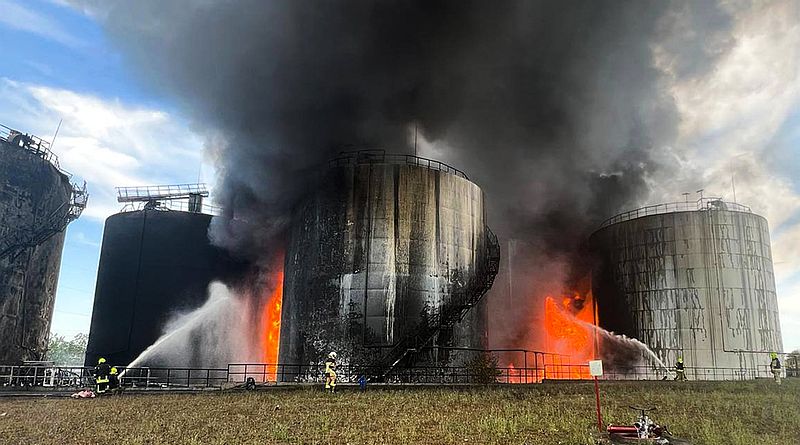
Due to increased Russian strikes on Odesa and Chornomorsk, Ukrainian deep-water ports, through which a significant portion of Ukrainian exports, especially agricultural, were transported, have effectively ceased operations.
There are no official prohibitions on the ports’ operations—shipowners themselves decide to suspend loading and unloading their vessels. The tragedy with the Golden Leo vessel, where 10 people died, only intensified this process. On July 22, one of the world’s largest container operators, Maersk, announced a temporary suspension of service and operations in Chornomorsk and redirected its vessel, which was supposed to arrive at a Ukrainian port, to Constanța, Romania.
“We have not restricted anything as a state,” said the newly appointed Minister of Agrarian Policy Taras Vysotskyi, emphasizing that the Ukrainian government is making maximum efforts to restore maritime logistics.
However, he advised farmers and traders not to panic and to “refrain from quick sales” of their products, stating that currently “there are enough places and capacities for storage in Ukraine.” Later, the official admitted that in the case of prolonged export delays, Ukraine might need additional storage for 10–12 million tonnes of grain. For this, the government plans to appeal to international partners to provide the country with temporary storage sleeves, and part of the additional capacity may be acquired by private businesses.
The intensification of Russian strikes and the stopping of port operations coincided with the harvest and the beginning of the new agrarian marketing year when prices are set and contracts are concluded.
Ukraine—even during a full-scale war—produces significantly more food than it requires itself. Therefore, the physical limitation of export routes would mean a drop in prices for producers’ products within the country, who counted on selling them abroad.
According to the head of the All-Ukrainian Agrarian Council, Denys Marchuk, the situation is not yet critical, but it could become so in two to three months. Already, the prices of certain grain positions have fallen by 30-40%.
“Due to export issues, we are already seeing a significant price drop in the domestic market. The grain group, particularly wheat, as well as technical oilseed crops such as rapeseed, has fallen in price the most. In some positions, the drop has already been 30-40%. If the situation does not change, prices may decrease even more,” Marchuk stated.
Meanwhile, Ukrainian grain traders are urging the government to officially acknowledge the problem, as they currently cannot explain to clients—such as in Egypt or Algeria—the cessation of shipments and non-fulfillment of contracts: facts about port shelling are not an argument, as they occurred before.
All this is happening against the backdrop of a major drought in Europe, which has already resulted in grain losses estimated at around 9 million tons, worth about 2 billion euros—and Ukraine could offset some of these losses.
Kyiv initiated an urgent meeting of the UN Security Council on July 27. Announcing this, Ukraine’s Foreign Minister Andriy Sybiha stated that in recent days, Russia shelled at least three civilian ships, resulting in the death and injury of dozens of crew members.
“Today (July 22 – Ed.) not a single ship passed through the Ukrainian maritime corridor in the Black Sea – right in the height of the harvest. This is deliberate economic and humanitarian terror,” wrote the minister on X, warning that “millions of families in Africa, Asia, the Middle East, and Latin America could face rising prices and hunger if this terror continues.”
But what does the halt in the operation of the Black Sea ports mean for Ukraine and Ukrainians?
Are there alternatives to the sea
The events of the first half of 2022, when Ukrainian Black Sea ports were blocked following the onset of the Russian invasion, showed that there are some alternatives, but they cannot “absorb” the entire potential Ukrainian export, especially agricultural, and they are also longer and more expensive logistical options, making Ukrainian products more expensive for buyers and reducing profits for producers.
The historical maximum export of Ukrainian grain without using the deepwater Black Sea ports was about 3.5 million tons per month, and under current conditions, the country is theoretically able to approach this figure again, stated Minister of Agricultural Policy Taras Vysotskyi. He says the current situation is fundamentally different from 2022 because there is no complete blockade of shipping.
Moreover, the official notes, in recent years Ukraine has significantly expanded its logistical capabilities – developed Danube ports, a network of dry ports, road and rail routes to the EU, and increased its fleet of grain carriers. However, Vysotskyi acknowledges that alternative routes cannot fully replace the deepwater ports. Their capacity is lower, and the cost of transportation is higher.
The Danube ports can handle up to 2.5 million tons of grain, the railway – up to 1 million tons, and roads – about 600 thousand tons, explains the head of VAR, Marchuk. However, Ukrainian agricultural export is much larger – only the remnants from last year’s harvest at the beginning of July amounted to 10-11 million tons.
In general, the Danube ports, railway, and road transport, even at maximum load, can provide only about 4 million tons of export, while through large seaports, Ukraine is capable of exporting about 7 million tons of agricultural products every month. Therefore, the sea is a key logistical route, says Marchuk.
Nevertheless, even on alternative export routes, there are several greater or lesser complications.

This year’s drought in Europe has led to a drop in river water levels, reducing the cargo volumes that can be shipped via the Danube.
It should also be noted that unlike 2022, the situation with exports via railways and highways has significantly changed, primarily due to protests by Polish farmers and, to a lesser extent, by those in other neighboring states to Ukraine.
It’s not surprising that Foreign Minister Sibiha mentioned discussions on “strengthening the resilience of alternative logistic paths and grain export routes” during talks with Moldovan Deputy Prime Minister Mihai Popșoi.
Another problem pointed out by experts is the increased Russian attacks on both railway infrastructure and rolling stock.
Furthermore, observers note that in 2022 it was easier with road transport – back then, there was still a margin of strength, and the market had enough vehicles and drivers, many of whom have since been conscripted into the army.
What this threatens
In the first half of 2026, Ukrainian seaports overall handled 42.4 million tons of cargo, of which 23.6 million tons were agricultural products.
Due to intensified Russian attacks, Ukraine has lost about a third of its ability to export grain through its key Black Sea ports, Reuters reports, citing its own sources and a report by the Association of Farmers (AAU).
Each month, Ukraine exports over 2 billion dollars’ worth of agricultural products. The absence of these funds will soon be felt in both the budget and the currency market.
Due to the inability to export the new year’s harvest, grain prices will drop, and producers will earn less profit – if any at all.
“If the situation doesn’t improve soon, many producers may face a shortage of working capital. This not only threatens the sale of the current harvest but also the conduct of autumn fieldwork,” says VAR head Marchuk.
At the same time, low grain prices will hardly affect food prices within Ukraine itself – its consumers do not need wheat or corn in the export volumes.
However, prices for imported products may rise — due to pressure on the currency market and the rising dollar exchange rate, as well as increased logistics costs for imports, which also went through seaports. Even if the ports are unblocked, freight will obviously become more expensive – in both directions.
We should also not forget another major sector, metallurgy, whose production volumes, although decreased during the war with the loss of several key enterprises, still remained quite significant for Ukraine’s export-oriented economy.
Overall, the blockade of seaports delivers a painful blow to the economy, producers, the inflow of foreign currency to Ukraine, and consequently, its ability to finance its defense.
Cards on the Negotiation Table?
There is another important aspect of the situation with the actual shutdown of Ukrainian seaports. It is the preparation for a new series of peace negotiations, which are clearly taking place both on the Ukrainian and Russian sides, and also in the USA – currently the main mediator.
Each side would like to enter this process with strong positions.
The positions of Ukraine, which is increasing its strikes deeper into Russia, have seemed the strongest in a long time.
However, after reports of a possible visit of President Zelensky to Washington in the last week of July (this visit has not yet been officially confirmed), many experts are wondering if the main topic of discussions with President Trump will be global food security instead of how to compel Russia to end the war.
On the cover: Fire at the “Kernel” oil terminal in the Odesa region after a Russian attack. Photo: Kernel press service
