
Today – Sloviansk direction.
1. Composition of enemy forces and means
The enemy’s (Russian forces) Southern Group of Forces continues to advance with part of their forces in this direction. Their core comprises units and formations of the 3rd Combined Arms Army (CAA), including:
– 6th Separate Motorized Rifle Brigade (SMRB);
– 85th SMRB;
– 88th SMRB (partially staffed by mercenaries from the former “Separate Reconnaissance and Diversion Brigade Española”, the same one consisting of Russian “ultras” and neo-Nazis);
– 123rd SMRB;
– 127th SMRB;
– As well as several territorial military formations (TDF) at the level of “motorized rifle/rifle regiment” (MRR/RR) or “motorized rifle/rifle battalion” (MRB/RB). Including those formed under the deployment of the “mobilization reserve” (MR) both in the occupied areas of Luhansk and Donetsk regions of Ukraine, and on the territory of the RF itself. In most cases, they have been integrated into the “regular” brigades of the 3rd CAA or attached to them under operational control as means of reinforcement. There are at least 3-4 such formations here;
– It is quite possible that part of the so-called Russian “volunteer assault corps” (VAC) is also operating in this direction. Since at least several small VAC subdivisions at the “platoon-company” level have been observed here.
2. Current situation
The forward units of the 3rd CAA continue active offensive/assault actions aimed at breaking through the tactical zone of the Ukrainian Armed Forces’ defense system in this direction, specifically:
– Forward units (likely the 127th SMRB, possibly reinforced by part of the 6th SMRB) continued attempts to advance along the southern bank of the Siverskyi Donets towards Zakytne — Kryva Luka, Platonivka — Kalenyky, and Svyato-Pokrovske — Riznykivka. Obviously, to reach the Mykolaivka – Rai-Oleksandrivka line and break through to the area of Starodubivka and Pyskunivka.
As of the evening of 28.03.2026, Russian troops likely managed to reach the road intersection south of Kryva Luka with several “ultra-small” infantry groups and also “secured” positions in Kalenyky and Riznykivka. They even managed to move a few “bodies” into the plantations south of Riznykivka.
However, their attempts to “break into” Kryva Luka were unsuccessful. Moreover, it is likely that in the area of Zakytne, the Ukrainian Armed Forces themselves pushed back the enemy, continuing to hold part of this village.
It is highly likely that currently the advanced Russian assault groups operating along the Zakytne-Riznykivka line are somewhat limited in continuing their active assault actions due to the increasing resistance of the advanced units of the Ukrainian Armed Forces in this area. At least after the penetration of Russian infantry groups between Kryva Luka and Riznykivka, they have been unable to advance further for a week. Additionally, it is likely that Russian forces do not confidently control either Kalenyky or Riznykivka, being present there only with separate “very small” infantry groups.
In this sense, the stubborn defense of the Ukrainian Armed Forces in the Zakytne region apparently forces the Russian command to direct part of their forces operating south of the Lyman-Siversk road there, instead of using them to intensify the pressure generally directed at Rai-Oleksandrivka from the northeast.
– Further south, where the command of the Russian 3rd ZVA is apparently concentrating its main efforts, the enemy continues very intensive attacks/assaults in a general northwest direction on both sides of the Slovyansk-Bakhmut road.
The units of the 123rd, 85th, and 88th motorized brigades operating here (possibly together with part of the 6th motorized brigade) have managed to achieve quite a significant tactical success in a month and a half of stubborn offensive battles — they have reached the line of Lypivka — Fedorivka Druha (advancing north of the Vasyukivka river to a depth of up to 10 km), and also achieved numerous tactical penetrations into the Ukrainian Armed Forces’ defense system in the area of Pryvillia, Minkivka, and Novomarkove (in some areas to a depth of up to 4.5 km).
At the same time, it is evident that the Ukrainian Armed Forces still hold some positions west of the village of Vasyukivka, thereby restraining the enemy’s actions north of the road, in the “triangle” of Lypivka — Nykyforivka — Fedorivka Druha.
3. Overall assessment of the situation and prospects for its further development
In my opinion, the situation is quite challenging for the Ukrainian Armed Forces in this direction and is determined by several quite clear factors (characteristics), in particular:
– It is evident that the command of the Russian 3rd ZVA is implementing a rather “classic” plan in its offensive strip regarding the encirclement of a certain part of the operational-tactical group of the Ukrainian Armed Forces opposing it. Its essence lies in a simultaneous breakthrough in the area of Rai-Oleksandrivka (from the northeast and southeast) through active offensive actions of its flank groups and thus encircling the Ukrainian units defending east of the village.
Additionally, the execution of this plan for the Russian 3rd ZVA is facilitated by the fact that the strip of its offensive in this direction gradually narrows, so to speak, in a “natural” manner (due to the reduction of the distance between its flanks by the advance of the flank groups of this army in converging directions). This allows the command of the 3rd ZVA to concentrate forces and means on the necessary sections and directions without significant additional reinforcement at the expense of reserves.
It should be noted that the Russian command is quite close to executing its plan (its advanced assault groups are already less than 4.5 km southeast of Rai-Oleksandrivka). But the situation remains manageable for the Ukrainian Armed Forces only because the northeast flank of the 3rd ZVA is currently stalled due to the persistent defense of the Ukrainian Armed Forces in the Kryva Luka and Zakytne areas and cannot break through to Rai-Oleksandrivka.
– However, as a result of the overall advance by the flanking groups of the Russian 3rd Army Corps along the southern bank of the Siverskyi Donets and on both sides of the Sloviansk-Bakhmut road in the previous months, including the capture of Siversk by its troops, the Russian command acquired a whole “fan” of new tactical possibilities, so to speak, besides the opportunity to encircle Ukrainian units east of Rai-Oleksandrivka. For example, it can significantly assist the “Zapad” Group of Forces (20th and 25th Army Corps) in eliminating the Ukrainian Armed Forces’ Lyman bridgehead by cutting its logistics through a hypothetical breakthrough in the Mykolaivka area, or the “Yug” Group of Forces and the 3rd Army Corps, in particular, can now attempt to reach the nearest approaches to Kramatorsk from the east (break through to the Vasylivka wasteland — Vasyutynske line), etc. For obvious reasons, I will not fully describe all these possibilities that have opened up for the command of the Russian 3rd Army Corps as a result of its recent tactical successes, but will focus only on two obvious to both sides.
If we try to assess the situation on the Sloviansk direction in the context of the upcoming Russian military campaign for the summer-autumn of 2026, which is likely to involve a large-scale offensive operation against the Sloviansk-Kramatorsk agglomeration, it is quite possible to highlight one of its rather non-trivial features.
The fact is that as of “now,” both Russian military groups (20th, 25th Army Corps of the “Zapad” Group and 8th Army Corps, 3rd Army Corps of the “Yug” Group), which theoretically should have already ensured preliminary encirclement of this agglomeration from the flanks and reached the starting areas for operational deployment of forces designated for this operation, are, compared to the grouping advancing directly on Sloviansk (3rd Army Corps of the “Yug” Group), to put it mildly, very “behind schedule.”
The 3rd Army Corps relatively quickly (during the winter-early spring of 2026) almost completely eliminated the tactical-operational bridgehead of the Ukrainian Armed Forces in the Siversk direction and created real prerequisites for its approach to the agglomeration from the east. Meanwhile, its “flanking neighbors” are quite heavily “bogged down” — some towards Lyman (20th and 25th Army Corps), others — in the Kostyantynivka direction (8th Army Corps and 3rd Army Corps). Moreover, it is already becoming clear that the hypothetical storming and capture of Lyman or Kostyantynivka along with Druzhkivka will not be quick and “almost triumphant” for Russian forces.
Moreover, according to many indicators, it is becoming clear that without substantial reinforcement of the flanking groups, this is generally at risk of dragging on seriously and for a long time. This, in turn, will result in the Russian 3rd Army Corps being forced at the designated moment to independently and exclusively “head-on” (i.e., from the east) “ram” the entire defense system of the Ukrainian Armed Forces in the Sloviansk-Kramatorsk agglomeration area, which very sharply and significantly reduces the likelihood of its capture by Russian forces during 2026.
It is obvious that this “situation” was quite well “read” by the Ukrainian command, which managed to organize a more stubborn defense precisely on the flanking directions relative to the Sloviansk-Kramatorsk agglomeration than to the east of it. If necessary, it even found additional reserves to conduct intensive counterattacks in necessary areas, as was the case on the Dobropillia direction when the penetration of the Russian 51st Army Corps began to seriously threaten a deep encirclement of Kostyantynivka and Druzhkivka from the southwest.
Thus, the current apparent tactical successes of Russia’s 3rd Guards Combined Arms Army in the Slovyansk direction may, of course, impress particularly emotional “experts”. However, if I were in their place, I would not rush to draw pessimistic operational-level conclusions from this.

Russian troops are unlikely to capture the “fortress belt” by 2026, but they will achieve some tactical successes and incur significant losses.
In the Lyman area, the enemy has increased airstrikes using KAB-3000, Lancet UAVs, and Molniya drones, making efforts to destroy Ukrainian logistics and the defensive capabilities of the 3rd Corps of Defense Forces before the offensive.
Russian troops are setting conditions for launching an operation towards Kramatorsk and Kostyantynivka, have intensified assaults in the Slovyansk and Kramatorsk directions, are attempting to advance on the heights approaching Kostyantynivka, actively transferring manpower to Kostyantynivka, increasing the use of FPV drones and Molniya attack UAVs from Chasiv Yar, deploying armored vehicles to the direction, doubling the number of fire and airstrikes in the Kramatorsk direction, continuing to create conditions for an offensive in the spring-summer of 2026, conducting an air campaign against the southern flank of the “fortress belt” at least since the end of February this year.
The aggressor is trying to capture dominant heights east of Slovyansk, particularly near Kryva Luka, continuing assaults to secure their flanks. Control by the Defense Forces over the dominant heights east of Slovyansk complicates the aggressor’s advance to the city, especially as the terrain favors defense.
In the Pokrovsk direction, Russian troops are using various routes during assaults, attempting to infiltrate their groups, distract the aerial reconnaissance of the Defense Forces, adapting their tactics considering previous experience.
In the Oleksandrivsk direction, Russian troops were unable to stop counterattacks by the Defense Forces, despite regrouping special forces units to the direction. The advance of the Defense Forces has slowed due to changing weather conditions, but troops continue to push forward, taking advantage of the absence of prepared enemy defenses.
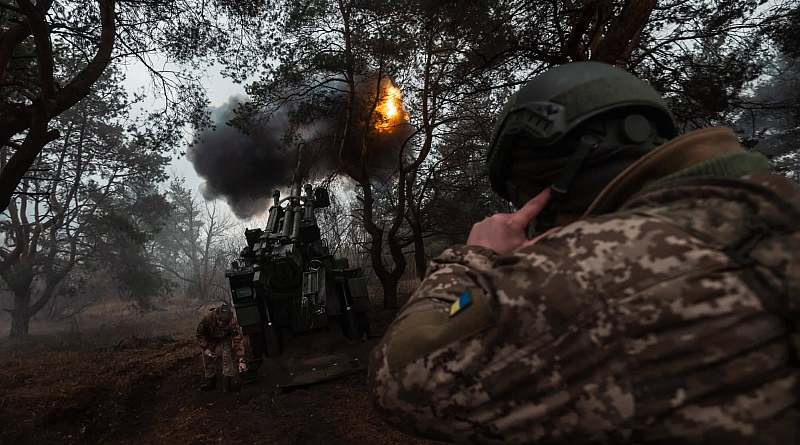
Cover photo: 148th Separate Artillery Zhytomyr Brigade 8 Corps of the Air Assault Forces of the Armed Forces of Ukraine
