

Imagine a girl sends her boyfriend an intimate photo or video. He responds by sending a dick pic (a photo of his penis). Both save the photos on their phones. These actions could already be interpreted by the police as “manufacturing, storing, and distributing pornographic materials,” thus leading to Article 301, a fine of 34–85 thousand UAH or restriction or deprivation of liberty for up to five years. Most often, people are judged for photos sent in private correspondence via Telegram and Viber.
Key takeaways:
- The Ukrainian law enforcement system penalizes people for intimate photos, webcam activities, and private messages, citing “public morality” and “traditions of intimate communication.”
- Court decisions are based on repealed laws.
- Serious sexual crimes, such as rape or child pornography, are investigated by the police worse than publicly available pornography.
- Most court rulings we’ve examined end with voluntary admission of guilt, a fine, or a suspended sentence.
- In court registers, we did not find any cases related to videos of real rape, which are advertised for sale in the darknet, unseen by search engines.
- As studies by international organizations show, and as Ukrainian experience demonstrates, the criminalization of pornography and sex services generates corruption.
We analyzed about 3.5 thousand cases in the court register filed under Article 301 of the Criminal Code and saw how the “Soviet” tradition of fighting pornography creates space for corruption, absurd sentences, and diverts law enforcement efforts from combating serious crimes: sexual violence, child molestation, etc.
Article 301 of the Criminal Code: what punishment
Article 301. Import, production, sale, and distribution of pornographic items.
- Importing works, images, or other items of a pornographic nature into Ukraine for the purpose of sale or distribution, or their production, storage, transportation, or other movement with the same purpose, or their sale or distribution, as well as coercion into participation in their creation, are punishable by a fine of 1-4 thousand tax-free minimum incomes (17-68 thousand UAH), or probationary oversight for up to three years, or restriction of freedom for the same period.
- The same actions involving films and video products, computer programs of a pornographic nature, as well as the sale to minors or distribution among them of works, images, or other items of a pornographic nature, are punishable by a fine of 2-5 thousand tax-free minimum incomes (34-85 thousand UAH), or restriction of freedom for up to five years, or imprisonment for the same period.
- Actions provided for in the first or second parts of this article, committed repeatedly, or by prior conspiracy by a group of persons, or with receiving income in a large amount, are punishable by imprisonment for a term of three to seven years with deprivation of the right to hold certain positions or engage in certain activities for up to three years.
Note. For the purposes of articles 301 and 301-1 of the Criminal Code, income in a large amount is considered to be an amount that exceeds the tax-free minimum income by 200 or more times (340 thousand UAH).

Discussions about the decriminalization of adult voluntary pornography have once again intensified in Ukraine after law enforcement authorities detained four heads of the Main Departments of the National Police and their deputies for “covering” the pornography business on May 20, 2026.
On May 28, the Verkhovna Rada of Ukraine considered a bill on the decriminalization of pornography, but only 207 deputies voted “for” it. Five people’s deputies voted against it, three abstained, and as many as 60 decided not to vote. The “European Solidarity” and “BYT” factions did not give any votes “for.”
66% of cases end in convictions
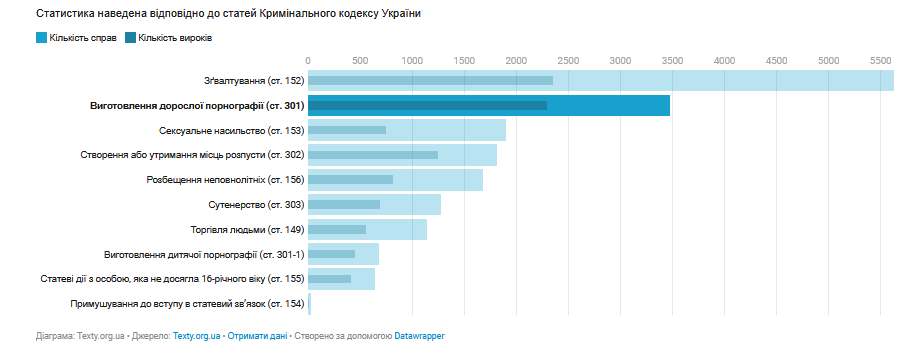
Among 3,473 court cases related to pornography over the past 20 years (starting from 2006), we found 2,293 convictions related to adult pornography. Thus, 66% of such cases end in convictions.
We analyzed 1,505 court verdicts, including 1,084 cases of pornography sales in video, photo, or online chat formats, and 30 cases in live streaming format. Such content was most frequently sent via the most common messengers in Ukraine: Telegram or Viber.
Regional distribution of pornography court cases
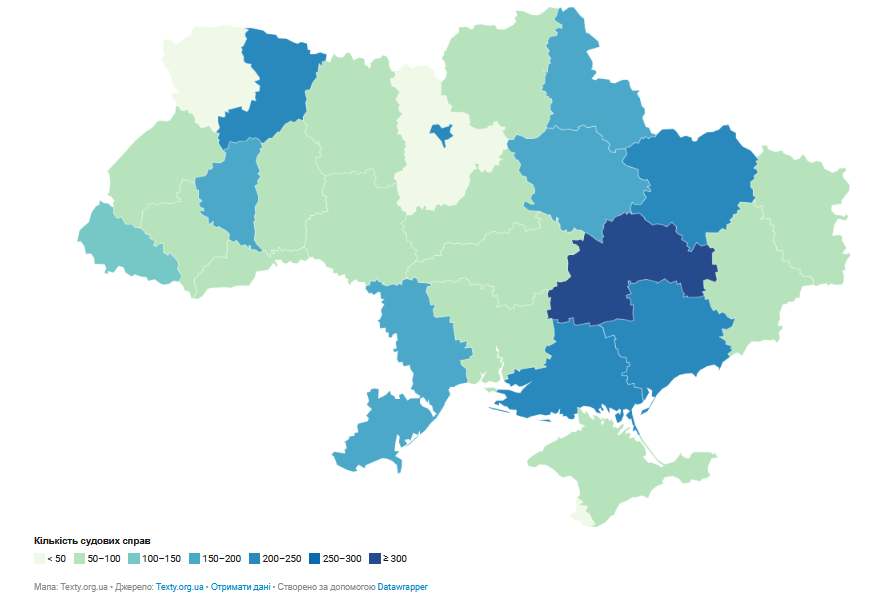
The most cases under Article 301 were opened in Dnipropetrovsk (331), Kharkiv (247) regions, and Kyiv (245). The fewest were in Chernihiv, Kyiv, and Volyn regions.
How adult pornography is investigated
The distribution of porn via streaming platforms and messengers significantly complicates the work of cyber police. Previously in Kyiv, sellers of CD discs with intimate content for 50 UAH were caught at Petrivka. Now, to prove the fact of a crime in private chats, a controlled purchase is necessary.
Investigators track offers of intimacy for money, purchase porn content with budget funds, and review it privately at home.
For example, in one of the verdicts, it is mentioned that an operative (Police Department No. 2 of Zaporizhzhia district) purchased tokens for an online strip chat for 2,850 UAH and verified how the accused “on the private channel on the specified site demonstrated her genitals and performed sexual acts, namely created a pornographic video with her participation.”
Assuming he liked it, a week later he spent another 1,920 budget UAH on a repeated controlled purchase.
Then a search was conducted at the woman’s place, a protocol was drawn up, which included over 3,000 photos and almost a hundred videos. These were also reviewed by experts, as required by their duty, to confirm that the content “contains demonstrations of female genitals and sexual acts by an adult female and is identified as pornography.” Unfortunately, the court decision does not specify how long and how many experts reviewed the three thousand pornographic photos and videos.
As a result, the webcam model was compelled to “feel shame for what was done, realize her wrongful behavior,” and promise not to do it again.
Verdict: four years in prison (replaced by one year of probation) plus a year ban on working in content distribution on the internet.
Sometimes during the investigation, sex toys are also seized as instruments of crime.
Moral values and traditions
“Illegal actions in the sphere of cultural, spiritual life of society and public morality” or “generally accepted rules of modesty.”
Since there are no victims of purchasing porn content in private chats, the prosecution invokes violations of social morality norms.
The arguments in the verdicts resemble the protocols of Komsomol meetings. For example, “cynical, obscene, self-serving, and special demonstration of genitals that do not meet moral criteria, insults human honor and dignity, inciting unworthy instincts.”
Ivan Vyhivskyi, Head of the National Police of Ukraine, also speaks about the “negative impact on the moral values of Ukrainians and violation of traditions” of intimate communication, opposing decriminalization. Meanwhile, his boss, Minister of Internal Affairs Ihor Klymenko, stated that the ministry agreed on the text of the bill submitted to the Verkhovna Rada, which was rejected by deputies yesterday.
Yulia Tymoshenko, who is being tried for allegedly bribing deputies of the Verkhovna Rada, is also guarding the moral values of Ukrainians: “I ask you, stop. At least during Christmas, do not propose such laws” (about decriminalizing porn. — Author), she stated in the winter during another attempt to decriminalize this “crime.”
Ukrainians certainly have traditions of intimate communication, at least on Pornhub, the world’s most popular porn site, where Ukraine ranks 16th in visitor numbers as of 2025. The list of the most popular porn actresses in Ukraine, according to Pornhub, is topped by Yulia Senyuk (Josephine Jackson) from Zolochiv, Lviv region, a renowned Ukrainian volunteer.
On September 21, 2025, she left Ukraine after searches of her colleagues: “When I saw the chaos that started with those searches of the girls, I decided to leave to avoid trouble. I see no point in being in a country where the law punishes for a naked photo on a phone.”
=====
Ineffective Laws and Conventions
The problems with the argumentation of court decisions regarding “adult pornography” are also evident in the documents referenced in the verdicts.
For example, several decisions refer to the archaic International Convention for the Suppression of the Circulation of and Traffic in Obscene Publications of September 12, 1923, initially adopted by the League of Nations and later by the UN. Ukraine did not ratify this convention.
Yet, a fragment of it appears in the decision:
“Liable for punishment is the production or possession of works, drawings, engravings, paintings, printed publications, images, posters, emblems, photographs, cinematic films, or other pornographic items for the purpose of selling or distributing them or publicly displaying them.”
The funniest part of the list is drawings, engravings, and paintings. Even museums could be punished for this.
References also appear to the Law of Ukraine “On the Protection of Public Morality”, which became ineffective in 2022.
Private Chats Compared to Television
Some courts refer to the Law of Ukraine “On Media,” which was the basis for the deactivation of the Law of Ukraine “On the Protection of Public Morality,” although it in no way regulates private correspondence, which is precisely the nature of messaging app chats.
In the court decision of April 17 regarding private strip chats, not only was the now-invalid law on the protection of public morality mentioned, but such a chat was also equated to television, with the European Convention on Transfrontier Television from May 5, 1989, cited in the argument.
This document defines the obligations of a broadcaster, establishing that all elements of program services related to their presentation and content must respect human dignity and the fundamental rights of others.
Overall, reading court sentences in pornography distribution cases is both sad and amusing. Intimate details and obscenities are masked with bureaucratic language. For example, “inciting arousal of sexual passion in others.”
Instead of modern and familiar words like “smartphone” and “internet,” archaic terms such as “electronic calculating technical devices” and “electronic communication” are used.
Cover for Pedophiles
Article 301 is sometimes used to cover up serious sexual crimes involving children.
For example, in one court case, it was mentioned that a mother filmed pornographic video herself and involved her 14-year-old daughter in it. The footage was sent to her acquaintance. This crime was qualified under Articles 301 and 301-1, which concern coercing a minor to produce pornography.
However, such actions are more suited to Article 156 “Corruption of Minors.” The second point mentions immoral acts committed against “a minor or committed by family members, close relatives, or guardians…punishable by imprisonment for a term of five to eight years with the deprivation of the right to hold certain positions or engage in certain activities for up to three years.”
The head of the Children’s Services Department of the Popivka Village Council of the Konotop District of the Sumy Region assured that “the family is known exclusively in a positive way, there were no problems, so it is believed that the punishment should be assigned without real imprisonment.” Thus, even the Children’s Services found “nothing special” in the committed crime.
The court sentenced the mother to five years of imprisonment, which was replaced with three years of probation, although the punishment should have been more severe. For example, in the court register, there is a similar court decision regarding a father who filmed pornographic videos with his 16-year-old daughter, but he was charged under Articles 155 and 156 and received 12 years of actual imprisonment.
Serious Crimes
Most of the court sentences we investigated end with voluntary admission of guilt, a fine, probation, and a prohibition on distributing “audiovisual content” on the internet. In such cases, it’s easy to achieve high detection rates (investigation efficiency, as we calculated, is 66%).
But compare this with the statistics on solving serious crimes: rapes, corruption of minors, and child pornography.
Since 2006, more than 5,600 rape cases have been recorded in the court register, but there are only 2,300 sentences (41%).
We also found 679 cases and 447 sentences regarding child pornography in the court register (65% detection rate). The efforts that courts and law enforcement put into investigating pornography could be directed towards uncovering such crimes.
We noticed that in court cases, the materials mentioned are mostly those distributed via messengers or public channels of the “white web.” Meanwhile, the darknet (a part of the global network hidden from search engines) is full of ads for selling both child pornography and rape videos for cryptocurrency. Investigating such cases is obviously much more challenging than combating webcam models on Telegram, where pornographic sessions are purchased with state funds.
Court Statistics on Sexually-Based Crimes
How Much Tax Can Be Collected
The Office for Effective Regulation BRDO wrote that the decriminalization of the pornography industry could bring up to 500 million UAH in revenue to Ukraine’s state budget.
According to BRDO estimates, about 5,000 people in Ukraine work in webcam modeling, and over 3,500 create content on OnlyFans. Their average monthly income is about 1,650 USD, including beginners and those partially engaged in this field. The commission from the studio where the model works is also included in the total income.
BRDO assumes that decriminalization of pornography will cover 100% of the webcam modeling market and 50% of OnlyFans authors.
Following the introduction of the “Google tax,” i.e., the obligation for international digital services to pay taxes on the territory of Ukraine, in 2022, the online platform OnlyFans transferred 305,000 USD (about 9 million UAH at the time) to Ukraine’s state budget.
This is just one of the major services, which, by the way, is mentioned in court decisions only once. In 2025, OnlyFans paid 1.6 million USD in taxes (about 66.6 million UAH) to Ukraine’s state budget.
Human Rights Advocates for Decriminalization
The decriminalization of “harmless” pornography is supported by international human rights organizations.
In 2023, the International Commission of Jurists, together with the United Nations Joint Programme on HIV/AIDS (UNAIDS) and the United Nations High Commissioner for Human Rights (OHCHR), published the “March 8 Principles for a Human Rights-Based Approach to Criminal Law.” The document addresses not only pornography but also states that the criminalization of prostitution (which is tolerantly referred to as “sex work”) violates basic human rights.
The voluntary exchange of sexual services between adults for money, goods, or services should not be criminalized in the absence of coercion, use of force, abuse of power, or fraud. Human rights organizations generally agree that, in the absence of third-party rights violations, the state should not and cannot interfere in the sexual lives of its citizens.
Criminalization exposes sex workers (including porn actors) to abuse and exploitation, notably by the police.
Human Rights Watch has documented that in criminalized environments, police harass sex workers, demand bribes, physically and verbally abuse them, or even rape or coerce them into sex.
Demands for money from webcam models were also reported in Ukrainian media. The scale of corruption in pornography was highlighted by recent arrests of corrupt police officers in Ukraine.
What is the situation in the world
In Europe and North America, the production and distribution of pornography were decriminalized several decades ago.
Status of pornography production in countries worldwide
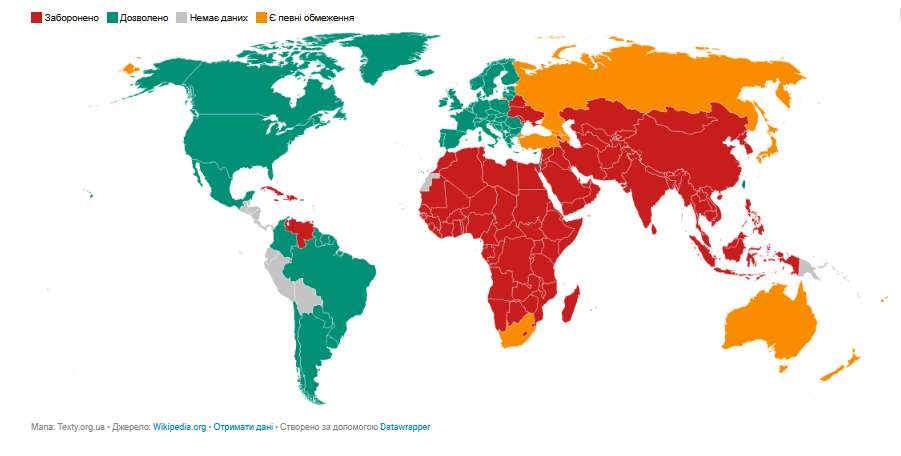
In most European countries, adult pornography was legalized in the 1980s-1990s (in Denmark in the late 1960s, in Spain in the 1970s). However, criminal liability is envisaged for child and adolescent pornography, scenes of violence, use of animals, etc.
Platforms providing adult content must restrict access for minors through age verification, registration, photo or video checks.
The exchange of intimate photos and videos in messages, online porn chats (free or paid) cannot be stopped, controlled, or banned since people have adopted such technological capabilities.
What consenting adults do with mutual desire, without harming anyone, is a personal matter, not a criminal one. And Ukraine should finally recognize this as well.
Collage on the cover: Radio Liberty
Copyright © 2021 RFE/RL, Inc. Reprinted with permission from Radio Free Europe / Radio Liberty
