
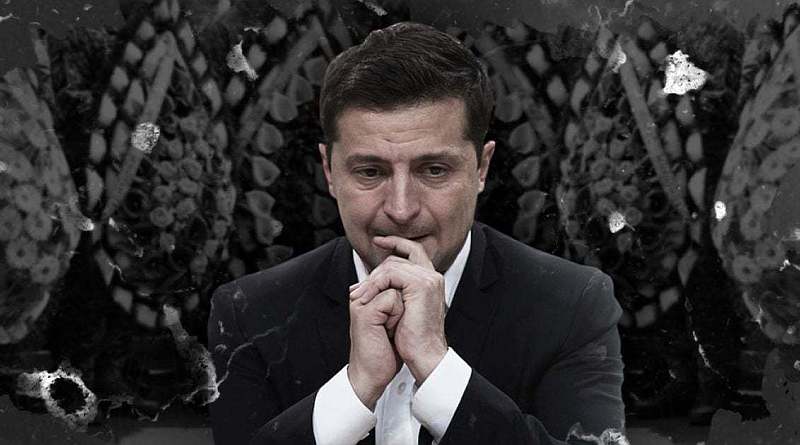
Does Volodymyr Zelensky want peace?
He definitely needs to show he wants it. Because Ukrainians desire peace, especially his core electorate, whom he once enticed with promises to “just stop shooting” and “meet in the middle.”
Moreover, an increasing number of respondents are ready to agree to a peace that could pressure Russia to start with a ceasefire along the existing line of contact. Both sides could then prepare for the next round, with a chance, under a different government, to prepare in such a way that Russia wouldn’t dare to attack and would collapse under internal problems.
Doesn’t it remind you of anything? Yes, that was the logic behind Minsk. But it was exchanged for “simple solutions.”
And now the “solution” is indeed very “simple.” Hang on until Russia lacks the means to continue. However, to hang on, we must constantly reduce Russia’s ability to continue—and increase Ukraine’s ability to stand firm.
Simple, right? In this logic, the path to peace is compelling Russia to stop.
So the question is not “does Zelensky want peace?”—he supposedly came to power with that, and now he must listen to the people. Sociologists, after all, report to him constantly.
But Putin doesn’t want peace.
Thus, the real question sounds different. Is Zelensky doing enough for peace?
And this is not about “Mendel-style.” Actually, similar questions have long been answered in Israel: “if the enemy stops—there is no war; if we stop—we cease to exist”; “the enemy wants to destroy us, we want to live; it leaves little room for compromise.”
The only way to peace is to compel Russia. To create conditions where continuing the war here and now becomes costlier than stopping. Even with the understanding that they “will be deceived,” “repeating” won’t work, and the scenario of Russia’s collapse like the USSR is quite feasible.
Simply, the “continuing” scenario must lead to an inevitable catastrophe here, a fear that must outweigh the fear of a possible catastrophe later.
This scenario is quite actionable. It requires very specific things:
1. More funds for the Armed Forces of Ukraine—for better defense and more effective deep strikes. This means corresponding budget priorities.
2. Better community protection, to deprive Russian attacks on the rear of their sense.
3. More effective foreign policy—more sanctions on Russia, more financial and military aid to Ukraine, more pressure on Russia (“either peace or Graham-sanctions, SWIFT disconnection, frozen assets for insurance payments, continuation of systemic sanctions like those on Lukoil or Rosneft, etc.)
And what about the lovers of “simple solutions” in power fulfilling this seemingly uncomplicated task?
That is where the problems begin.
The policy of the Ukrainian government contradicts this. Why? Because priorities are different.
The authorities act not in favor of the country’s demands. Instead, they act to support the loyalty of the electorate and the collective “state bureau of repression”:
– unjustifiably large expenditures on officials and rear security forces (spending increases disproportionately more than inflation);
– non-transparent budget projects (fakes, cashbacks, screenings, marathons, thousands of springs);
– monopoly in foreign policy – with an inability to professionally outplay seasoned politicians both in the West and the East;
– struggle with mayors for influence and resources instead of uniting forces and opportunities;
– exclusion policy (“we can do without Poroshenko’s/‘Holos’/Razumkov’s opinions, etc.”) instead of inclusion (as it was in March 2022, when all ideas were considered and effective decisions made)…
As a result, we find ourselves where we are now.
Does Zelensky want peace/ceasefire? He says yes. After all, this is what most respondents want, so he cannot say otherwise.
But is he doing everything necessary? That’s the real question. And the answer is obvious. Unfortunately, it’s negative.
And then there are three scenarios.
1. Zelensky understands the need to share power and responsibility. The parliament begins to work as it did in March 2022. The government cooperates, seeking necessary steps. Ideas are implemented – even if they come from Poroshenko.
Europe supports, the USA plays along, Russia loses the race of ideas and decisions, leading to a ceasefire by spring 2027. Zelensky returns to creative self-realization.
Election, return to the state of 2022, the country breathes out and moves towards the EU, pressure on Russia.
2. The “Swamp of 100 Servants” in the Rada understands it’s time to become a parliament. A “unity coalition” like in March 2022 emerges, but not as a conscious decision from the Bankova, rather as a rebellion against it.
Everything that happens in scenario 1 occurs, but not in cooperation with Zelensky, against his desperate resistance. Everything takes longer and is more complicated, but overall like scenario 1. Only Zelensky will have to fight for the opportunity for creative self-realization.
3. Zelensky continues to resist. The Verkhovna Rada is repeatedly declared guilty of everything. Deputies gather to “force through” the adoption of laws pressured by partners, and then go on a break. Firstly, so that people have someone to hate, and secondly, to prevent the leaders of the “Swamp of 100 Servants” from organizing the Verkhovna Rada into a Parliament.
The country moves from crisis to crisis. From each – at least three exits.
Either systemic decline with the risk of failure (the exit from which – is a topic for another conversation, requiring the choice of all who claim to determine Ukraine’s future).
Or exit to scenarios 1 or 2.
Or a local resolution – and another cycle begins.
Currently, we are following the third scenario.
According to the plan, the Verkhovna Rada will meet on October 12, to adopt laws for the next few European billions, then deputies will again be sent on a break to avoid self-realization under the “harmful” influence of the opposition, partners, and society.
We are entering another cycle.
But the cost of these cycles – killed Ukrainians, seized lands, and destroyed life infrastructure.
Factors for exiting the cycle – work of anti-corruption institutions to undermine the corrupt foundations of the ruling “dynasty”, a tougher position of partners “money in exchange for changes”, reaction of society (cardboards; demands like an open press conference; pressure in social networks and sociology).
The backdrop, which makes the prospect of a leisurely repetition of the third scenario blasphemous, is the Russian terror in the rear and the overwhelming of the front with meat to achieve results “on the ground.”
The cost is the lives of Ukrainians.
These will be difficult autumn and winter. We must do everything for Ukraine to win and compel the Russians to stop.
Collage: TSN
