

Well, if God wants to punish someone, he takes away their mind. Otherwise, I can’t explain the desire to hold a parade to mark “how we won 70 years ago” while refineries burn like candles, defense enterprises suffer, and ships face troubles in the Baltic and Caspian.
However, since the air defense has gone to guard the Garden Ring, and there’s a strong desire to parade in front of the president of Laos — go ahead, brothers and sisters. Simply put, your Perm and Yaroslavl are less important to the regime than dead grandfathers — accept it, showing off is better than your only lives.
In Moscow, for now, there’s the “Carpet” plan and sleeping on the airport floor. I thought it might be interesting to load the air defense with drones made of rubbish and twigs, causing flight cancellations worth millions and coughing up missiles worth tens of millions. But we went subtler — we disabled the “Aeronautics of Southern Russia” branch in Rostov-on-Don. The federal Ministry of Transport reported that operations at 13 airports in southern Russia have been halted.
You don’t need all those Thailands and Ceylons — go to Tuapse to smudge oil stains on the beach; you supported this when participating in rallies for special operations.
And on the down low, I won’t tell anyone: you washed in blood for ten years in Chechnya, while Chechens crossed into Moscow through three lines of checkpoints. Rust flew into your Soviet Union at its peak and landed on Red Square. Did you really think the fun little war wouldn’t touch you in three days? When’s the last time the whole country checked with a psychiatrist, isn’t grandeur itching?
For now, we have a technological advantage: “Starlinks” plus EU satellites provide feedback and imagery, finally, the German-Ukrainian mid-strike drones “Anubis” are in play, the number of strikes on enemy air defenses and “eyes” in operational rear areas is increasing, with powerful warheads. Salvos of 300+ UAVs on the Russian Federation have become routine. It will take months for them to switch to interceptor drones and modern small-caliber anti-aircraft artillery. And during all this time, we will bleed the regime’s economy. This week you killed dozens of civilians, hitting rescuers with double-taps. Retaliation hits the wallet:
Yaroslavl: Minus the fuel monster JANOS
On the morning of May 8, a swarm of drones broke into Yaroslavl and struck PJSC “Slavneft-JANOS.” This is not some small-town tank; it’s one of the largest and most technologically advanced refineries in the Russian Federation, processing about 15 million tons of oil per year. At the site of the strike — a massive fire. The strike was surgical — not on storage tanks, but on complex technological installations. JANOS is a key fuel donor for the central part of Russia and Moscow in particular. Disabling rectification and cracking units means a guaranteed loss of foreign exchange earnings and an immediate shortage of high-octane gasoline in the domestic market, which instantly drives inflation. The largest refinery in the Baltic fell, now here. For now, they’re avoiding a sharp fuel shortage, but export bans mean a 10% decrease in the annual military budget.
Perm: Precision Strike Beyond 1500+ km
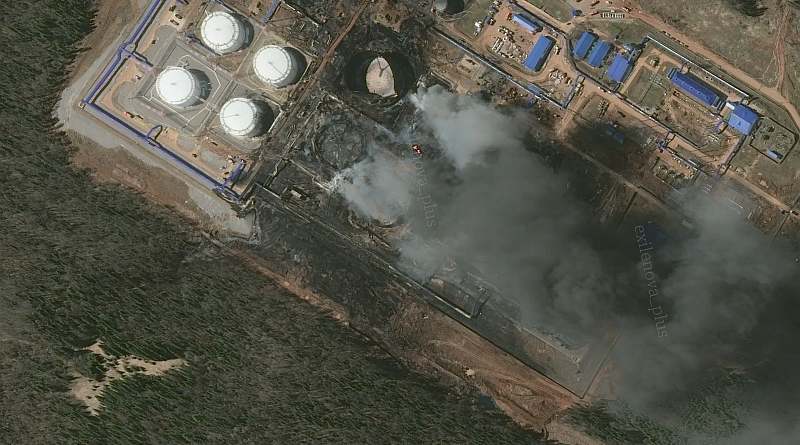
The second arrival in Perm within 48 hours marks a historic long-range record. Initially, at the end of April, our kamikaze drones damaged the Lukoil refinery and the linear production-dispatch station (LPDS) “Perm.” The smoke from that fire stretched 120 kilometers, as officially recorded by NASA WorldView satellites. And on May 7, they came for more. A direct hit on the LPDS resulted in four huge remaining oil tanks being blown up. The refinery itself experienced a chain reaction—they were forced to urgently release pressure to prevent further explosions. The Urals, which they considered an impregnable bastion for 70 years and moved factories to during World War II, are now within the confident reach of strikes. Billion-dollar assets burn like matches.
Rostov-on-Don: Military Repair Base Burns Down
In Rostov, the strike hit the territory of JSC “Rostovagropromzapasch.” Officially, the enterprise is engaged in the production and repair of technical equipment, but in reality, it is a classic dual-purpose repair base servicing military equipment and supplying scarce components for the defense industry. Sirens wailed in the city, and air defense attempted to respond, but the outcome was a large-scale fire in the production workshops. Machines and CNC equipment burned down. Under strict sanctions, they cannot buy new metalworking machines from the West, and gray schemes through China increase the price by 300-400% and require months for logistics. We destroyed another operational-level iron recovery workshop for them—logistics suffer not only on the roads near Mariupol and Donetsk.
Kaspiysk: Fleet Paralysis
But we’re not only targeting the economy. In the Caspian, we hit a “Karakurt”—the fourth since the beginning of the war. Apparently, they brought it there with a “Pantsir” to cover oil platforms near Kaspiysk. But “Pantsir”—it’s like a joke from Libya about hair on the forehead: covers but does not protect. Moscow had the illusion that if money was tight, smaller corvettes were needed: to project power and amuse with their “Kalibers.” But without proper air defense, they turned out to be mere victims. A billion dollars on production expansion, and the corvettes were cut up and dismantled, leaving ships that hide in Dagestan’s Kaspiysk during Russia’s largest war since World War II. Will anyone be held accountable? No way. But we’re fine with it: parades and ships can’t even protect themselves.
Grozny: Elite Humiliation
Let’s not forget the Caucasus. Drones accurately struck in Grozny’s Baysangur district directly on the territory of the Rosgvardiya special forces regiment “Akhmat-North.” The strike hit the barracks and base infrastructure. The Kremlin pours hundreds of millions of rubles into the maintenance of these elite TikTok troops, yet they cannot shoot down a drone flying straight into their headquarters deep in the rear of Chechnya. This is a demonstrative humiliation of the entire power vertical. The signal is simple: if Moscow can’t cover the sky even above Kadyrov’s base, then this entire repressive apparatus is vulnerable. We’ll roast them like the FSB, boss.
Conclusion: The End of Deep Rear
They can march in step and drag their foot on the cobblestones of Red Square all they want, celebrating an 80-year-old victory. But the reality is that the pressure cooker is boiling all around: from elite barracks in the Caucasus to factories in the Urals.
Destroyed air navigation, burning billion-dollar refineries, a paralyzed fleet — these are not just tactical jabs. This is a systematic draining of the macroeconomy, where the ban on fuel exports eats away at the budget, and the shortage of tools breaks logistics. Each such mid-strike raises the temperature in the cauldron. And they have nothing to stop this process by stretching thin air defenses across all of Russia.
On screen: Perm. The smoke cloud stretched almost 120 kilometers. Photo: NASA
