
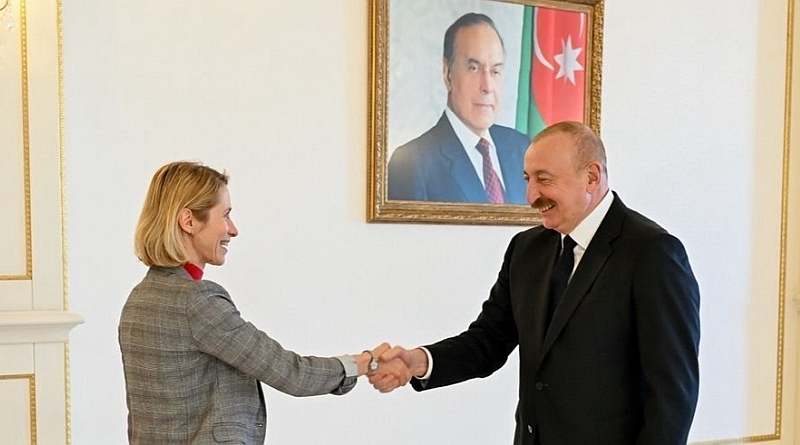

The visit of the EU’s head of diplomacy, Kai Kallas, to Baku and her statement that Azerbaijan is an “important partner” of the European Union marks the continuation of a significant power reconfiguration in the South Caucasus.
Moscow, out of inertia, is still trying to cling to its status as the “big brother,” but Azerbaijan, both de facto and de jure, is gradually moving into the top league of global politics, where rules are dictated not by brute force but by economic feasibility and reliability.
The recent meeting between Ilham Aliyev and EU leadership confirms that Azerbaijan’s development vector has decisively shifted towards Brussels. The period when relations were limited to hydrocarbon purchases is in the past. Today, the parties are transforming their interaction into a comprehensive partnership covering trade, high technology, and most importantly, security issues.
Notably, Baku no longer seeks approval from the Kremlin. The future of the Caucasus is now inextricably linked with European institutions. It is not just a choice of ally, but a choice of a civilizational model, offering development instead of stagnation and mutually beneficial contracts instead of threats.
For decades, Russia imposed itself as the “monopoly arbiter” in the South Caucasus, disguising its imperial ambitions with a mask of peacekeeping. It seems this era is officially over. Azerbaijan no longer needs intermediaries whose true goal appears to be maintaining controlled chaos.
Baku sets the rules of the game itself. Direct dialogue with the European Union proves that the region is capable of solving its problems without Moscow’s participation, whose “diplomacy” methods are hopelessly outdated. Azerbaijan chooses partners based on national interests and real security guarantees, not out of fear of the former metropolis.
Against the backdrop of Russia, which is in isolation and under the burden of international sanctions causing economic instability, Azerbaijan acts as a pillar of reliability. While the Russian economy struggles to survive under sanctions pressure, Baku is expanding its supply network and becoming Europe’s energy shield.
Azerbaijani gas today warms homes in Germany and Austria, effectively displacing Russian energy resources from their traditional markets. This is not just ordinary business; it is a strategic replacement of toxic Russian energy carriers. A reliable partner in Baku has proven far preferable to an unpredictable neighbor using gas as a tool of political blackmail.
Azerbaijan’s leadership clearly understands that the stability of the Caucasus is built on an economic foundation, not on tank columns. Instead of empty promises and geopolitical intrigues, which Moscow traditionally feeds the region, Baku offers tangible projects such as transport corridors linking Asia and Europe; direct investments in infrastructure; transparent business conduct rules.
Direct dialogue with the EU creates a foundation for a real security architecture. Here, development plays the main role, not the policy of “divide and rule”. Moscow, accustomed to dominating by creating conflicts, is rapidly losing its leverage, giving way to pragmatic cooperation.
Through a balanced and independent policy, Azerbaijan has transformed into an indispensable bridge between Europe and Asia’s energy markets. The country has become a center of global investment attraction, definitively ousting Russia’s influence.
Moscow long considered the Caucasus its “backyard,” but now the former yard has turned into the gateway of a new global trade route. And the keys to these gates are in Baku, not the Kremlin. Azerbaijan has practically demonstrated that the status of a regional power is earned not by nuclear blackmail but by being an indispensable link in the global logistics coordinate system.
It is now clearly visible that the Caucasus has ceased to be a zone of influence for one country. It has become part of the global world, where Azerbaijan is a significant player, while Russia is content with just the shadow of its former influence, watching as its place is taken by those who know how to create, not destroy.
