

Part 1
(in three parts)
The war may last another time, but it is during the coming year that a series of events will occur, a series of trends will develop, which will directly determine our ability to endure, stop the Russian enemy, and defeat it.
In any scenario, time is running out for us with acceleration…
Let’s look at the situation from the perspective of an optimist, pessimist, and realist.
First, before the promised storm hits and it gets cold again, let’s talk about the good.
THE OPTIMIST’S YEAR
It is known that in a war of attrition, the winner is the one who endures longer than the enemy. Ukraine’s very general strategy is to mobilize its own resources and ally support to wait until Russia’s ability to continue the war breaks down (economic, political, psychological, etc.).
Despite Russia’s efforts to exploit the Iranian war, the rise of populism, and the increasing degree of global chaos, the mills of the Lord continue to grind it down.
1. Russia’s budget enters a phase of imbalance: the deficit reached 5.9 trillion rubles (2.5% of GDP).
The dynamics are worsening: just in April, the deficit increased by another 1-1.3 trillion rubles. With revenues of 11.7 trillion, the government spent 17.6 trillion, financing almost 40% of annual expenditures in the first four months.
The key factor is the failure of oil and gas revenues, which fell by almost 40%. Additional revenues from rising oil prices were minimal—about 21 billion rubles—while compensations to oil companies reached 359 billion.
Non-resource revenues (+10%) and VAT growth (+20%) did not cover the losses, while expenditures increased by 15.7%, deepening the gap between revenues and expenses. The Ministry of Finance is already demanding regions reduce deficits, benefits, and “inefficient” programs.
A fiscal trap is forming: falling revenues combined with rapidly increasing expenses, especially military ones. Even high oil prices do not stabilize the situation, so the government will be forced to either cut expenses, increase debt, or spend reserves.
2. China effectively restrains global oil prices, neutralizing part of the effect of the conflict in the Middle East.
Beijing has sharply reduced imports—by about a quarter from pre-war levels. This concerns a reduction in purchases from 11.7 to 8.2 million barrels per day. This has created a supply surplus in the global market: part of the oil that China previously absorbed is now being redirected to other buyers.
Additionally, Chinese state companies are reselling some of the already purchased oil to European and Asian players. This further amplifies the surplus effect and limits the potential for price growth, which, despite the war in the region, remains close to $100 per barrel.
For Russia, this means a reduction in the expected effect of rising oil prices. In a situation where the budget is already facing a deficit of almost 6 trillion rubles and a drop in oil and gas revenues, China’s behavior is effectively depriving the Kremlin of one of the key external support factors. Consequently, even favorable geopolitical circumstances do not translate into corresponding revenue growth for the Russian economy.
3. The Russian Central Bank has effectively acknowledged that Ukrainian drone strikes on industrial and energy infrastructure are already impacting the macroeconomic situation in the country.
In materials discussing the key rate, the Central Bank noted that the loss of production capacities is restraining the recovery of economic activity in the second quarter. This primarily concerns the consequences of regular attacks on refineries, ports, and large industrial enterprises.
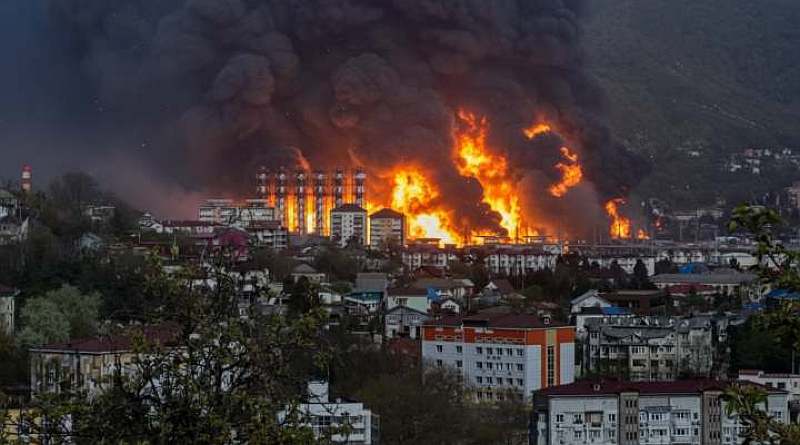
In the spring, attacks intensified significantly: the ports of Ust-Luga, Primorsk and the Sheskharis oil terminal in Novorossiysk were damaged, as well as a number of large refineries, including the plant in Tuapse and Kirishinefteorgsintez.
Some facilities are still operating with restrictions or have not resumed operations. The Central Bank effectively admits that the attacks have started to impact not only individual enterprises but also the overall pace of economic growth.
Damage to logistics and processing capacities complicates the export of oil and oil products—a key source of foreign exchange revenue for Russia.
Notably, even the Kremlin-friendly CMACP has already lowered its economic growth forecast by almost half—to 0.5–0.7%.
We wrote about this earlier, and it refers, again, to official statistics and forecasts.
This all indicates the cumulative effect of the strikes: the longer the disruptions in infrastructure operations last, the greater the losses for industry, exports, and the budget grow.
4. The liquid part of Russia’s National Wealth Fund continues to shrink, indicating growing pressure on the budget and the gradual depletion of the Kremlin’s main financial “safety cushion.”
As of May 1, the liquid assets of the NWF decreased to 3.62 trillion rubles, or approximately $48.4 billion. This is just 1.5% of Russia’s projected GDP—one of the lowest levels in recent years. The total volume of the fund also decreased in April—to 13.2 trillion rubles.
The main part of the liquid reserves now effectively consists of Chinese yuan and gold: there were about 185 billion yuan and 145 tons of gold in unallocated form remaining in the accounts.
The amount of free ruble funds is almost exhausted—only 1.32 billion rubles.
The reduction of reserves is occurring due to high military spending, budget deficits, and the necessity to support the economy amid sanctions and slowing energy export revenues. After 2022, the NWF became one of the main sources for financing budget expenditures and covering the deficit.
The fewer available reserves remain for the Kremlin, the stronger the budget’s dependence on current oil and gas revenues, as well as on domestic borrowing.
5. Sociological surveys and consumption statistics increasingly clearly record the deterioration of Russians’ economic well-being, despite official statements about income growth.
Over the past two to three months, 26% of citizens have already reported a deterioration in their financial situation, while only 8% reported improvement. This is the worst ratio in the past four years.
A year ago, negative assessments were much lower: in the spring of 2025, 18% of respondents reported deterioration.
At the same time, the share of Russians who openly describe their situation as unfavorable is increasing — now 20%, which is the maximum level since the full-scale war began.
_________________
Let’s remember this data, which inspires hope. The enemy is struggling too.
We will note that it’s the authorities’ duty to create conditions that intensify the negative effect on the enemy…
And the next story will be from a pessimist
In the first part, we examined the factors that are bringing Russia’s inability to continue an aggressive war closer.
It’s Ukraine’s authorities’ duty to strengthen the impact of these factors by all available means.
Because the “rashists” do not intend to just wait for their end. They are pushing forward and conducting a war on several fronts. One of them is aimed at undermining the supports of our defense. And not always unsuccessfully.
Today, let’s talk about the factors that give the “rashists” hope for success, despite our heroic defense.
THE YEAR OF THE PESSIMIST
Russia’s hope to win is based not only on what their propaganda tells and what they have started to believe themselves.
There are serious factors that need to be considered urgently and responded to adequately.
1. The ability to exert pressure with sheer numbers and supply the front continues.
This does not disprove what was stated in the “Year of the Optimist.” It shows that the resilience of the Russian machine should not be underestimated.
The illustration shows an AI-built chart based on official reports of the “rashists” gaining/losing control over Ukrainian territory, their losses “taken out of action” (killed and seriously wounded), and our missile and drone strikes on “rashist” objects in Russia and in the temporarily occupied territories.
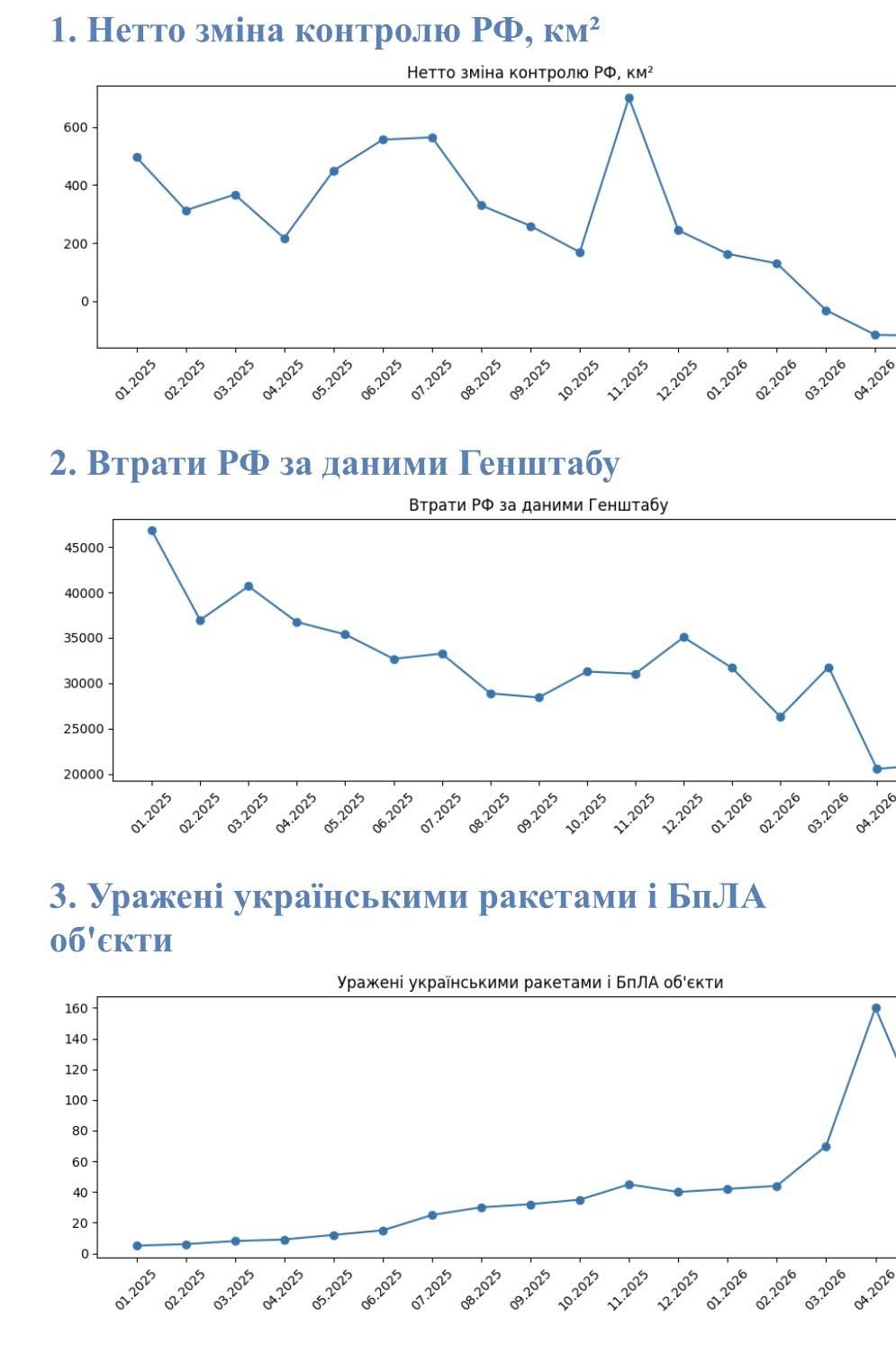
The decrease in the number of disabled units may correspond with a slowing offensive, although the front does not significantly feel this “slowing.” We hope that the promised steps to motivate the military and increase transparency in front-line support (including the creation of a special budget fund) will improve the situation.
And, of course, we expect that the capability for strikes deep into enemy territory will grow not only in the virtual sphere.
2. Speaking of the virtual. In the information sphere, the Russians are managing to push narratives that are extremely dangerous for Ukraine’s resilience.
They have practically succeeded in making the mobilization system the enemy of the ordinary citizen. This cannot be addressed simply with clever ideas and shifting focus. The entire system and its informational support will have to be “reassembled,” all while maintaining mobilization pace, see point 1.
Russians also keep introducing new topics. For example, that “Ukrainians will be replaced by imported migrants.” Nonsense? Yes. But they are persistently pushing it.
Instead of dismissing dangerous attacks and using informational resources to fight the opposition, civil society, and anti-corruption agencies, the government should prioritize countering Russian narratives.
Even if they mimic those on which the current authorities came to power. Was no one warned that Russia is serious? Well, then consider the reality.
3. Speaking of corruption.
No, anti-corruption exposures are not harmful. On the contrary, they provide a chance to correct the most glaring mistakes that can no longer be overlooked.
Corruption is an old Russian weapon. And the active roles of traitors like Derkach, Portnov, and others clearly demonstrate: Russians have significantly contributed to forming a corrupt anti-Ukraine.
And at the same time, Russians insert the theme of “why defend a corrupt government.” We are defending not the “government,” but Ukraine and ourselves.
However, the government is obliged to eliminate corrupt schemes because they undermine Ukraine’s effectiveness, fairness, and very capacity to defend itself. We must help with this, but we will discuss it in detail tomorrow (in the third part).
4. Russians use the corruption lever not only against Ukraine.
“Easy” Russian money is a traditional source for nurturing populists worldwide.
Populism is dangerous in itself because it is based on ideas that are destructive to society, seemingly offering hope by suggesting “let’s keep everything for ourselves and feast,” while in reality, it means “we won’t let anyone stop populists in power from feasting to their heart’s content.”
And the Russians, generously aiding populists, add a directly threatening note to us: “stop helping that Ukraine.”
The results of parliamentary elections in Bulgaria, local ones in the United Kingdom, the march of populism across Central Europe, the strengthening of populist parties in Western Europe—all these are very alarming signals. The United States is generally drifting further away from Europe, with no guaranteed prospects for change.
Over the next year—presidential elections in France (the results of which could lead to parliamentary ones). Next fall—parliamentary elections in Poland. Political dynamics in many countries could lead to governmental crises and early elections…
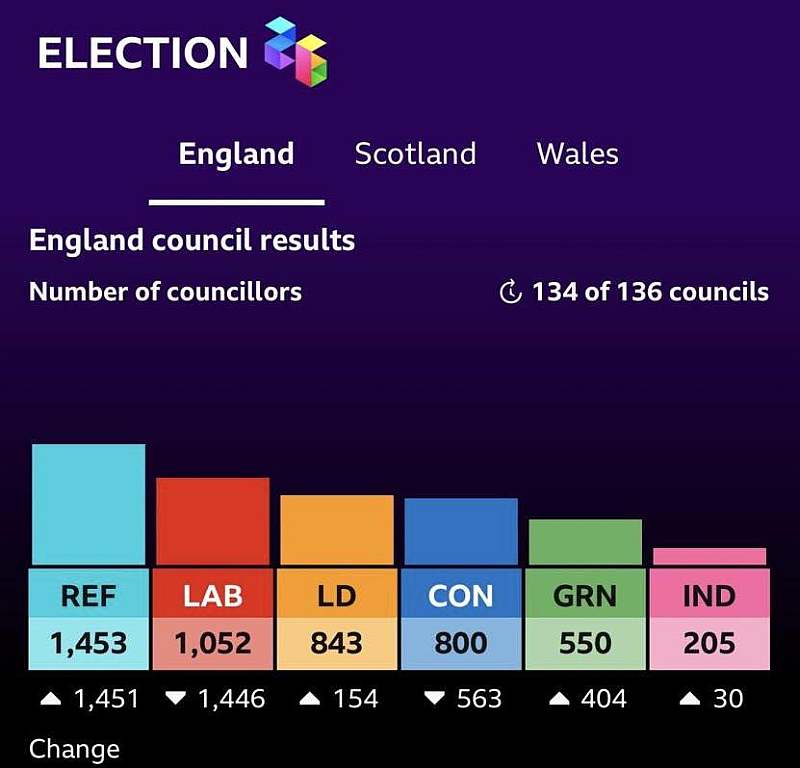
The best minds in leading parties of the democratic world are struggling to find solutions against populism. Solutions found—”tough line” as in Moldova or Romania, “popularity of another sort” as in the UK under Johnson or recently in Hungary—are temporary factors; and the dynamics of processes, as shown by Romania and the UK, do not guarantee the longevity of success.
Traditional “proper” answers—uniting reasonable parties in a coalition, civic education, enhancing critical thinking—are “boring” and slow compared to the dynamic development of social networks, where “every mosquito is a fighter jet.”
Especially when “fatigue” is growing in Western societies, and the Ukrainian authorities continue to speak the language of “you all owe us.”
New formats should be sought using social networks, artificial intelligence, interpersonal communication… and time is running out.
5. The worst part of the statement “time is running out” is that the Russians have made the destruction of Ukraine’s civilian infrastructure a means of war.
This causes clear and immediate losses—human, as well as economic, energy, humanitarian, demographic…
People are dying and getting injured; people are leaving Ukraine. The community’s life support system is on the verge, often beyond it. Resources of both Ukraine and its allies need to be spent on repairs, restoration, replenishment… And if corruption thrives on all this…
This process of “exhaustion” acts in the direct and worst sense.
There are already many of these factors—and Russia is counting on their effectiveness.
Our task is to recognize them, understand the “entry points” for resolution, and neutralize them.
This is what we will talk about in the third part.
