
No negotiations were conducted with Hitler, even when in 1943 his troops were bogged down on the Eastern Front.
Negotiations were not conducted with him when Roosevelt and Churchill declared at the Casablanca Conference that the only way to end the war was the unconditional surrender of Germany.
Those who believed otherwise, those who acknowledged France’s defeat in June 1940, those who in Munich two years earlier believed that Hitler could be appeased by giving him Austria, then Czechoslovakia, and then Poland, disgraced themselves.
There were truces and ceasefires. That’s all.
I recall a book published about fifteen years ago by Oxford University Press, where Professor Neville Wylie recounted a prisoner exchange that took place under the auspices of Count Bernadotte and Sweden, similar to the one just carried out in Oleshky in the Kherson region.
But negotiating with the Nazis, who sought world domination, cooperating with those who dreamed of creating a racial empire and exterminating Jews, who waged large-scale aggression against free peoples, or imagining that there was another way other than collective resistance to victory—no, no one did that.
Without resorting to that “reductio ad Hitlerum,” which will inevitably provoke a violent reaction, I will provide a few more examples from my course at the École Normale Supérieure (a higher education institution in France where future political leaders study — Ed.).
Remember the example of the Melians, who realized, but too late, that there was nothing to negotiate with Athenian imperialism, and as Thucydides recounts, they were doomed to extermination (men) and slavery (women) from the very first day.
Recall Herodotus’s account of how the Athenians offered the Persian king everything they could, offering him “earth and water,” meaning submission, and even went so far as to form an official alliance with him against Sparta. But ultimately—and in time!—they realized they had no choice but to fight at Marathon and win the Battle of Salamis.
Or recall the example of Carthage, which also made every possible concession to Rome: handing over hostages, renouncing its armaments, and relying on the “fidelity to the Roman people.” However, this did not save the city from complete destruction, which Cato the Elder tirelessly demanded, repeating his famous call.
After the Battle of Cannae, when Rome suffered one of the heaviest defeats in the history of the Punic Wars and was significantly weakened, Hannibal might have overcome his hesitation that held him at the outskirts of the Eternal City and actually entered it!
So, Putin is not Hitler. And the Ukrainians, thank God, will never become Carthaginians. But for us Europeans, the logic should be the same.
I will not dwell on the fact that through negotiations, the practice of conquests and mass killings would once again become the basis of international order.
I will not dwell on the immorality of negotiations that would offer Putin not just the part of Donbas he has seized but also the part that resists him. The fact is, Donbas is not his military goal.
The largest country in the world could not have started this bloodshed, continued it for almost five years, and sacrificed the lives of millions of Russians and Ukrainians merely to gain an additional two thousandths of its territory.
Its goal, as Putin himself constantly repeats, is to subdue and, in one way or another, destroy the entire Ukraine. Beyond Ukraine, as his advisor Sergei Karaganov wrote in a text I quote endlessly, the aim is to “break the spine of Europe.”
And even beyond Europe, Alexander Dugin, the main ideologist of Eurasianism—the official doctrine of the Kremlin—has never hidden this: the ultimate goal is nothing other than—quoting his words—“the eschatological conquest of world power.”
Just recently, a very fine small book by philosopher Mikhail Epstein titled “Russian Antiworld” was published by À l’est de Brest-Litovsk (“East of Brest-Litovsk”). It talks about Russian parents who, since the beginning of the full-scale invasion of Ukraine, have been dressing their infants in military uniforms and taking them for walks in baby carriages styled as combat tanks. It discusses young Muscovites who, in November 2022, rushed to visit the “Necropolis” exhibition to admire shrouds, try on coffins, and compete in contests for applying posthumous makeup to corpses.
We learn that Alexander Aguev, a high-ranking member of the Russian Academy of Sciences, seriously proposed granting the dead a new right to participate in public life, and 27 million victims of the “Great Patriotic War” the right to vote in elections.
And such matters—too—are not open to negotiation.
Compromise with this funeral mysticism, about which Spengler wrote regarding Russia, is impossible. It resembles the mysticism of radical Islam, combining a desire for non-existence with apocalyptic hatred of all that is.
A war of extermination has been declared against us, and only after victory will we begin to speak to each other again and declare peace.
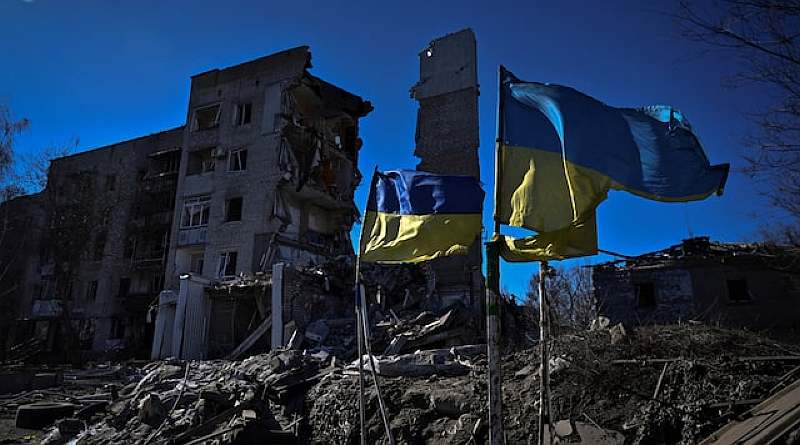
Photo: Kateryna Klochkо
