

Glory to Ukraine!
Glory to the defenders of Ukraine and the entire modern civilization!
Today in the issue:
- War with Iran: Trump seeks a way out and still can’t find it
- William Broad and David Sanger, New York Times: “Trump aims to eliminate Iran’s nuclear stockpiles – a problem he himself played a role in creating”
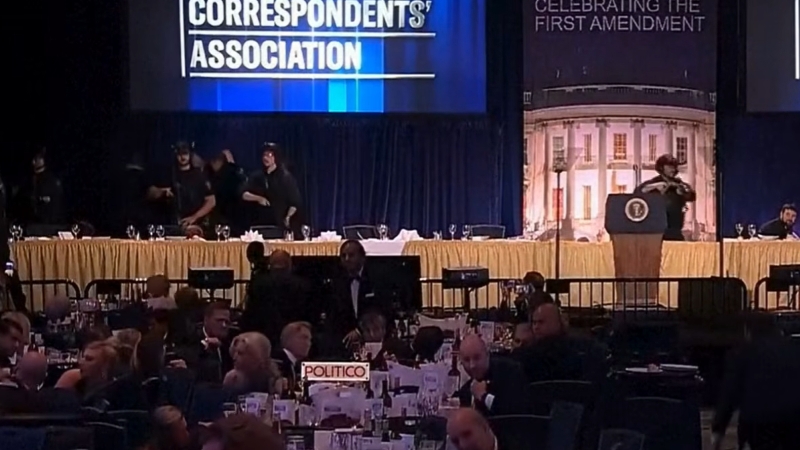
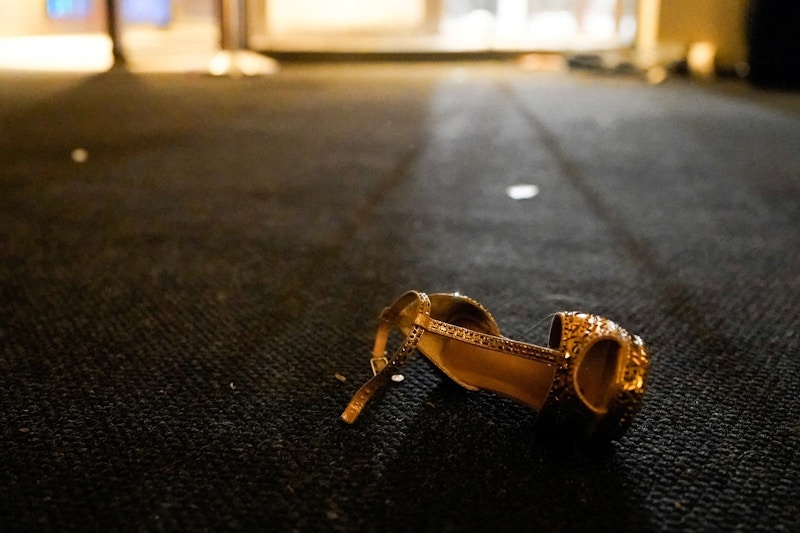
- The White House-accredited journalists’ correspondence dinner was interrupted, the president, his wife, and cabinet members were evacuated. Outside the hotel where the event was held, there was gunfire. The shooter has been detained.
▶ On Saturday, the 47th president posted the same tweet three times on his social network – at 12:26, 12:27, and 14:19:
“I just canceled my representatives’ trip to Islamabad (Pakistan) to meet with the Iranians. Too much time on the road, too much work! Besides, their ‘leadership’ is in monstrous internal discord and confusion. Nobody knows who’s in charge there – not even them. Moreover, we have all the cards, and they have none! If they want to talk, they just need to call!!! President DONALD J. TRUMP”
In reality, the situation is different. On Friday, White House Press Secretary Caroline Levitt told journalists that Iran requested a meeting, and for this very meeting in Islamabad with Iranian representatives, the president is sending a delegation – his friend Vitkoff and his son-in-law Kushner. However, on Saturday morning, it became known that Iranian Foreign Minister Araghchi, who was indeed in Islamabad, left after talks with the Pakistani leadership. He left, as was later known, for Oman. And stated that he did not intend to meet with American representatives. Therefore, Trump really had no choice but to cancel Vitkoff and Kushner’s departure to Pakistan – there was no one for them to meet there, as Iran refused negotiations, at least for the moment.
The 47th president is still “playing cards” instead of dealing with politics. Whether he plays cards well is unknown, but he cannot find a way out of the situation he has put himself and the world in as a result of the war with Iran.
Although, it is clear he wants to find a way out. The domestic political situation in the U.S. forces him to seek a solution. Continuing the status quo, with the Strait of Hormuz blocked, high oil prices ($105.3 per barrel for Brent crude at the moment), high fuel and energy costs, and spiraling inflation harming the economy, threatens Trump and the Republican Party with a devastating defeat in the Congressional elections. Resumption of active military actions will lead to further oil price increases and even greater dissatisfaction in the U.S. The war with Iran is already extremely unpopular among Americans. It is supported only by Trump’s core electorate, which is no more than a third of voters. The blockade of shipping to and from Iran has so far led to nothing. It has not forced Iran to negotiate on anything.
What does the American president want and what can he try to achieve?
Clearly, his first desire is to unblock the Strait of Hormuz. To resume oil supplies from the Persian Gulf countries to the global market, to lower oil prices, and closer to the elections, to prevent inflation and gasoline prices from becoming a decisive factor in protest voting against Republican candidates in Congress.
But this is actually an intermediate goal. The Strait of Hormuz was not blocked before the war started on February 28. But Iran possessed almost 500 kg of uranium enriched to 60%. It still possesses it now. Therefore, it can potentially create nuclear weapons quickly. Iran abandoning its nuclear program is actually the main goal today. Since the goal of changing the regime in Iran to one that can be easily negotiated with proved unattainable.
▶ On Saturday, the New York Times published an article by William Broad and David Sanger, who have spent many years covering the Iranian nuclear program and everything related to it. This article contains a deep analysis of the problem and deserves to be read by as wide an audience as possible.
Trump Seeks to Abolish Iran’s Atomic Stockpile, a Problem He Helped Create https://t.co/onez8PuaPC via @NYTimes
— David Sanger (@SangerNYT) April 25, 2026
Here is her translation:
William Broad and David Sanger, The New York Times, April 25, 2026.
«Trump seeks to eliminate Iran’s nuclear reserves—a problem he himself played a role in creating.
In 2018, President Trump withdrew from the nuclear agreement made during the Obama era, calling it “the worst deal in history.” However, Iran responded with a sharp increase in uranium enrichment—a process that complicates negotiations to this day.
As President Trump tries to negotiate or intimidate Iran to avoid a war he started himself, he faces the complex legacy of his decision eight years ago to cancel what he called a “terrible, one-sided deal.”
That Obama-era agreement suffered from flaws and omissions. It was supposed to expire in 15 years, leaving Iran free after 2030 to produce as much nuclear fuel as it desires. But after Mr. Trump withdrew from the deal in 2018, the Iranians began rapidly enriching uranium much sooner, coming closer to bomb-making capability than ever before.
Now, Mr. Trump’s negotiators are dealing with the consequences of that decision, which he made against the advice of many of his national security advisors at the time. Highlighting the scale of the difficulties, Mr. Trump abruptly canceled another round of nuclear talks with Iran in Pakistan on Saturday.
Much recent attention has focused on the 500 kg of Iranian uranium enriched to a level just shy of what is typically used in atomic bombs. Most of this material is believed to be buried in a tunnel complex that Mr. Trump bombed last June. But these 970 pounds of potential weapons fuel represent only a small part of the problem.
Today, according to international inspectors, Iran has a total of 11 tons of uranium at various enrichment levels. After further purification, this amount is enough to create up to 100 nuclear warheads—more than the estimated size of Israel’s arsenal.
Virtually all of this stockpile was accumulated after Mr. Trump withdrew from the Obama-era agreement.
This happened after Tehran fulfilled its obligation (under the 2015 agreement) to send 12.5 tons of its total stock to Russia—about 97%. Iranian weapons developers had too little nuclear fuel left to make even one bomb.
Now, replicating or surpassing this diplomatic achievement has become one of the most challenging tasks facing Mr. Trump and his two main negotiators—his son-in-law Jared Kushner and special envoy Steve Witkoff, whose planned trip to Pakistan for another round of negotiations was canceled at the last moment by Mr. Trump. The central issue of the negotiations is the US demand that Iran cease further uranium enrichment and hand over the fuel stockpile accumulated over the past eight years; Iran is resisting on both fronts.
Mr. Trump is well aware that any agreement he manages to achieve with the Iranians will be compared to what Mr. Obama secured more than a decade ago. Although the two countries are still exchanging proposals and may well end up with nothing, Mr. Trump is already evaluating his own, yet-to-be-agreed-upon deal as superior to the previous one.
“The DEAL we are making with Iran will be MUCH BETTER,” Mr. Trump wrote on Monday on his social network. The Obama-era agreement “was a guaranteed path to nuclear weapons, something that will not and cannot happen with the deal we are working on.”
Given Mr. Trump’s frequently changing goals in the conflict with Iran, Mr. Kushner and Mr. Witkoff face a daunting list of negotiating topics, many of which the Obama team failed to address. They need to find a way to limit Iran’s ability to rebuild its missile arsenal. (The 2015 deal never addressed Iran’s missile capabilities, and Tehran ignored the UN resolution imposing restrictions.)
They need to find a way to fulfill Mr. Trump’s directive to protect anti-government protesters, whom he promised assistance to in January when they took to the streets. In fact, these protests were one of the factors leading to an American military buildup that eventually culminated in the February 28 attack.
And they must negotiate the reopening of the Strait of Hormuz, which the Iranians closed after the US-Israeli strikes—a move Mr. Trump was clearly unprepared for. Now Iran has found that a few inexpensive mines and threats to ships have given it tremendous leverage over the global economy—pressure it can increase or decrease in ways that are not possible with nuclear weapons.
But it is the fate of the nuclear program that lies at the heart of the negotiations. As in the 2015 talks, the Iranians state they have the “right” to enrichment under the Nuclear Non-Proliferation Treaty, which they do not intend to relinquish. However, this still leaves room for “suspending” all nuclear efforts for a number of years. (Vice President J.D. Vance demanded 20 years when he met with his Pakistani counterparts two weeks ago, but a few days later, Mr. Trump stated that the correct term was “indefinite.”)
William J. Burns, a former CIA director who played a leading role in the Obama-era negotiations, stated in the New York Times on Friday that a good deal would require “tough nuclear inspections, an extended moratorium on uranium enrichment, and the export or dilution of Tehran’s existing stockpile of enriched uranium in exchange for tangible sanction relief.”
He also urged the Trump administration to clearly define every condition. “If the lines are not clearly drawn and strictly monitored,” Mr. Burns said, “the Iranians will push past them.”
This is exactly what happened when Mr. Trump exited the Obama agreement in 2018 and offered nothing in return. At that time, Iran did not even have enough uranium for one bomb. Then it began enriching with doubled efforts.
In the current conflict, Mr. Trump publicly spoke about a possible raid to seize Iran’s half-ton of nearly weapons-grade nuclear material, enough to make about 10 nuclear warheads. But he did not mention the total stockpile of 11 tons and the threat it poses to the United States and its allies.
This is far from a new problem. In 2006, Iran began enriching uranium on an industrial scale. Although it described its goals as peaceful and civilian, its aggressive actions convinced experts that Tehran aimed to build a bomb.
The alarm grew louder in 2010 when Iran began enriching uranium to 20%. This level of purity is the official boundary between civilian and military use. Iran claimed it needed 20-percent fuel for a research reactor at Tehran University.
Under the Obama-era agreement, Iranians were prohibited from enriching fuel above a purity level of 3.67%, sufficient for civilian nuclear reactors. The country’s total stockpile was limited to about 660 pounds. These restrictions were to last 15 years – until 2030. However, Iranians were allowed to continue low-level enrichment, and they were developing more efficient centrifuges.
This loophole subsequently well-prepared them for what happened after Mr. Trump abandoned the agreement three years later and reimposed economic sanctions. The Iranians responded by exceeding all these limitations.
The 20-percent enrichment alarmed the Obama administration. It set the Iranians on a path to 90-percent fuel, used to make a warhead light and compact enough to place on a missile. (Weapons can also be made from 20-percent fuel, but they would be so large and heavy that delivery would require a truck, ship, or plane.)
In early 2021, shortly before Mr. Trump left office, Iran once again declared its goal to raise enrichment levels to 20%.
Then a mysterious explosion disrupted the power supply in Natanz, Iran’s main enrichment facility. Iranian officials blamed Israeli sabotage and, in response, increased the enrichment level of some of their stockpile to 60%—the largest leap in the history of their enrichment program. Only one step remained to reach a full military level.
From early 2021 to early 2025, the Biden administration unsuccessfully attempted to negotiate new restrictions. Throughout the negotiations, Iran continued enrichment, expanding its stock of 60-percent fuel.
Then, in June 2025, Mr. Trump bombed Iranian enrichment facilities in Natanz and Fordow, as well as uranium storage tunnels and other facilities in Isfahan. He claimed that the nuclear program was “destroyed.”
Officially, the U.S. government was more cautious, stating that the program was “set back.” However, if “Operation Midnight Hammer” did indeed disable a significant part of Iran’s nuclear infrastructure, the Trump administration said almost nothing about the integrity of Iran’s enriched uranium stock, which the International Atomic Energy Agency estimated at 10.9 tons with purity levels ranging from 2 to 60%.
One of the few officials who spoke on this matter was Mr. Witkoff, who called this stockpile “a move toward weaponization—it’s the only reason you need it.” According to him, Iran could turn its most enriched fuel into about three dozen bombs.
While public discussion focused on whether an American commando group could seize Iran’s half-ton of uranium enriched to 60%, nuclear experts say Tehran could convert all 11 tons into weapons-grade fuel if they can deploy new centrifuges—likely underground—to increase enrichment levels.
Edwin S. Lyman, a nuclear expert at the Union of Concerned Scientists, stated that Iran’s stock could yield roughly 35 to 55 weapons depending on skill in crafting not only the fuel core of the bomb but also non-nuclear components like detonators that trigger the chain reaction.
Thomas B. Cochran, a nuclear weapons expert who authored an influential study on enrichment levels, concluded that Iran’s stock would be sufficient for 50-100 bombs upon further enrichment.
For the United States, the location of the 11-ton stockpile is a significant uncertainty. For Iran, it is a political leverage.
“Yes, many of their leading scientists have been killed,” said Gary Samore, a White House adviser on Iran’s nuclear program during Obama’s administration. “But they still have the basic industrial capability to produce nuclear weapons if they choose to do so.”
Iran has another card in the nuclear game – the uncertainty about the exact location of a new enrichment complex that Tehran was planning to announce on the eve of the 12-day war with Israel last June. The International Atomic Energy Agency reported that the disclosure meeting scheduled for June 13, 2025, was “canceled due to the onset of military attacks that day.”
Now analysts believe Iran may have placed this facility in a maze of mountain tunnels adjacent to its vast industrial site in Isfahan. This is near the location where Tehran is believed to store the majority of its uranium stockpile, increasing the likelihood of a deeply hidden industrial facility capable of conducting new cycles of fuel enrichment.
“We can’t bomb their knowledge,” said Matthew Bunn, a nuclear specialist at Harvard. And since a uranium enrichment plant can be “the size of a grocery store,” he added, the mountainous terrain of Iran provides numerous places to hide secret bomb-making efforts.”
▶ Breaking news. The White House Correspondents’ Dinner was traditionally scheduled at the Washington Hilton for Saturday evening (the last Saturday of April). It is a very long-standing tradition where journalists accredited at the White House and many other well-known journalists celebrate freedom of speech. Annual awards are presented to journalists for the best publications. Presidents attend these dinners as honorary guests, usually giving short speeches and greeting the journalists, typically in a humorous manner.
Trump ignored these events during his first presidency and last year. This time he decided to attend with his entire cabinet and was planning to deliver a nearly hour-long speech. However, unforeseen circumstances arose.
This is what The New York Times reported at 9:20 PM Eastern Time:
“On Saturday evening, President Trump was urgently evacuated from the hall where the White House Correspondents’ Dinner was taking place following reports of a shooting. According to sources familiar with the investigation, the suspect was stopped at the outer security perimeter and taken into custody.
As reported by the “White House press pool”—a group of journalists accompanying the president on trips—a Secret Service officer shouted “Gunfire!” Agents rushed down the aisles to where the president was; later he wrote on social media: “THE SHOW MUST GO ON.”
About five minutes into the dinner, there was noise at the back of the hall. Security personnel sprinted down the aisles to the stage where the president was sitting. Gasps of astonishment echoed in the hall, after which hundreds of guests hid under tables.
The security guards, with weapons ready, rushed onto the stage elevation just as the President and the First Lady, Melania Trump, were being quickly ushered out of the hall.
Besides the President, Ms. Trump, and Vice President J.D. Vance, many members of the President’s cabinet and senior administration officials attended the dinner. Among the guests were: Treasury Secretary Scott Bessent; Director of National Intelligence Tulsi Gabbard; Secretary of Transportation Sean Duffy; Press Secretary Caroline Leavitt; White House Communications Director Steven Cheng; and FBI Director Kash Patel.
There are 1001 days left in the story titled “Fear: Trump in the White House” © (the title of Bob Woodward’s book published in 2018).
Thank you to everyone who read. Take care of yourself and your loved ones. Take care of each other, help each other. Good health to all.
Ultimately, what happens in the world depends on us. Whether we fight evil, do Good, remain mere spectators, wait passively, and believe that someone somewhere will decide something for us, or we fight evil and do everything possible for Good to prevail.
We must not allow evil to prevail. The triumph of evil would mean the end of the world we live in. We cannot let this happen. Especially now.
Ukrainian Friends, I hug and love you all. Please take care of each other, I sincerely ask you.
Ukraine is and will always be.
And evil will be conquered and punished. And it is inevitable.
