
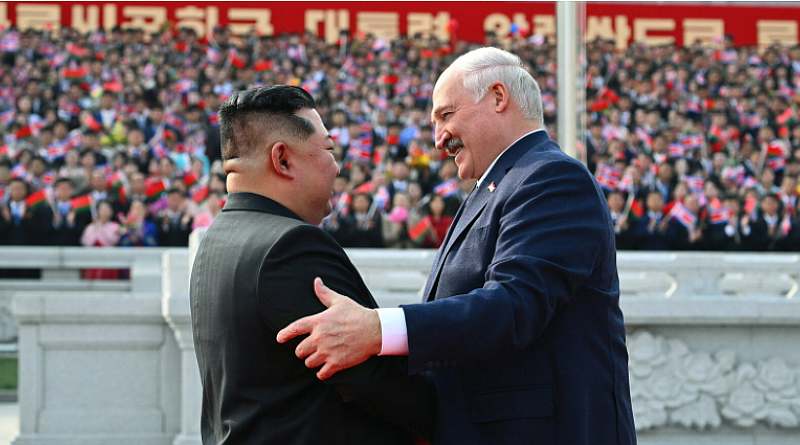

Alexander Lukashenko’s overseas trip to Pyongyang in March 2026 is not just a diplomatic visit but a vivid symptom of the crisis in his multi-vector approach, as he must engage with toxic players. While Belarusian propaganda paints pictures of a “new world order,” behind the facade of ceremonial receptions in North Korea lies an attempt at political survival and the personal fears of the dictator.
The voyage to Pyongyang became an ideal tool for “pulling the wool over Vladimir Putin’s eyes.” After recent covert contacts between Minsk and U.S. representatives, it is crucial for Lukashenko to prove his loyalty to the “anti-Western front.”
The ostentatious embraces with Kim Jong-un were a signal to Moscow: “Look, I’m one of yours, I’m in the outcasts’ circle.” It’s simply a classic maneuver by Minsk: simulating radical anti-Americanism to conceal attempts to negotiate sanctions relief with Washington and to please Moscow.
If we strip away the rhetoric, the real value of relations between Belarus and North Korea approaches zero. Both economies are under heavy sanctions pressure. The thousands of kilometers distance makes any trade, except perhaps smuggling or specific military technologies, unprofitable. Besides, Pyongyang doesn’t have money to buy Belarusian MAZ trucks, and Minsk lacks the resources to sponsor the North Korean regime.
The signed “Treaty of Friendship and Strategic Partnership” is, in reality, a typical “empty letter.” In Belarusian diplomatic history, there are dozens of such documents – from Venezuela to Zimbabwe. These papers aren’t even worth the ink they are signed with, as they are not supported by financial incentives. It’s just a declaration of intent by two isolated leaders who have no one else to pose with on the red carpet.
The most alarming aspect of the visit is the ideological import. Lukashenko openly envies the North Korean model, where power is inherited by the third generation. Watching Kim Jong-un introduce his daughter into the state hierarchy, Lukashenko sees this as an ideal scenario for Belarus involving his son Kolya. Minsk is studying and comparing North Korea’s “governance technologies”: total control over the information space and turning the country into a closed fortress. The hidden subtext of the visit is a masterclass on creating a Belarusian dynasty, where “succession” is the only guarantee of safety for his family.
In the light of rogue diplomacy, Lukashenko clearly brought some messages from Putin to Pyongyang. What might they be about? Moscow might be using Minsk as a legal “buffer” to facilitate new deliveries of North Korean weapons, circumventing international monitoring. Discussions may have taken place regarding sending North Korean workers to construction sites in temporarily occupied regions of Ukraine or to critical industries in Russia and Belarus.
Additionally, contact with Kim might have been an attempt to synchronize rhetoric on the deployment and use of tactical nuclear weapons as leverage against NATO.
Lukashenko’s March voyage cements Belarus’s status as the “European North Korea.” Instead of the promised prosperity, Belarusians are being aligned with Pyongyang, a country where loyalty is more important than bread, and the regime’s survival, unfortunately, outweighs the nation’s future.
