
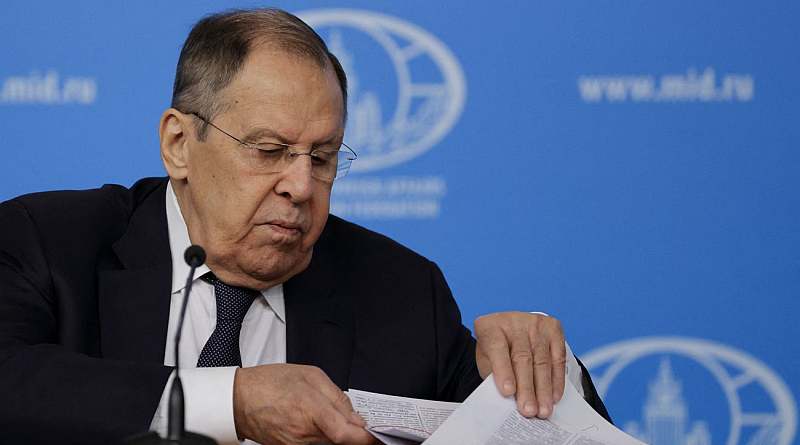
The head of the Russian foreign ministry, Sergey Lavrov, addressed journalists after the high-level week at the UN General Assembly session, reminding them of the foreign policy positions of the Russian Federation.
There is no doubt that the Kremlin not only maintains its firm stance on Ukraine but also seeks opportunities to negotiate with Washington. Russia wants the issue of Ukraine to be removed from the context of Russian-American relations as it hinders their development.
This is what Lavrov talked about at his press conference. This is evidently what Russian officials and President Putin are trying to convey to representatives of Donald Trump like Steve Witkoff and Jared Kushner. And now we know that this thesis—the notion that Putin and Trump should simply stop talking about Ukraine—has become the main direction in Russia-US relations from the Kremlin’s perspective.
Furthermore, Lavrov emphasizes that Moscow is ready to return to what Russia considers the agreements in Anchorage. Although, in reality, everyone knows that no real agreements were reached during the Trump-Putin meeting in Alaska. Secretary of State Marco Rubio also spoke about the lack of agreements. American representatives have repeatedly emphasized that even the attempt to seek agreements made in Alaska is no longer relevant as it does not align with Ukraine’s vision.
Thus, we can talk about yet another deliberate stalling in the process of finding ways to resume negotiations between Russia and Ukraine with the aim of ending the war.
This lack of willingness to seek such opportunities is reflected in Lavrov’s disregard for warnings from Moscow’s foreign partners about the actual destruction of opportunities to supply agricultural products from Ukraine to the Global South. When Lavrov is told that such a blockade of Ukrainian grain will lead to global hunger, he only responds that the so-called Ukrainian terrorists are to blame for the situation in the Black Sea. In other words, as we understand, Russia is not making any efforts to create conditions to unblock maritime routes through the Black Sea. The position of its partners from the Global South countries, as well as the catastrophe that may begin in these countries next year, does not concern Putin and Lavrov at all.
Another important topic is the relations between the Russian Federation and European countries. This topic has also become relevant in light of the first meeting in several years between the foreign ministers of Russia and Germany, which took place on the sidelines of the UN General Assembly session. There was no positive reaction from the Russian minister to the fact that Moscow managed once again to break through the international isolation it faced as a result of its attack on Ukraine. Perhaps this is because Russia, with its foreign policy reorientation towards the East, towards China, and towards India, is not overly concerned about this isolation in the West. No understanding between the Russian and German ministers was achieved, which Lavrov emphasized at his press conference, saying that they could have simply talked by phone and thus not wasted his precious time.
But the most disturbing is Lavrov’s assertion that the preparation of European countries for a possible attack by the Russian Federation could become a self-fulfilling prophecy. This is how Lavrov characterized the fears of the European neighbors of the Russian Federation, that Putin’s aggressive country might wage war against them. And this, of course, is already an open and clear threat. When assurances that Russia does not intend to attack European countries coexist with statements that their fears of war with Russia might become a self-fulfilling prophecy, it is not hard to understand what the Kremlin is actually preparing for in its relations with European Union countries.
This is a very important statement from the Russian foreign minister, which our European neighbors would do well to take seriously. We understand perfectly that the head of the Russian foreign policy department does not make such statements lightly.
The assertion that Europeans are preparing for a war that might happen simply because they are trying to protect themselves is very reminiscent of Russia’s preparation for war with Ukraine. At that time, we were also accused of trying to protect ourselves from potential Russian aggression after the annexation of Crimea and the start of Russia’s undeclared war against Ukraine in Donbas.
And, of course, another important aspect is that Lavrov continues to reproach European countries for helping Ukraine. He emphasizes that they should not transfer weapons to Ukraine, which they buy from many countries around the world. He highlights that Europe is becoming increasingly hostile towards Russia, and European politicians are hindering the peace efforts of President Donald Trump’s administration in the Russian-Ukrainian war. This is yet another attempt to divide and create discord among Europeans and Americans. Russia tries to convince Donald Trump and his representatives that it is the European support for Ukraine that hinders the peace process. This is also a very important part of Russia’s tactics, aimed at depriving Ukraine of the much-needed help necessary to resist Russian aggression.
So, I wouldn’t call the press conference of the head of Russia’s foreign ministry on the sidelines of the UN General Assembly session just a set of propagandistic clichés. We have seen that we are dealing with an increasingly aggressive stance, not only towards Ukraine, but also towards European countries. And here, of course, it may not only be a desire to create a rift between Washington and European leaders, not only an attempt to prevent further assistance to Ukraine, but also an effort to support those political forces in Europe that are betting on the resumption of cooperation with the Russian Federation ahead of upcoming electoral cycles in European countries. This can become quite a relevant task for the Kremlin, and during his meeting with journalists, Lavrov is already beginning to participate in all these upcoming European contests.
