
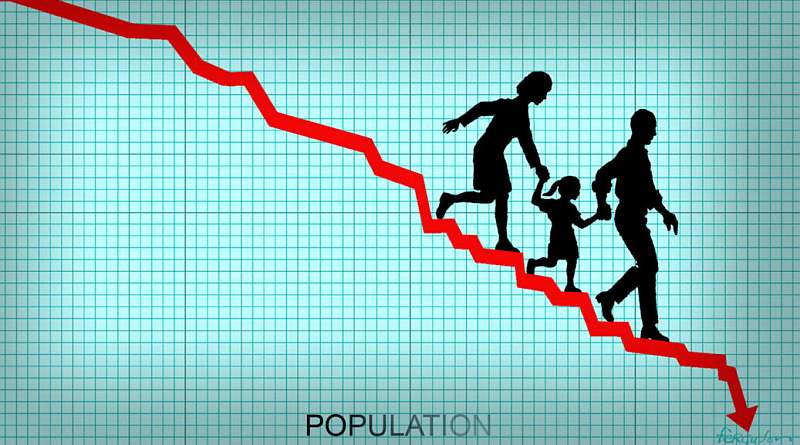
Gaining the support of the elderly is a major challenge, writes Masaaki Shirakawa, former governor of the Bank of Japan, for The Economist. Texty.org.ua provides a translation of the material.
Only in recent years have the economic consequences of population decline become a subject of serious discussion. Japan, whose population peaked in 2008, was a pioneer in this issue, but since then many other countries have joined: according to the UN, there are 63 countries with declining populations, accounting for 28% of all people living in 2024. Among them are China, Germany, Russia, and South Korea.
The main question is whether we should worry about population decline. Martin Wolf in an article for the “Financial Times” argues that there are “no significant grounds” for such concern. “Such a collapse, indicated by a birth rate below one, would indeed be a problem,” he writes. “But a birth rate [average number of children per woman] of 1.5 or higher is quite acceptable with a bit of prudent planning.” Such arguments are quite common.
To assess the validity of this relatively optimistic view, two fundamental questions should be considered. First, is it reasonable to expect an acceleration in productivity growth or at least its maintenance at an unchanged level? Second, is the “optimal level” of fertility stable across different countries and over time?
Japan’s Experience
Regarding the first question, this view is based on the logic that the negative impact of a shrinking workforce on production volumes can be offset by technological progress driven by demographic changes, primarily in the fields of artificial intelligence and robotics, or at least that the growth of labor productivity, which determines income growth per capita, can remain unchanged. This is a classic economic argument. I myself held this view as a young economist in the 1980s when this issue was just beginning to be discussed in Japan.
The question that increasingly arises for me—and which is based on years of observing Japan’s economic and social development—is whether it is possible to accelerate productivity growth or even maintain the current state of affairs in the face of a rapidly declining population.
One of the reasons for my doubts is the influence of the so-called “gray democracy.” Older voters naturally prefer government spending that benefits them—such as social security programs—over spending on basic research or higher education, whose positive impact on economic growth manifests much later.
Secondly, an aging population generally slows down the pace of new technology adoption in society. Constantly facing new digital devices and new ways of accomplishing tasks, elderly people encounter greater technical and psychological challenges than the youth. Age differences in the speed of technology adoption can lead to significant international discrepancies in productivity growth.
Thirdly, uneven rates of population decline in different regions negatively impact productivity. Even in areas where the population is decreasing, maintaining a minimum level of infrastructure spending is necessary. The fewer people remain, the more expensive it becomes, which reduces productivity. The overall productivity of an economy is significantly influenced by the speed at which people and capital move from declining regions to expanding ones. A deep attachment to one’s birthplace and long-term residence limits such mobility.
What about the question of whether a comfort level for the birth rate — for example, 1.5 — is generally stable? Here it is worth mentioning how actual birth rates have developed in countries with low fertility. In 1990, Japan’s rate was 1.54, and South Korea’s was 1.57. Today, they are 1.15 and 0.75, respectively. Both countries were above the comfort level 30 years ago. Consider the mechanisms that gradually reduce birth rates, and the very notion of a comfort level becomes illusory.
Speed of Economic Growth
The decline in birth rates, although a global phenomenon, is particularly noticeable in East Asia. This indicates the need to study factors specific to particular countries or regions that operate alongside global ones. One such factor is the “marriage penalty” or “motherhood penalty” — the reduction of lifetime income due to career breaks for women. Demographic studies indicate a positive correlation between birth rates and the participation of men in household chores and childcare: both indicators are relatively high in Scandinavian countries and relatively low in Japan and South Korea.
Economic historian Claudia Goldin associates the decline in birth rates with the speed of economic growth. “Men benefit more from maintaining traditions, while women benefit from rejecting them” and striving for greater independence, she wrote in her recent article. This mismatch deepens during rapid economic growth, which may contribute to a decrease in birth rates. Is there a structural mechanism in society that promotes the decline in birth rates? If so, the resulting feedback loop, though slow, can become problematic. Social norms lower birth rates, and subsequent societal changes — an accepted new norm regarding the number of children — force it to drop even further.
Social norms are perhaps best reflected in employment practices. Many large Japanese firms have long operated under the so-called system of lifetime or long-term employment. In the late 1990s, faced with existential threats after the credit bubble burst, they increasingly relied on part-time, temporary, or contract employees, who usually receive lower wages and fewer benefits than full-time staff.
The consequences were serious: far fewer people were getting married. In 2020, 28% of Japanese men aged 50 had never been married, compared to just 3% in 1980. In Japan, unlike Western countries, childbirth outside marriage is extremely rare. Therefore, the decline in the birth rate was mainly due to the increase in the number of unmarried people, rather than married couples having fewer children. This is why there was no third baby boom in Japan when the “second generation of baby boomers” — children of the generation born between 1946 and 1949 — reached marriageable age.
A comfort level for the fertility rate may or may not exist. In any case, “prudent forecasting” is crucial. It must be based on an analysis that considers the complex interrelationships between demography, society, and the economy.
The most challenging aspect of “prudent forecasting” is how to garner support from the elderly. Let’s address the issue that fewer children naturally mean fewer grandchildren. About 13% of Japanese women born in 1935 did not have grandchildren. The projected figure for women born in 2000 is 45%. The elderly, of course, prefer to receive adequate support within social protection programs, but at the same time, they are concerned about the financial burden on future generations.
In other words, people are both selfish and altruistic. However, as ties with future generations weaken, older voters are less inclined to support long-term solutions and are more willing to accept budget deficits that burden these future generations. As low birth rates persist, the balance between selfishness and altruism in society may shift. Navigating these changes will require both common sense and foresight.
