
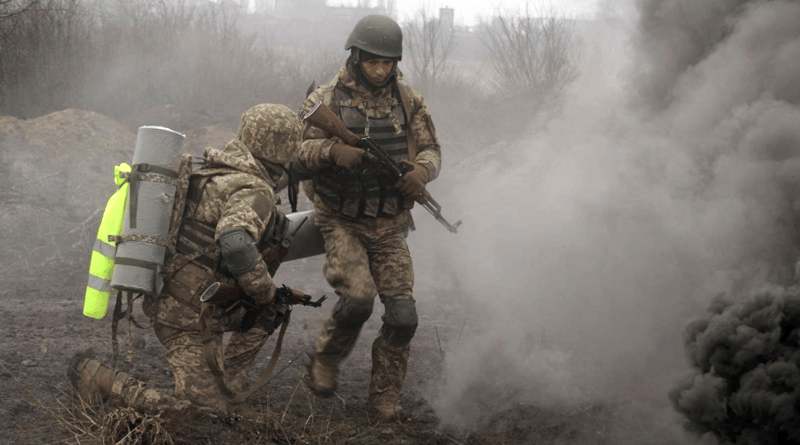
The use of Russian culture of theft and misleading superiors gave the Defense Forces good results. By calculating the behavioral traits of enemy leadership, our troops were able to reclaim small but tactically important territories near Lyman. We explain how this happened in our article.
On September 15, Brigadier General Andriy Biletsky first reported on Operation “Vivaldi.” This is a counteroffensive by Ukrainian troops north of Lyman, Donetsk region, taking place under a regime of information silence. It has been ongoing since the end of May. However, two weeks before Biletsky’s statements, neither Russian osinters nor the higher military leadership of the Russian Federation seemed to be aware of the scale of Ukrainian troops’ actions and the issues faced by two Russian armies in this direction.
Biletsky is currently very cautious in releasing information about Ukrainian control over settlements — referring to a series of settlements on both banks of the Nitrius River.
This can be explained by the fact that the operation is ongoing, and the information silence regime is maintained. Meanwhile, Western osinters, particularly Clément Molin, speak of the presence of Ukrainian troops significantly further east, near the next natural boundary — the Zherebets River.
In bolder reports from osinters and a number of military and political analysts, it is said that the Lyman protrusion — an area of up to 240 sq. km — has been effectively cut off.

If indeed this is the case, it is one of the greatest successes of the Defense Forces in 2026. Yet, until recently, nothing was known about this success not only to the general Ukrainian public but also to the Russian military-political leadership — recall how on September 1, Putin “took Sviatohirsk.”
Even according to official Ukrainian data, the line of contact lies at least 10 km east of this city, and according to reports from Western osinters, up to 25. The Ukrainian troops’ advancement has continued since May.
Since the beginning of summer, Putin and his General Staff had enough time to find out everything and not talk nonsense about Svyatogorsk. But for some reason, they failed. Why? There are reasons, and they are quite amusing.
First reason: impossibility to steal
This story was detailed in his YouTube blog by Russian-speaking military analyst Michael Naki, who is involved in OSINT and organizes numerous assemblies for the Armed Forces of Ukraine. Unfortunately, the video is only in Russian, but we recommend watching it — it contains a lot of sarcasm and mockery of inept Russian OSINTers, including Rybar and Anatoly Radov. We will only give a brief overview of the events described there.
So, at the end of May, the first actions of our forces began in the Liman salient area. In early June, these actions were noticed by French OSINT analyst and war cartographer in Ukraine, Clément Molen, who, among other things, monitors Russian airstrikes. Molen realized that “something was happening” in this area when he noticed traces of Russian KABs near the village of Novoe on satellite maps. The traces indicated that the territory was controlled by Ukrainian troops, because the Russians do not strike with KABs where their occupying forces are located.
Molen checked with the data of his colleagues — Western analysts who verify control over territories using photos and videos and post these data on the social network X. They often work under strange nicknames, this community is also known as OSINTers, geolocation analysts, or simply geolocators.
Molen’s guesses were confirmed, and then something interesting happened: Western geolocators stopped publishing updates about this territory.
This is where one of the reasons why none of the Russian command knew about our offensive lies.
The already mentioned Russian OSINTers Rybar, Anatoly Radov, and several others are so lazy that they mostly do not conduct their own photo and video verification of events on the front, but simply steal this information from Western geolocators on the X network. They publish data and maps under the guise of their own on their Telegram channels and other platforms.
This is confirmed in a comment for Texty.org.ua by one of these OSINTers @moklasen:
“After my publication on May 23 (about Ukrainian actions near the village of Novoe. — Ed.), representatives of the 3rd Army Corps contacted us and asked me and others to stop publishing geolocations from this area. Personally, I decided to heed this request because I know that some enemy resources, such as Rybar, rely heavily on this work to verify certain reports from Russian units.”
It gets even more interesting.
According to Naki, which this story confirms, Russian OSINTers — Radov less so, Rybar more so — are read in the Russian Ministry of Defense. If Rybar and Co. notice the advancement of Ukrainian troops and start raising the alarm, the MO of Russia learns about it. It has happened more than once that after these OSINTers’ publications, reinforcements were sent to “hot” directions for the Russian army.
But this time, sources in X were silent, so Russian OSINTers had no clue that “something was happening.” They raised the alarm only at the beginning of September, when it was already too late.

Second Reason: Ukrainian OPSEC
Ukrainian official sources have not reported anything about the operation from the very start. In other words, OPSEC was applied.
What does this mean? In English, this abbreviation stands for Operations Security. In NATO, it is defined as a process that ensures the proper security of a military operation. The goal of OPSEC is to prevent the enemy from learning about their plans and actions, including from open information, observations, digital and physical traces. It involves information silence, camouflage, deception, and concealment of intent.
Information silence also means that even domestic media are unaware of the operation. They cannot spread sensitive data, thus depriving the enemy of another source.
Since the beginning of the full-scale invasion, this tool has worked several times in Ukrainian hands, creating an effect of surprise. The expulsion of Russians from Kharkiv in 2022 and our Armed Forces’ invasion of Kursk in 2024 are vivid examples. This year’s counter-offensive by Ukrainian forces at the junction of the Donetsk, Dnipropetrovsk, and Zaporizhzhia regions was also accompanied by information silence. Meanwhile, the widely publicized counter-offensive of 2023 is an example of insufficient OPSEC.
The counterargument often arises: what information silence? The Russians see everything from satellites, and their commanders on the ground are not silent either! Here we come to the third reason.
Third Reason: “Silence Culture” in the Russian Armed Forces
“I think the staffs in the Russian army at the battalion and regiment levels still have information that their occupation forces are losing positions in their area. But this information doesn’t go higher; they only report good news. Or like this: information goes up but in limited doses, ‘insignificant infiltration of individual enemy servicemen.’
Even at the division level, or wherever they make decisions about airstrikes, they understand things are going wrong, but they hope for the best: ‘Well, maybe not everything is bad yet, they infiltrated somewhere, we will strike there with KABs, maybe everything will still get better.’ Then problems accumulate, and it becomes too late.”
This is how an officer of one of the Ukrainian Armed Forces’ corps explains the circulation of “embellished” information in the Russian Armed Forces. According to him, commanders on the ground fear punishment from higher command, so they do not want to report bad news. There is such a phenomenon in the Ukrainian army too, but it is on a much smaller scale, mainly practiced by “old school” commanders.
If the army headquarters has no information about territory losses and only receives “embellished” reports, they will be forwarded upwards in an even more embellished form.
Thus, in the case of Operation “Vivaldi,” there was a perfect coincidence of several factors: Western geolocators remained silent, Russian OSINTers remained silent, Ukrainian media remained silent, and lower-level Russian headquarters remained silent. So while the units of the 20th and 25th Russian Armed Forces suffered defeat at the Lyman Salient, their General Staff and Commander-in-Chief Putin were “capturing” Lyman and Sviatohirsk.
As previously mentioned, this is not the first time such a situation has occurred: by maintaining Operations Security, Ukrainian troops manage to mislead the Russians and conduct successful operations. Is the enemy capable of drawing conclusions and beginning to counteract?
“I think not,” says our interlocutor officer. “That’s just the culture in their army. It has been this way for centuries, and it will be difficult for them to change.”
Photo General Staff of the Armed Forces of Ukraine
