
“Spring Wind” – Tavaszi szél – is possibly the most well-known Hungarian folk song. The simple melody about the awakening of nature, love, and sadness can be heard at school celebrations, around the dining table, at official events. Forty years ago, at a packed stadium in Budapest, it was sung by Freddie Mercury, and this recording is considered one of the iconic moments in Hungary’s history.
It would seem that nothing could further strengthen the iconic status of this song. But now it has every chance of becoming a symbol of seismic changes on the Hungarian political scene. Tavaszi szél has been sung across the country for the last two years by participants at each of Peter Magyar’s hundreds of campaign rallies.
Magyar’s supporters often compare their idol to the spring wind that will dispel the stale fog over the swamp that Hungarian politics has become after 16 years of Viktor Orban’s undivided rule and his Fidesz party. Skeptics speak of the blind fanaticism of the “Magyar sect” and call him an upstart and a dandy, “slim fit Jesus”, at best a younger, more refined version of Hungary’s current leader.
Peter Magyar won the elections in Hungary and is set to gain a constitutional majority in parliament. Viktor Orban has already conceded defeat: “The election result is clear and painful.”
Elite Childhood
Peter Magyar – by the way, his surname in Hungarian truly means simply “Hungarian” – was born on March 16, 1981, in Budapest into a family that could confidently be described as the elite of Hungarian society.
Magyar’s grandfather was Eres Pal – a Supreme Court judge in Hungary and a well-known media figure in the country during the 1970s-80s. Pal was a television star – the host of the popular show “Legal Affairs”, which was shown for years on state television. Pal’s analysis of real court cases became part of the pop culture of the time, he was recognized on the streets and was considered one of the most influential lawyers in the country.
Peter Magyar’s godfather was his grandmother’s brother, Ferenc Madl, a law professor at one of Budapest’s universities. He would later join the Fidesz party and, from 2000-2005, serve as the President of Hungary.
Magyar’s parents were also lawyers. So it is not surprising that Peter himself went on to study law at university.
But before that, Magyar graduated from the prestigious Piarist Catholic school in the center of Budapest. It was here, as Magyar would much later recount in an interview with BBC correspondent Nick Thorpe, that he first personally encountered Viktor Orban.
Either in 1996 or 1997, the leader of the “Fidesz” party, which was gaining strength at the time, visited Magyar’s school and spoke to its students. Peter even managed to ask Orbán a question: why was he, a politician who was recently known as a liberal, becoming visibly more conservative? Orbán replied with Churchill’s words, saying it’s normal to have leftist political views in youth and become a conservative in adulthood. Orbán’s answer convinced the young Magyar.
As a student at Pázmány Péter Catholic University, Magyar, along with his then-friend Gergely Gulyás, was so affected by Orbán’s defeat in the 2002 parliamentary elections that they joined his “Fidesz” party in solidarity.
Today, Gergely Gulyás holds the position of head of Viktor Orbán’s administration and is considered one of the most powerful people in the country. He and Magyar haven’t spoken for two years.
However, it was at a party in 2005, hosted by the young lecturer Gulyás, that Péter Magyar met 25-year-old Judit Varga, a graduate of the law faculty at the University of Miskolc who was interning at one of the Budapest firms.
The following year they got married, and in 2009 the couple moved to Brussels when Varga received a position as an assistant to Hungarian MEP János Áder.
In 2012, Áder was elected President of Hungary, but Varga stayed in Brussels and worked in the offices of other Hungarian MEPs. During this time, Magyar was initially on paternity leave, then worked in minor positions within the Hungarian Foreign Ministry and its EU representation.
Péter and Judit
During the dramatic changes in Hungarian politics – Viktor Orbán’s return to power in 2010, his constitutional changes in 2011, and the beginning of the rollback of democracy – Magyar observed from Brussels.
Later, he said he perceived Orbán’s centralization of power and tightening of control positively: after eight years of left-liberal coalition rule and the severe blow to the Hungarian economy dealt by the 2008 crisis, the country, he thought, needed a firm hand. The realization that Orbán was essentially taking the country under his personal control came to him much later.
Péter Magyar and his family – by that time he and Judit Varga had three sons – returned to Budapest in 2018 when Varga was offered the position of Secretary of State for EU Affairs in Viktor Orbán’s administration.
The following year, Magyar’s wife was promoted: she was appointed Minister of Justice, with her responsibilities still including Hungary’s relations with the EU. Some observers speculated that Varga was part of the inner circle of “Fidesz” leadership who could potentially succeed Viktor Orbán.
During this time, Péter Magyar held important posts in various state and state-associated institutions: he headed the EU law directorate in a state bank and was the CEO of the Student Loan Center.
Magyar repeatedly attempted to secure higher positions in government, but unsuccessfully, writes Politico.
“He was always denied because he was too ambitious and independent”,– quotes the publication of political scientist from the University of Copenhagen, Miklos Shukeshda, who studied the Magyar phenomenon. – “His ambitions were suppressed, and this imbalance led to frustration”.
In March 2023, Peter Magyar and Judit Varga announced their divorce. “Our marriage was tense on both sides”, – he would later say in an interview with Guardian.
Significant Interview
Around the same time, in April 2023, Hungarian President Katalin Novak signed a decree pardoning Endre Konya, the former deputy director of a children’s home in the city of Bicske. Konya, along with his director, had been sentenced to imprisonment two years prior: the children’s home director for pedophilia, and Konya for attempting to cover up the crimes and pressuring their victims.
Information about the pardon came to light at the beginning of February 2024 and shocked not only Orbán’s opponents but also many supporters of his party “Fidesz” – a right-wing conservative force that defended traditional values at every turn.
Initially, the authorities tried to suppress the scandal, but after a series of critical media publications and a protest outside the presidential palace, Katalin Novak announced her resignation live on television. Judit Varga also immediately announced her departure from politics: in 2023, she had signed the presidential pardon decree for Konya, so from a formal point of view, she was also involved in this decision.
Less than an hour and a half after Novak’s resignation announcement, a post appeared on Peter Magyar’s Facebook, which at that time was updated rather infrequently, in which he stated his resignation from positions in state companies for “non-professional reasons”.
“I do not want to be part of a system for even a minute where true leaders hide behind women’s skirts… I long believed in the idea of a national, sovereign, civic Hungary…, but today I had to finally realize that all this is merely a beautiful facade serving two purposes: to hide the work of the machine and ensure the accumulation of colossal fortunes”, – the post stated.
The next day, Peter Magyar came to the studio of the independent YouTube channel Partizan.
An almost two-hour interview transformed him from essentially a politician not even in the second, but third tier of the Fidesz party into a national hero, embodying the Hungarian society’s sluggish search for new leaders different from the “old opposition” who were in a deep ideological crisis.
The number of views of this video quickly reached two million – a fantastic result for a ten-million Hungary.
In this interview, no specific allegations were made: Magyar spoke rather about the viciousness and corruption of the Hungarian power system itself.
But his speech was a sensation in a country where systemic sins were usually discussed by familiar opposition figures or, at best, independent media. Madjar, however, did not sound like a revolutionary but a disillusioned insider – someone who knew how the Hungarian power system worked, how politics intertwined with intelligence services and business, and who could no longer live in this flawed system of coordinates.
In short, the interview caused a furor.
“The first two weeks (after this interview) were terrible because I lost everything, I just stopped everything in my life… It was a very negative period. But it only lasted two weeks. Then another story began,” Madjar recalled later.
A kind of “trial run” for Madjar was on March 15 of that year, when Hungary celebrated Freedom Day. Madjar called on his compatriots to rally on one of Budapest’s main avenues.
“Estimates put the number of attendees at 30,000 – more than any opposition party could gather in one place in recent years,” described the event’s scale, unexpected even for Madjar, by independent publication Telex.
At this rally, Madjar announced that he intended to create his own political party, which would welcome “all Hungarians of goodwill who wish to work for the benefit of their country.”
Accusations of Violence
But even before fulfilling his promise, at the end of March 2024, Peter Madjar released a recording made in January 2023, two months before his divorce from Judit Varga, of his kitchen conversation with his wife.
In the conversation, Varga, unaware she was being recorded, tells her husband about how the prosecutor’s office was “cleaning up” some sensitive documents in an important corruption case. At the time, the serving Minister of Justice openly admitted that the Hungarian government had turned into a mafia system from which one could not simply exit.
In a documentary filmed much later, Madjar stated that in 2023 he made this recording as insurance in case he and Varga fell out of favor with the regime, writes Politico.
The recording gave Orbán’s opponents additional arguments for claims about the fundamental perversity of the system of state power he built: it turns out that serious abuses were known at the very top, but nothing was done about it, or nothing could be done.
Immediately after the publication of the recording, Judit Varga stated that her ex-husband had been blackmailing her with the release of their conversation for a year.
“Now he has used (this recording) to achieve his political goals. Such a person deserves no trust… This was done by a man to whom I gave three sons…, to whom I lovingly and hopefully gave countless chances to start anew during the horrific years of violence in the relationship,” she wrote on Facebook.
The pro-government press seized on Varga’s accusations of physical violence against her by her former husband.
The main propaganda mouthpiece for Orban, the newspaper Magyar Nemzet, dedicated an extensive article to Magyar with the headline “Brat.” In it, Varga’s ex-husband was referred to as a “zero without a stick,” who achieved everything in life thanks to his wife, who eventually left him.
Three days after the scandal began, Peter Magyar responded to Varga’s accusations. In a Facebook post, he did not deny that their relationship of eighteen years had seen all sorts of things, but he wrote, “I never raised a hand against the mother of my children, while she hit me many times, with fists and feet, sometimes in front of witnesses, sometimes behind closed doors.” Separately, Magyar declared a discredit campaign launched by the authorities against him.
In any case, this whole situation gave the authorities a chance to turn the informational hype around Magyar into tabloid news.
In response to a question about his attitude towards Magyar, Viktor Orban retorted: “I am engaged in running the state, not soap operas.”
Overall, it seemed in the spring of 2024 that the Hungarian authorities had made a strategic decision to simply ignore this upstart, assuming that his popularity would fade as quickly and unexpectedly as he had found himself in the spotlight.
“One of the people long close to the Fidesz party characterized Magyar’s time in the public eye as ‘a three-day affair,’” wrote Guardian at the time.
Origins of “Tisza”
Meanwhile, Peter Magyar, as promised, started his own party.
Observers in Budapest recalled that he initially thought about creating a political force from scratch. But the timing was against such a scenario: European Parliament elections were to take place in early June 2024. Magyar, who was rapidly gaining popularity, intended to participate, but he didn’t have enough time to establish a fully-fledged party.
Therefore, in early April 2024, Peter Magyar announced that he and his supporters would run for parliament from the party “Respect and Freedom” (Hungarian abbreviation – TISZA, coinciding with the name of the Tisza River) – a marginal political force registered four years earlier, which Hungarian media called a “party of two people.” It was founded by elderly friends from the resort town of Eger, and all activities of “Tisza” before Magyar’s entry were limited to its leaders traveling around the country in a van painted with Hungarian flags and posting amateur videos of their travels on YouTube.
Magyar told journalists that he had been negotiating with several parties, and an important factor that played in favor of “Tisza” was its name, which he said had a “positive and joyful connotation in Hungarian culture and history.”
Indeed, for Hungarians, the Tisza is not just a river; it is a system-forming water artery of their country, an element of national identity like the Dnipro for Ukrainians or the Vistula for Poles. In light of the fact that after 1920, part of the once Hungarian lands through which the Tisza flows found themselves outside the borders of the modern state, this river became somewhat of a symbol of memory and nostalgia for a lost past.
In any case, a few days after joining the leadership of “Tisza,” Magyar announced the start of team selection and the beginning of a significant pre-election tour across the country.
The First Elections
When Budapest observers talk about the main factor of Magyar’s success, they, of course, mention the common fatigue of Hungarian society from the long years of Viktor Orbán’s rule. But even a few years ago, Orbán was, by European standards, a veteran of state governance, yet at that time, the opposition could not challenge him.
Hungarian experts say Magyar is distinguished by diligence and perseverance. The main “feature” of his election campaign, both for the current parliamentary elections and the European Parliament elections in 2024, is a prolonged tour of cities and villages, during which Magyar could hold four to five, or even six meetings with voters a day.
For Magyar, it was not just about demonstrating closeness to ordinary people. The fact is that Viktor Orbán was considered the master of the souls of the absolute majority of residents in the Hungarian provinces in a political sense. Thus, Magyar and his associates were initially not even sure if people in small towns and villages would come to meet someone who openly calls himself an opponent of the current prime minister.
“And so we go to Gyula (a town with a population of about 30,000 people. – Ed.). This was supposed to be the first performance of our tour, and then a friend calls me: you won’t believe it, about a thousand people have gathered near the castle. It felt good, I tell you,” Magyar later told BBC journalist Nick Thorpe.
Indispensable attributes of these rallies were Magyar’s speech, answers to spontaneous audience questions, obligatory photos with those wishing – “I think I am the person photographed in the most selfies in Hungarian history,” the politician said in the same interview.
And the inevitable “Spring Wind,” which he performed together with hundreds of supporters at each rally.
The campaign of a completely marginal party, which just two months ago was run almost single-handedly by a politician unknown several months prior, ended in incredible success. In the June elections, “Tisza” received almost 30% of the vote and brought seven of its representatives to the European Parliament, headed by Péter Magyar himself.
Even then, it became clear that the “next stop” for “Tisza” was the 2026 parliamentary elections, and the goal Magyar aimed to achieve was the post of Prime Minister of Hungary.
New Campaign
The new pre-election tour of the “Tisza” leader began last year. He held several meetings a day, sometimes in such remote areas where not only European Parliament members but even local council deputies did not always reach.
Once again, Magyar’s trump card became his well-structured speeches – with maximum attention given to economic, social, and infrastructural issues, areas in which Viktor Orban cannot boast of any significant achievements. Special attention is given to combating corruption, especially as recent journalistic investigations provide Magyar with a broad field to challenge the current prime minister. Broad strokes are used regarding foreign policy, a topic on which Viktor Orban has built his campaign.
The views of “Tisa” on the future structure of the country are gathered in a substantial volume – a 240-page pre-election program titled “Foundations of a Functional and Humane Hungary.” Supporters of Magyar call it a comprehensive strategy that answers practically any question regarding the future government’s policies, while opponents joke that such a voluminous and wordy document could only have come “from the pen” of artificial intelligence.
Somewhat paradoxically, the greatest chances of defeating Orban – a conservative, nationalist, and ideological ally of Donald Trump – have come not from an ideological opponent of the current Hungarian leader, but from someone emerging from his own party, an advocate of entirely right-wing political views. Magyar stands for a strict migration policy and, for example, expresses very cautiously on the rights of the LGBT community, in short, he ideologically positions himself as a carrier of the values of the true “Fidesz” he joined back in 2002, and not what Viktor Orban has turned the party into.
For the current elections, Magyar presented a team largely composed of individuals from big business – these people are to form the basis of Hungary’s future technocratic government.
In the context of total dominance by propaganda media in the field of “traditional” media, Magyar and his supporters have engaged the authorities in a battle on social networks – and, according to our Budapest interlocutors, they have won this battle against Orban’s team.
But, of course, the most important factor in Magyar’s success is the hope for change shared by hundreds of thousands of his compatriots. Hence the rallying around him by supporters of the most diverse ideologies and convictions, who sometimes only agree that for Hungary’s further development it is crucial to replace its leader, and then figure things out. Hence the unprecedented network in the country’s political history called “Tisa islands” – local volunteer centers that support Magyar’s campaign in the regions.
Of course, a separate question is how realistic it is to implement the fundamental changes promised by Magyar in all areas of the country’s life, even if he does indeed come to power. In 16 years of rule, Viktor Orban has literally cemented Hungary’s political system, and to begin dismantling it, a constitutional majority of two-thirds of parliament members is critically necessary.
Incidentally, it also remains an open question whether Kyiv’s hopes will be fulfilled that after Peter Magyar comes to power, Ukrainian-Hungarian relations will emerge from the current deep crisis.
On one hand, experts from Budapest we interviewed say that in the field of foreign policy, Prime Minister Magar will focus on repairing the badly damaged relations between Budapest and Brussels and returning Hungary to the European political mainstream, which currently involves maximum support for Ukraine. It is also considered very important that in the summer of 2024, Magar visited Ukraine shortly after the Russian attack on “Ohmatdyt” and even met with its director, visited Bucha, and paid tribute at the memorial to the fallen defenders of Ukraine.
On the other hand, Hungarian society is currently extremely influenced by anti-Ukrainian propaganda, which Viktor Orban has placed at the forefront of his campaign, and Péter Magar will inevitably have to take this into account.
“When asked whether Hungary under Magar’s leadership will lift its veto on the EU loan (for Ukraine) of 90 billion euros, a source familiar with ‘Tisza’s’ position replied that ultimately it will depend on public opinion,” wrote Politico days ago.
“We are not marrying him”
Finally, another trait of Péter Magar, noted by observers from Budapest and abroad, is his “teflon-like nature.”
No accusation among those massively produced by the authorities, nor any potentially scandalous situation into which he is placed or enters willingly, affects his ratings or harms him politically.
“The authorities call him a traitor to his family, his party, his homeland, but he doesn’t care,” said one of our interlocutors.
The authorities even tried to initiate a criminal case against him. In June 2024, shortly after the triumphant European Parliament elections, in one of Budapest’s nightclubs, Magar—likely being intoxicated—took a phone from someone trying to film him dancing and threw it into the Danube.
The Hungarian Prosecutor General then began proceedings to bring Magar to justice, with the politician stating that law enforcement should investigate corruption cases involving government officials as diligently. Eventually, the European Parliament refused to lift Magar’s parliamentary immunity, and the potential case against him ended in nothing.
Obviously, even after this, attempts by the authorities to “get” Magar did not cease. In February this year, he warned his supporters that the authorities were preparing a “Russian-style defamatory operation” against him—the publication of an “intimate moment” of Magar with his ex-girlfriend.
“Yes, I am a 45-year-old man, I have a sexual life,” he wrote on social media X at that time.
However, the publication of the “announced” video by Magar did not happen.
Moreover, criticisms of Magar also come from outside Orban’s camp.
A former colleague of Magar calls him stubborn.
The mayor of Hódmezővásárhely, Péter Márki-Zay, who unsuccessfully led the united opposition in the 2022 parliamentary elections, describes him as arrogant and selfish.
Entrepreneur Dezső Farkas, a former associate of Magyár who started the party-building of “Tisa” with him and later stepped away from the business, complained to Politico that the startup culture his team began with is turning into a toxic atmosphere increasingly resembling “Fidesz,” from which Magyár originally came.
In fact, observers already note that Magyár is extremely selective in his communication with the media and has forbidden all members of his team from giving interviews – only a few are allowed to give brief comments to journalists.
On the other hand, “we’re not marrying him,” Péter Márki-Zay tells Politico. “We just need someone who will leave Orbán in the past,” he concludes.
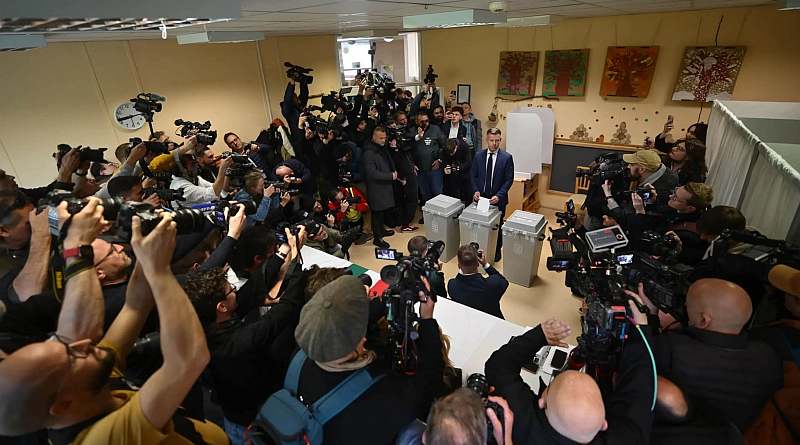
In the cover: Péter Magyár during voting at the polling station on April 12, 2026. Photo: X/Péter Magyár
