
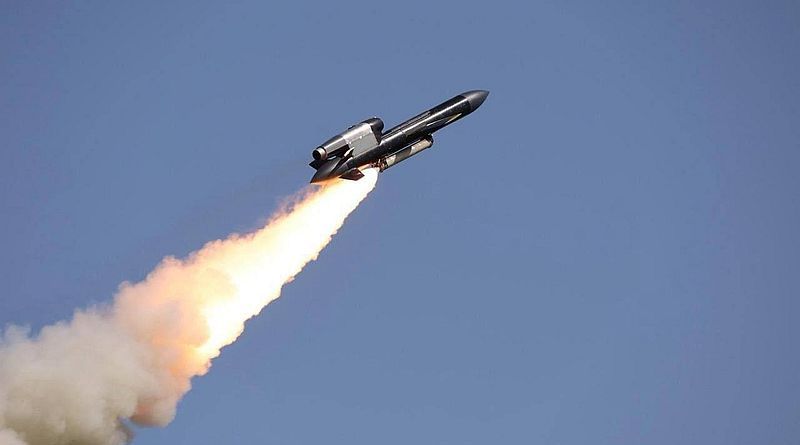
Flamingo missile over Chapayevsk — 35 kilometers south of Samara and over 700 kilometers from our border.
Explosions, shattered windows, massive plumes of smoke over Promsintez, their largest military chemical manufacturer — it hit very well. We launched from the tables — as usual, working in pairs to better penetrate the layered air defense. But what layered air defense does Russia have now — bypassing the LBE, at low altitude, then holes and half the division stretched over hundreds of kilometers.
The “Flamingo” does exactly what heavy subsonic machines are supposed to do — it arrives in a circle near industrial targets, which are easy to soften and disable. The area of total destruction for this ton-heavy warhead, equal in destructive potential to two half-ton FABs, is about 30 meters. The area of severe destruction, when the excess pressure breaks through solid brickwork, collapses ceilings, and shatters hangars to pieces, is about 100 meters. And that’s all that’s needed. In the galvanic stamping shop of “Iskanders,” a fire breaks out after such a strike from titanium powder, industrial oils, and specific chemicals.
In Kotluban at the GRAU arsenal, after a similar visit, rockets were set off and began scattering. At the FSB border post near Armyansk, the headquarters was damaged, cutting off the section where the communication antennas stood, and boats were covered with debris. This is enough to paralyze the object.
Yes, this is a heavy missile, radio-contrast, and theoretically, it should be shot down. But let’s be honest: sports planes carrying half a ton of cast iron on autopilot, and then crashing into the target themselves, should also be shot down. And the old Soviet “Swifts” — huge machines that ideally light up on radars, should be shot down, not allowed near the nuclear triad airfields in Saratov. Yet they manage to reach.
You see how it turns out: we’ve been systematically dismantling the Leningrad region for a week, hitting three ports with gas and oil transshipment, and they still can’t extinguishthe fires, and now suddenly it hit a thousand kilometers to the south, on the Volga.
A large theater of operations is always inconvenient. Transferring scarce air defense systems between Petersburg, Moscow, and Belgorod is difficult. It’s hard to distinguish a bunch of false targets like MALD, which can create interference, from a real “Flamingo.” Fighting is generally hard. Especially when they knock out 17 air defense systems and a dozen eyes, from observation to radar and division management, in just a week.
The Defense Forces accurately struck the city’s industrial hub, where behind one tall fence are located two defense giants — JSC “Promsynthesis” and JSC “Polymer.” Governor Fedorishchev, of course, immediately activated the radioactive copium mode and cheerfully reported that the attack was “unsuccessful” and there were no damages. However, the locals already filmed the hits, and since early morning, the police completely blocked the exit from Lenin Street directly to the factory sites. You wouldn’t cordon off the entire industrial sector if fragments just peacefully landed in a field.
To understand why Chapayevsk is an absolute jackpot, you need to look at their macroeconomics, invested budgets, and logistics. Promsynthesis is one of the main and oldest producers of industrial explosives in Russia and the CIS. This giant produces TNT, tetryl, ammonites, and nitrobenzene. The neighboring Polymer takes this base and manufactures ammunition. So this is the very basic combat chemistry used to load their favorite FABs and rockets. In Russia, there may be hundreds of thousands of empty cast-iron blanks. But without explosives from Chapayevsk, it’s just heavy scrap metal.
Our strategy of bottlenecks and financial strikes works. There a $200 million icebreaker, there a fat plant, there combat chemistry, and there one of the main oil terminals has been burning for three days. It’s expensive and difficult to replace.
And here begins the most interesting — the math of losses. Just in the last few years, 4.7 billion rubles have been invested (as declared) in the modernization and development of the “Chapayevsk” advanced development territory to expand capacities and logistics around this chemical cluster. Promsynthesis itself generates about 2.5 billion in annual revenue. This is an extremely costly, highly specialized production.
They have complex nitration reactors there, imported cooling and automation systems. Potential damage from the impact of a ton of warhead is not just destroyed walls that can be patched with foam blocks in a month. It’s the destruction of unique equipment, replacement of which under severe sanctions will cost billions of rubles and require months, or even years, of finding gray procurement schemes through third countries. And they were guaranteed to be hit by a ton of head.
And the most beautiful part here is our systematic approach. Promsynthesis was hit exactly a week ago, on March 22. Then drones pierced the roof and caused a fire. And it didn’t hit just anywhere but directly in the shop area No. 3. This is the very core of the factory, where back in summer 2023, during repairs, a nitrogen supply line exploded, tearing six workers to pieces. This is the key synthesis line where death itself is brewed. Then, a week ago, we tested their air defense, halted the technological process, and checked the coordinates. And now we have reliably reinforced the result with a heavy missile.
To hit a chemical plant with heavy weaponry a thousand kilometers from the border and systematically burn out invaluable TNT production lines is the essence of logistics warfare. While they are fervently celebrating advances over a few fields, we are physically destroying their gunpowder, without which these advances will cease.
Again, the heavy missile warfare over a territory larger than the EU continues, and we are also suffering significant losses. But we are increasingly reaching the enemy. Each time, their important strategic enterprises become the targets. Apparently, they cannot reach ours. The evidence is clear: the increasingly frequent episodes of “Neptuns” and “Flamingos” reaching their targets, and the 250 drones attacking Russia every night. Even an icebreaker has taken a rest on the slipways in the Baltic.
Pictured: Missile “Flamingo.” Photo: Fire Point
