
Previously, we targeted the Russian rear with relatively simple kamikaze drones — from “Strizhi” to modified light planes of small aviation. In the early stages of the war, this was sufficient: the Russian air defense system proved unprepared for massive raids. But the enemy learns quickly. The occupiers began to densely deploy small-caliber anti-aircraft artillery, set up mobile calculations on flight paths, and massively jam radio frequencies or deceive inertial systems with powerful electronic warfare. Classic UAVs lost effectiveness. A qualitatively new tool was needed, the next step in the evolution of medium-range — mid-strike. Blinding the enemy, destroying radars, hitting medium and long-range SAMs, targeting pilots.
And this step was taken. Meet — Anubis.
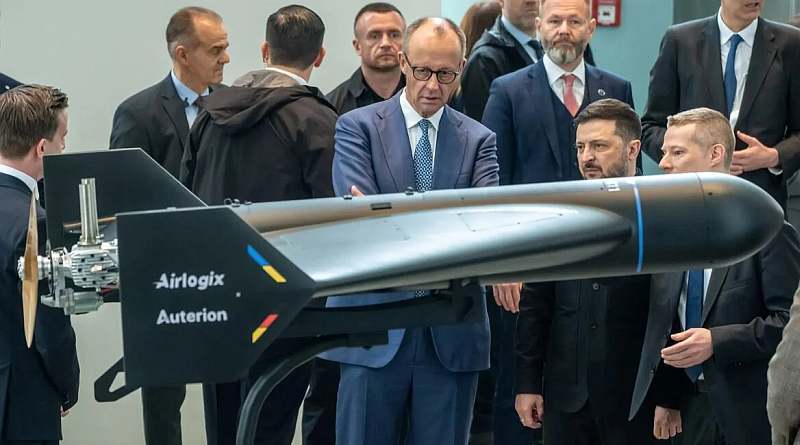
Anubis is a joint development that is currently turning the most expensive Russian anti-aircraft missile systems and command posts into charred scrap.
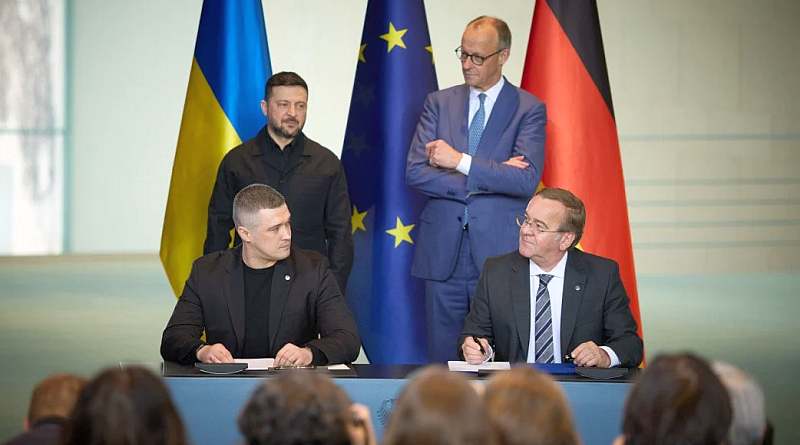
Germany allocated 281 million euros for the joint production of the unmanned system Anubis (as well as their counterparts Seth-X-G) — German officials spoke of “thousands of machines” without specifics.
If we divide the budget by the volume, we get the cost of one unit ranging between 50–100 thousand euros (depending on the configuration and the share of senior machines with a range of up to 1600 km).
What’s under the hood?
Anubis is not just another “flying moped,” assembled from garage components, but a fully-fledged light cruise missile for the budget-conscious, equipped with intelligence from very expensive Western systems.
The development was made possible by the collaboration of the Ukrainian company Airlogix and the Western giant in drone software development, Auterion. The main advantage of this machine is its complete autonomy in the final segment of the flight.
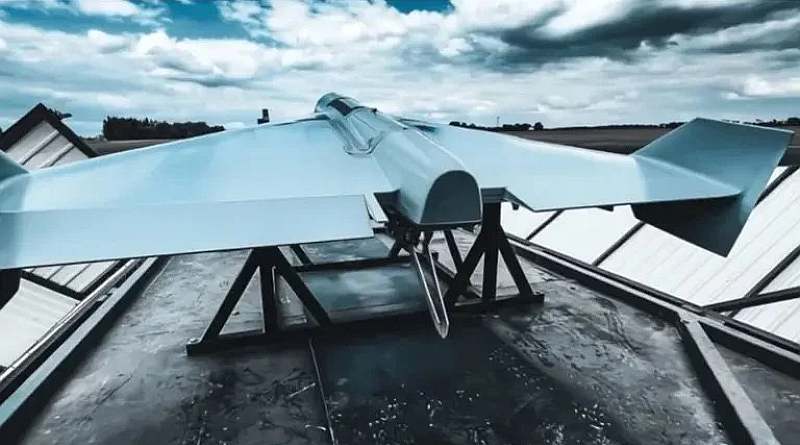
When the drone enters the zone of Russian stations “Pole-21” or other powerful jammers, it simply stops listening to the outside world. It does not care about the absence of GPS or GLONASS signals. On the terminal section, the inertial navigation system is activated, backed up by machine vision using neural networks. The processor of Anubis is programmed with the optical signatures of potential targets: artificial intelligence recognizes the distinctive silhouette of a radar illumination target from the S-400, the outlines of a launcher, or the complex geometry of a rectification column at an oil refinery.
The UAV autonomously finds the target through an electro-optical station, locks onto it, and reliably dives, even amidst total electronic jamming.
The aircraft’s airframe, designed with a kinked or delta-wing configuration, is created under the principle of “poor man’s stealth.” Specific composite materials and optimized aerodynamic shape make its radar signature minimal.
To older generation Russian radars, it looks like a regular bird, and when modern radars do detect it, there’s not much time left to intercept.
The combat unit of the vehicle deserves special attention. It carries a warhead of up to 45–50 kilograms, with a strategic flight range of up to 1600 kilometers for older versions. Such a warhead can not only damage an antenna with fragments but also break through the dome of a command post or turn an aircraft’s arched shelter into a scorched frying pan. This offers tactical flexibility: we can strike the operational rear and overload the channel capacity over a strategically important factory.
Hunting UAV Operators
Reducing the tasks of Anubis solely to destroying air defense systems underestimates it significantly. Recently, we see this weapon being used with pinpoint precision against specific targets in urban settings and field shelters.
Recently, the Drone Systems Forces published striking footage from the Zaporizhzhia direction: an Anubis strike landed precisely at the location of Russian reconnaissance drone operators. The Russians have learned to hide crews in basements or on the first floors of reinforced concrete buildings, placing antennas on rooftops. Regular artillery often just demolishes upper floors and scatters antennas with cluster munitions, leaving the crew alive. Thanks to machine vision, Anubis can literally fly into the required window or doorway. A thermobaric or high-explosive blast in a confined space leaves no chance for control equipment or the crew itself. This is excellent work that instantly blinds the enemy across the entire front line.
How Air Defense Umbrella is Broken
The effectiveness of Anubis is revealed in swarm tactics, working within a strict echeloned structure. The first stage is to uncover the umbrella. Cheap decoy drones like the MALD are launched to “draw” missile paths. Their sole task is to simulate a massive raid, forcing Russian “Pantsirs,” “Tors,” and “Buks” to activate radars and expend their ammunition.
Once the enemy air defense is illuminated on electronic reconnaissance screens and fires its initial missile salvos, Anubis quietly steps in. They pass at ultra-low altitudes, using terrain folds, and strike directly at radars and launchers that have lowered their guard. This is classic suppression of enemy air defenses. When the eyes and teeth of the air defense are finally burned out, the main mass of our long-range UAVs calmly flies through the breach, heading to burn oil bases, distilleries, special fat production and defense industry workshops deep within Russian territory, hundreds of kilometers away.
Production Rear, Unreachable by Any “Iskander”
But the coolest aspects of this story are the logistics and localization. The enemy strikes Ukrainian industrial zones with ballistic missiles every night, trying to halt weapon production. With the Anubis project, this tactic will not work at all.
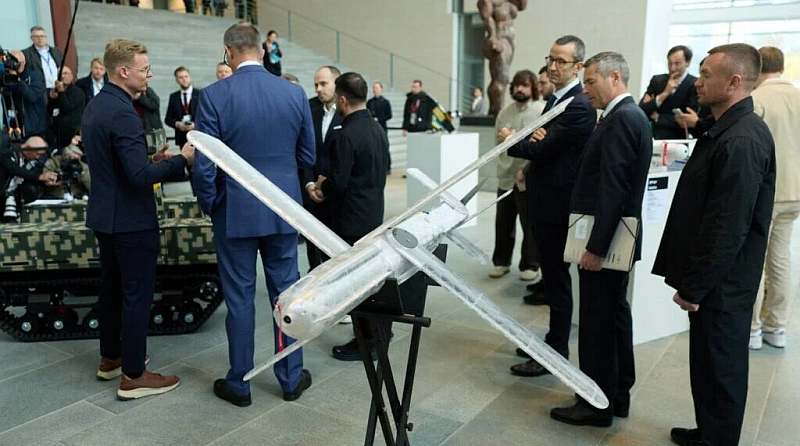
The reason is that the mass production of these machines has been completely moved to Germany. In February 2026, a joint venture Auterion Airlogix Joint Venture GmbH was established. Recognizing the potential of this weapon, Berlin has already financed and contracted the production of thousands of these drones for the Defense Forces.
The assembly line capable of producing thousands of units per year is under the secure protection of NATO and German export legislation. Russian “Iskanders” and “Kinzhal” missiles simply cannot reach there, and even if they could, an attack on German territory would guarantee the Union’s entry into the war. We have received an uninterrupted supply channel of high-tech weapons, 100% protected.
Arithmetic of Attrition
The most gratifying aspect of this technological war is the economic component. A single anti-aircraft missile from the S-400 system costs over a million dollars. A missile from a “Pantsir” costs tens of thousands. The production cost of one Anubis is approximately the same as a missile for the “Pantsir,” but the damage it causes is strategic — Moscow’s economy has been declining for a year, while the EU is flourishing, and defense spending is only increasing.
When the Russians are forced to spend million-dollar missiles on interception (and often unsuccessfully, as shooting down a composite autonomous drone is extremely difficult), they are literally bankrupting themselves. We are driving their air defense system into a deep financial and logistical deficit, depleting supplies that the Russian military-industrial complex cannot physically replenish due to strict sanctions on critical microelectronics, strikes on explosives and solid fuel, and targeting of electronics factories.
Anubis is quite a useful tool for breaking the Russian access denial system (A2/AD). While Moscow is creating beautiful charts for the leadership about an impenetrable shield over Russia, these drones are methodically cutting through their air defense systems in the operational rear and clearing drone operators in gray zones. This is why we are currently seeing such spectacular fires at refineries and defense enterprises at distances of over 1000 kilometers. And they will only increase with the scaling of midstrike in the EU.
