
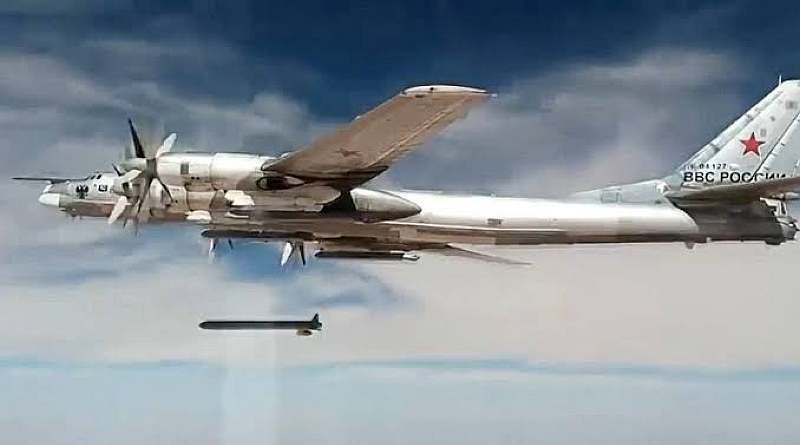

The topic of the effectiveness of cruise missiles has started being discussed on Facebook, but unfortunately, there is little constructiveness there, as discussions often hit upon “where are the three thousand Flamingos,” “why haven’t they destroyed the entire Russian military-industrial complex by yesterday,” “hahaha, our Flamingos shot down, I told you it was trash” and other very expert statements that are mostly fueled by propagandists. Well, there’s this type of propaganda “giving the enemy,” where a leader forms the algorithm “we are for everything good, while those guys are bastards, get them, get them,” and this paradigm forms their popularity. In principle, it’s an understandable construct, effective but not constructive.
Let’s try to figure out what’s what.
As we understand, cruise missiles are missiles that move close to the ground, at altitudes of tens of meters, using the terrain as cover.
Well-known Russian cruise missiles are the X-32 and X-101. Both are armaments of Russian strategic bombers. There are also other products, both modern and Soviet.
Recently, Russia has halted the launch of cruise missiles because they were proving extremely ineffective, with more than 90% being shot down, according to statistics.
In Ukraine, things aren’t exactly good with the “Flamingo” launches either. They don’t often reach, we must admit. However, when they do, the special effects are impressive, we must admit.
So why is that?
The answer is aviation.
Both Ukraine and Russia have powerful, experienced, and coordinated aviation. Honestly, it’s strange to read such a phrase now because a few years ago, comparing Ukrainian aviation in the context of Russian would have been laughable. But time goes on, and Ukrainian aviation successfully operates during massive drone and missile attacks and even sometimes successfully hunts Russian planes.
Russia, despite not comparing favorably with Western planes, also has experienced and trained aviation. And it’s working.
Air defense forces, capable of destroying over-the-horizon targets, also effectively counteract cruise missiles. These exist for us, and for the Russians. I won’t lay out a comparative table, Google is your friend.
But air defense is much less effective against missiles covered by terrain than aviation. Which is understandable, because the concept of cruise missiles is to specifically counteract missile defense.
So, are cruise missiles done for? Not working? A remnant of old wars?
No.
Additionally, we have to admit, we’ve oversimplified the effectiveness of a system that has no analog in the world. I’ve seen our pilot being awarded for his 400th combat flight. Do you understand what that is? TOP GUN steps aside. Compared to Europe, where they long sought experienced pilots to teach ours to fly F-16s, there is a global difference. Essentially, there are three aviation forces with such experience: Russian, Israeli, and Ukrainian.
But we are heading into winter, times when the weather will often be non-flying. When aviation will be limited purely by weather conditions. Clouds at 100-200 meters seem to hint at this.
So winter will be a window of opportunity for our cruise missiles. Still, to counter drones and missiles in Russia, several hundred boards are raised into the sky, including various planes and helicopters. This is a powerful force to get through.
But there’s also a nuance. This paradigm plays both ways. That is, our aviation also won’t be able to rise in the air. And Russian cruise missiles will also be more effective and will carry their deadly force this winter, and we need to prepare for this.
Cover image: Russian strategic bomber Tu-95MS at the moment of launching an air-launched cruise missile (likely X-101). Photo: Occupiers’ Ministry of Defense
