
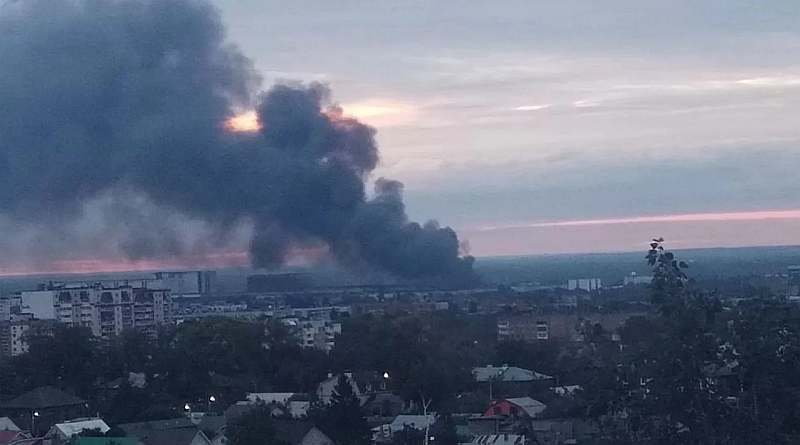
On August 15, our Flamingo cruise missiles reached Samara, almost a thousand kilometers from the border. And they hit directly at their strategic underbelly.
The target area is a massive industrial zone where two key enterprises are located side by side: RCC “Progress” (manufacturers of Soyuz launch vehicles) and “Aviacor” (repair of strategic Tu-95MS bombers). A good choice — even if electronic warfare works or there is an interception, something important can still be hit.
The Russians spoke of some wild 20 Flamingo missiles, but that’s nonsense — five were launched, three of which they managed to shoot down with AWACS and aviation intercepts. Two reached the target — one direct hit in a workshop, the other between them, with the shock wave infiltrating.
We simply do not have the capability to launch 20 in one volley — due to the lack of launch pads and the particularities of route construction. The task is not to overload the channel — it’s impossible to do with 20-30 missiles, considering the number of aviation flights, object air defenses, and drones they have.
Our task — diving through the terrain folds, following riverbeds, entering areas where radar is not visible or under maintenance, where missiles appear over the radio horizon and then disappear, on days with weather windows or deployed decoys, is to deliver a dagger-like strike through a breach, not fire tens of millions under anti-missiles and interceptor drones.
RCC “Progress” is a plant for the production of the “eyes” and “nervous system” for the Russian military-industrial complex. They assemble both spy satellites and Soyuz-2 rockets that put all this into orbit. It is the only serial “bus” — their heavy “Angara” still flies only on special occasions in a test mode and costs as much as a “Falcon Heavy,” nearly a hundred million dollars, but delivers a useful load three times less.

By 2026, the Russian satellite constellation numbers about 300 units. Among them, military and dual-purpose ones are the absolute minority (the majority are GLONASS and old communication units). The orbital group is aging. Satellites are breaking down, and their orbits are degrading. For CABs to fly accurately, Roscosmos needs to consistently launch 1-2 new units of the “GLONASS-K” or “GLONASS-K2” series per year. The price of a unit: about $60–80 million each + $40–50 million for the launch of “Soyuz-2”.
They have critically few truly capable and high-tech spies, which is why Moscow aims to replace those going out of service and expand the constellation. And they are not living solely off “Rassvet,” which is their equivalent of “Starlink” and has been hyped in the media, although, of course, it is currently their priority number one.
Project “Rassvet” from “Bureau 1440” (the Russian Starlink). After their gray Musk terminals began to be cut off, they rapidly accelerated the creation of their low-orbit broadband internet constellation for the front and drone control.
They have already conducted several launches on “Soyuz-2.1b” (in March and July 2026, they launched packs of 16 “Rassvet-3” units). The satellites maintain inter-satellite laser communication and operate on 5G protocols.
The plan is to deploy about 300 units by 2027–2030. Russia has officially invested 102 billion rubles in it (under the national project “Data Economy”), plus around 330 billion in declared private investments. This is colossal money — approximately $4.5 billion.

But there’s also “Kupol”. It’s their missile attack warning system (MAWS). “Tundra” type satellites, which are supposed to detect ballistic missile launches and calculate the impact area, not just record launch flames. Not updating them is a risk of missing the first disarming strike of strategic nuclear forces. This is paranoia of the highest level; all the money will go wherever needed to restore the conveyor. The price: these are devices costing $150-200 million each plus launch.
“Bars-M” (Product 14F148) – a topographical cartographer. Produced by RKK “Progress”. Currently, there are about 4-5 devices in orbit (the latest were launched at the end of 2023 – early 2024). They scan the surface of the earth with high resolution so that a cruise missile can fly bypassing the terrain—thus creating an analogue of the western “TERCOM”.
Project “Razdan” (Product 14F156) – their main hope and main headache. It was supposed to be a state-of-the-art next-generation optical satellite (to replace the old “Persona” satellites), which sees through clouds in high resolution. But the project is bogged down in sanctions. Assembly of telescopes and unique optics requires clean rooms (like the 106th shop that got hit) and western electronics, which they smuggle. Deadlines have shifted years to the right.

System “Liana” – global radio-electronic and radar reconnaissance. They scan the emissions from our radars, air defense, and communications. Platforms for them are partially made by “Progress”, and the payload by the “Arsenal” plant. It consists of the following components:
“Lotos-S1” (Product 14F145) — passive radio intelligence system (ELINT). Captures radio signals. The grouping is deployed (about 7-8 active devices).
«Pion-NKS» (Product 14F139) is an active radar. It is a heavy 6.5-ton monster. It illuminates the land and sea with its radar, providing coordinates even at night and through dense cloud cover (including for the Onyx and Zircon missiles). The first “Pion” was crafted over nearly ten years and launched with significant difficulty in 2021 (“Kosmos-2550”). Each such device is an exceptionally complex, bespoke item.

Dual-purpose devices «Resurs-P» and «Obzor-R». Formally, they are civilian land remote sensing devices of “Roscosmos.” In fact, they capture military objects for the Ministry of Defense’s interests. They are produced at the same place, “Progress.”
Plus, the «Soyuz-2» itself is a single-use rocket: each launch requires assembling a new device from scratch, as they have no reusable stages. If you want to launch a satellite, you have to build a new tube. The assembly of the stages (the first stage side blocks and the second stage central block) is not just about welding two tanks. In the affected production complex, high-class clean zones operate. It is there that the microelectronic components are assembled: onboard electronics, control systems, gyroscopes, and printed circuit boards — the entire nervous system of the rocket connects with the engines.
The high-class clean assembly zone requires strict control of pressure, microclimate, and absolute dust filtration. An explosion, shock wave, dust, debris, soot from a fire, and water from extinguishing instantly destroy this ecosystem. Plus, the toxicity of the fire — even if the engines were not fueled, the plastics damage the HEPA filters and climate systems irreparably, essentially cementing them.

Our strike assets, costing a nominal few million dollars, breached the necessary roof. The direct and indirect damage to the Russian military-industrial complex from the paralysis of this single workshop breaks the billion-dollar mark in the first year of downtime alone. To bring this conveyor back to life, they will have to cut this money from tank and artillery production and salaries. If a ready satellite worth $200 million waits for its rocket for two years, its batteries degrade, seals dry out, optics and microchips age. It needs to be opened, reassembled, and tested again. This adds tens of millions of dollars and lost time on top.
If Russia disrupts the launch schedule to the ISS (as crews need to be changed, and the station needs to be resupplied and its orbit boosted), they violate international commitments. This risks the complete isolation of “Roscosmos.” If they can’t launch cosmonauts, they will either have to ask the Chinese for help or pay Elon Musk for seats on Crew Dragon. For imperial pride, this is a humiliation comparable to the loss of the flagship of the Black Sea Fleet.
So it turned out well — at the only plant that carries military payloads into orbit, the SOU took out the key assembly workshop.
On the cover: Consequences of the strike on Samara, August 15. Photo: video screenshot
