
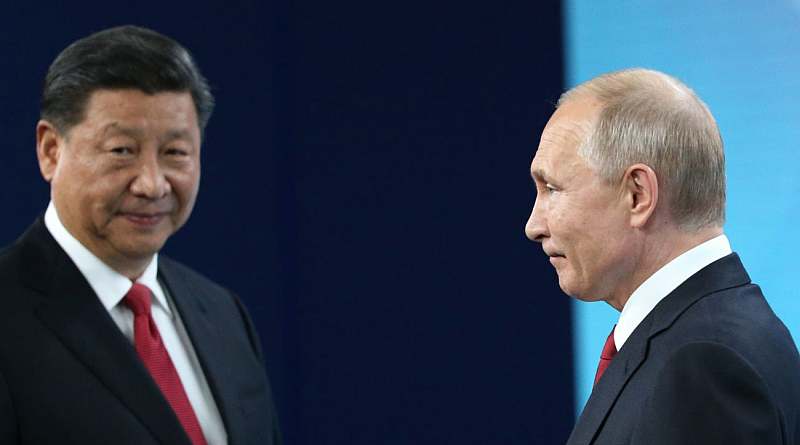

Vladimir Putin’s trip to Beijing served as clear confirmation of the new geopolitical reality in which Russia, partly due to the invasion of Ukraine, has cemented its status as a junior partner and resource appendage of China. Behind a parade of flowery statements about a “multipolar world” and “boundless friendship” hides the progressive desovereignization of Moscow.
The main economic and symbolic outcome of these negotiations looks like another and extremely painful failure for the Kremlin: Xi Jinping again refused to consent to the implementation of the strategic gas pipeline “Power of Siberia-2.”
On the eve of the trip, Putin publicly expressed hope that “practically all key issues” on energy cooperation were agreed! An unprecedentedly large delegation arrived in Beijing, including five deputy prime ministers, key ministers, and heads of major state corporations, including Alexey Miller (Gazprom) and Igor Sechin (Rosneft). However, in the final list of 40 signed documents, there was not a single agreement concerning “Power of Siberia-2.”
The Chinese leader did not even mention the vital project for Russia in his public speeches.
The market reaction was immediate. Right after the negotiations ended, Gazprom’s shares on the Moscow Exchange plummeted by 3.5%, losing over 100 billion rubles in capitalization in one day. Following this, shares of the Pipe Metallurgical Company (TMK) tumbled, losing 6% due to the absence of long-awaited orders for large-diameter pipes. The failure of the negotiations pulled down the entire Russian stock market, highlighting the critical vulnerability of the Russian economy to Beijing’s whims.
For China, Putin’s visit was merely a piece of a large diplomatic game. Significantly, a few days before Putin, Xi Jinping welcomed US President Donald Trump to Beijing, calling that meeting “historic” and “epochal.” By squeezing the Russian dictator into the schedule between visits from the White House leader and Iran’s foreign minister, Beijing clearly demonstrated who is the true center of global diplomacy.
Moscow’s dependence on the Chinese carries a deep desovereignization character. In the framework of extending the Treaty of Good-Neighborliness, Russia was forced to once again unconditionally acknowledge Chinese claims to Taiwan and commit not to enter alliances that could harm China’s security. China, on the other hand, retains complete freedom of maneuver, strictly rationing its support for Moscow to avoid secondary Western sanctions.
Western media and independent analytical centers are unanimous in their assessment of the summit’s results.
For instance, the French press characterizes Russia’s position as “strategic vassalage” (vassalité stratégique), noting that isolation from European markets has deprived Moscow of room for maneuver, turning the “pivot to the East” into a one-way street.
German experts emphasize China’s tough pragmatism. Beijing does not need the costly “Power of Siberia-2” project on the Kremlin’s terms. China dictates domestic subsidized gas prices and demands that Russia itself fully finance the construction of the infrastructure. Xi Jinping deliberately delays the process, understanding that time is on his side and Moscow’s desperation will only grow.
Thus, the visit confirmed a deep imbalance of power. Russia is critically dependent on Chinese imports of electronics and cars, as well as oil purchases, while China successfully diversifies raw material supplies from Central Asia and Gulf countries.
Putin’s visit to China in May 2026 finally dispelled the myth of an “equal partnership.” Deprived of the European market and the Chinese contract for “Power of Siberia-2,” Russia is rapidly losing economic independence, becoming a submissive vassal of the celestial empire.
