
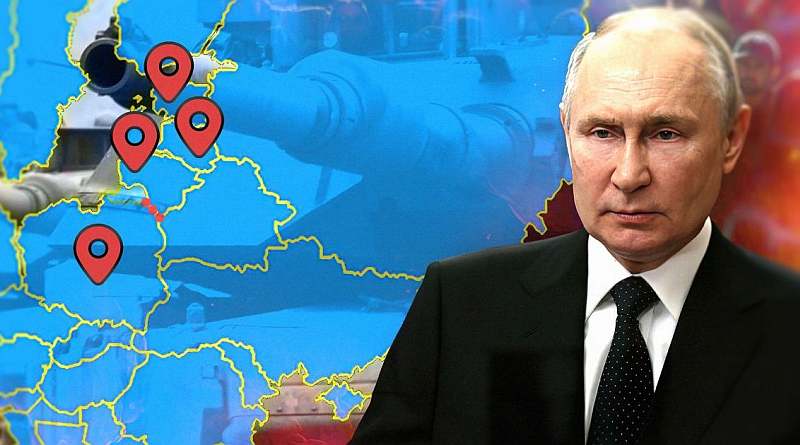

Moscow’s information aggression against Latvia, Lithuania, and Estonia has reached a new, strategically dangerous level. According to the Ministry of Defense of Latvia, a coordinated PSYOP has been launched against the Baltic countries, aiming to turn the victim into an “aggressor” and justify potential Russian provocations on NATO’s eastern flank.
On March 25, 2026, the airspace of all three Baltic countries was violated by drones heading towards Russia. However, as officials in Riga and Tallinn emphasize, this was not a “coordinated strike.” Analysis showed that the drones went off course due to extensive operations of Russian EW systems and GPS signal spoofing.
Instead of acknowledging the dangerous consequences of their own manipulations, the Kremlin immediately launched a disinformation campaign. Federal channels, including “Russia 1”, and a network of pro-Kremlin Telegram channels began spreading a coordinated falsehood that Ukraine is using airfields in the Baltic countries as “proxy launch pads” for attacks on the Leningrad region.
This is a classic tactic of reflexive control. Moscow is trying to convince its population and the international community that NATO is directly involved in the conflict by using the territory of the Baltic countries as a launch platform.
The Russian aggressive info campaign pursues three key goals aimed at undermining stability in the Baltic region.
Firstly, it is discrediting NATO’s Article 5. By trying to present the Baltic states as a “source of threat”, the Kremlin is testing the reaction of Western allies. If they manage to convince part of European society of Riga’s or Tallinn’s “guilt”, it will weaken the unity of the Alliance.
Secondly, Moscow is trying to create internal tensions. In Estonia, bot activity has been recorded again, promoting the idea of creating a “Narva People’s Republic”. These attempts to revive 2014 scenarios in 2026 seem anachronistic but are aimed at radicalizing the Russian-speaking minority.
Thirdly, Russia seeks to cover its own weakness. As noted by the Ministry of Defense of Latvia, accusations against neighbors look like Moscow’s attempt to divert attention from its inability to protect its own military objects from Ukrainian strikes.
The current hybrid attack differs from the methods of 2022 with a more profound use of AI and micro-targeting. Russian bot farms no longer operate in broad strokes. Now they mimic local communities on Facebook and Telegram, use deepfakes of Baltic politicians allegedly confirming secret agreements with Kyiv, and play on people’s economic fears by linking military support for Ukraine to inflation in the region.
However, the Baltic states are demonstrating unprecedented resilience. Latvia has become the first state to start criminal prosecution for the deliberate spread of dangerous misinformation. At the same time, enhanced military cooperation, including the joint production of drones, which the defense ministers of Latvia and Ukraine agreed on the day before, is becoming the best response to the Kremlin’s attempts to intimidate the region. Latvian Defense Minister Andris Spruds emphasized: Riga, Vilnius, and Tallinn do not participate in planning attacks, but their support for Ukraine will remain unwavering.
The Baltic info attack in spring 2026 is not just propaganda but an artillery preparation in virtual space. By trying to impose the narrative of a “Baltic foothold,” Russia is preparing a legal and moral basis for possible “acts of retribution”. The leading way to counter the updated Russian threat is known: maintain transatlantic unity and continue to expose the Kremlin’s lies in real time.
Collage: TSN
