
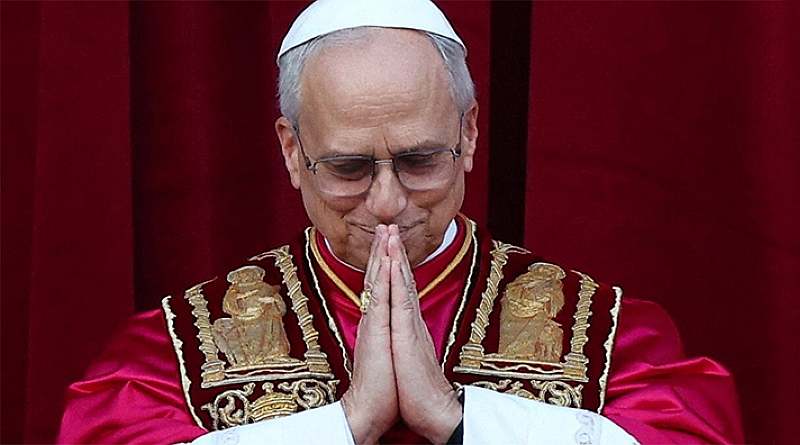
“Obviously, he decided to be Pope,” one of my interlocutors, a reputable church hierarch, said to me as we discussed recent statements made by Pope Leo XIV during the war between the United States and Israel against Iran. The fact that the pontiff evidently – and not just expressing his own opinion, but from the perspective of dogma – refutes the approach to war as a benefit that solves any problem, and as “the continuation of politics by other means,” contradicts not only the position of countries such as Russia or Iran, but also the position of Donald Trump’s administration. While American Secretary of War Pete Hegseth, a newly converted Protestant fundamentalist, tried to portray the war as a holy crusade in the name of Christ, the first Pope from the United States noted that “God does not bless any conflict. Those who are disciples of Christ, the Prince of Peace, are never on the side of those who once wielded the sword, and today drop bombs.”
When, after the death of Pope Francis, a native of Latin America, the cardinals elected a hierarch from the United States as the new head of the Church, many who are distant from the Vatican but try to analyze the conclave’s actions from a political perspective believed that this election was another victory for Donald Trump and evidence that the new-old American president is feared even by the Catholic clergy.
But in reality, this was the greatest challenge to Trump. Cardinals, capable of analyzing events not so much in terms of political expediency but in terms of challenges for God and the Church, could not fail to realize that the Trump administration is a triumph of fundamentalists – albeit Christian ones, but nonetheless dogmatists. And they could decide that only an American who defends the ideals of humanism is capable of opposing these self-appointed “crusaders” and having authority among Americans and the world.
In other words, practically the same thing happened as we observed in October 1978, when the conclave realized that to oppose other dogmatists, the communist ones, it was necessary to have a Pope from the communist camp – and elected the first Polish pontiff, Cardinal Karol Wojtyla, who became John Paul II.
In fact, now, no less danger looms over the world than during communist times, because any dogmatism, religious or political, is always an attempt to return the world to the past and deprive us of the freedom of choice. We may ironically smile when observing collective prayers in the Oval Office, but we must realize that the people praying there are absolutely serious about their beliefs and intentions. We do not even know whether they perceive the self-centered and greedy Trump with his instincts of a political animal as a true leader or just as a tool for the tasks of their religious sect leaders. And this is no joke.
When we discuss, say, Pete Hegseth’s biography, we first recall his service, unsuccessful career in the veteran environment, and work as a television journalist. But Hegseth became a neophyte in one of the most radical fundamentalist Protestant groups in America. The founder of its ideology, Douglas Wilson, whom one can see next to the minister during joint prayers at the Pentagon, refutes the equality of men and women, advocates for corporal punishment for children and for “theology of street fighting.” And he believes in the concept of the Southern Confederate States, which (unlike the US, where the great founders confidently separated Church from state) were a “Christian state” – not in the way, of course, that Iran is an “Islamic Republic,” but still… And, of course, this person rehabilitates slavery and brands its opponents as God-haters. And yes, this person was invited by Hegseth to preach at the Pentagon. And yes, when he joined the community, he had to promise to be accountable to its elders. And yes, Hegseth, along with his mentor Pastor Bruce Potteiger, called on Pentagon employees to monthly prayers “on a voluntary basis.” There is some irony in the fact that the minister, destroying Iranian ayatollah-fundamentalists, seems to be clearing the territory for “ayatollahs” from Christian fundamentalist sects. And I just mentioned one representative of the administration whom the Pope unofficially opposed. Describing the entire fundamentalist web of this administration would require writing a book.
Therefore, the significance of the Pope’s humanistic view of the world in this dark time (primarily dark not politically, but morally) is absolutely unsurpassed. In such times, he who clearly distinguishes between good and evil – and can do so from one of the main pulpits of the world – is indeed a true savior of humanity’s virtues. Leo XIV could save all of us – Catholics and non-Catholics, Christians and non-Christians – just as John Paul II did in his time.
Of course, if he really decided to be Pope.
