

A bit about the night missile attack.
Yes, it was unique again, but in a negative light for the aggressors. It surprised me with its disarray, not with quantity or timing.
I observed it all night (I noted some moments in my Telegram to avoid flooding here), and there were two surprises that must be mentioned in the analysis:
1. Practically no ballistic attacks on Kyiv.
And there should have been! To send strategic planes from Siberia just to launch up to 50 Kh-101 cruise missiles? Knowing we shoot down 95% of such missiles, and they didn’t use them at all in the last two major ballistic attacks — it’s a failure, not an attack. Sorry, but this is definitely not a strategic plan.
Yes, you might say the targets were objects in the western regions of Ukraine, and ballistic missiles wouldn’t reach there, hence their absence. But cruise missiles still need to get there, and their chances decrease along the way. And there are Zircons and Kinzhals for such a distance. And they killed half of a large family near Kryvyi Rih with a Zircon!
Lviv was also affected, and I express my condolences to everyone. But 60 cruise missiles (one to Poland) — for what? Because they can? But every attack pursues certain goals. They can’t just launch 300 million because they can.
| 2. This aspect is clearly emerging. Exhaustion of people. And not only our air defense and aviation forces (which again shot down most of the cruise missiles). From the first hour of the night, every hour there was a “salvo” — either informational (launch of several ballistics and cruise missile entry into Ukraine) or missile. From 4 to 5, everyone watched a herd of cruise missiles to Lviv region. At 6 a.m., another group of cruise missiles flew in. This is terrorizing the population, ensuring they don’t sleep all night, observing and sitting in shelters.
This was definitely a planned attack. Closing the month. There might be a ballistic salvo on Kyiv today. But this night clearly showed it was planned weeks ago after our news about the increasing number of people in metros and parking lots. I think such attacks will continue. We are taking out their Wildberries warehouses with packages, and they are terrifying Ukrainians with prolonged nighttime shelling. This is their response to our actions. They are simply insane to do such things. The conclusions are already in the text. |
Now let’s look at Poland’s reaction, because the missile flew 90 kilometers over their territory. And it’s very difficult to electronically interfere with the X-101, its route is programmed for several days to avoid being off course. Because for now, as in the video, they can’t shoot it down with four F-16s. And a helicopter is searching for a crater in the fields. Near Lublin…

About today’s attack in the context of the month.
According to the Ukrainian Air Force, on the night of July 29/30, Russia used 74 missiles against Ukraine.
This is a planned strike. I emphasize, planned. Not a “response”, because there can’t be “responses” from the aggressor. Not “for Wildberries”, not for the photo with Trump. A planned massive strike.
There were two similar-scale missile attacks in July: 01/02.07 – 74 missiles and 05/06.07 – 68 missiles. The previous massive strike was on 19.07 – 41 missiles. In June, there were 2 massive strikes – 70 and 73 missiles.
So we see: 70+ missiles is practically the limit for a single attack by Russia. More occurred only once in recent months – May 23/24, when Russia conducted a psychological attack with 90 missiles.
What are the anomalies of July? If approached formally (!!!) – within the calendar month, this is the picture.
As of July 30, Russia used against Ukraine twice as many missiles as in June: 364 versus 178.
In July, there were no Kinzhals, but the number of Zircons/Onyxes doubled (31 versus 16).
The number of ballistic missiles increased by 34%: 125 versus 93.
2.3 times more cruise missiles were launched: 146 versus 62.
The number of guided aviation missiles increased 10 times (!): 51 versus 5.
Plus, Russia used 11 anti-radar missiles.
Overall, in the calendar month of July, there were 4 massive rocket attacks and about ten intermediate ones.
However, I consider counting missiles by calendar months under the current Russian tactics (1 major strike approximately once every 2 weeks) misleading. Plus, the statistics were affected by the “unscheduled” strike aligned with the NATO summit. If we exclude the “summit strike” and hypothetically shift the last strike by 2 days – from July 30 to August 1 (i.e., exactly 2 weeks after 19.07), we would have different statistics without dramatic increase like in May. With a clear distinction: an increase in the use of guided aviation missiles.
We can talk about some general increase if in August, Russians use 300-350 missiles.
How to interpret this? Formally speaking.
Not in percentages/times, but in units, the number of BRs increased by 32 units compared to June and by 39 units compared to May. By subtracting a potentially “extra” strike in the month and a strike “for the summit”, we get comparable figures with previous months.
Also, 16 more Zircons/Onyxes were launched. Here, there is a steady growth from month to month. Its nature needs separate investigation.
Overall, it suggests that even if the Russians slightly increased production, they likely drew a bit from reserves for the overall increase (they set aside a bit monthly).
This is also true for cruise missiles, which were used 40 fewer units in June than in May. In July, they used the saved ones and took from the reserves.
If there were stable production growth, they would somehow evenly distribute activity within the month. The total number of missiles in the first and second half of the month is roughly equal, but the structure differs. In the second half of July, there was less ballistics, but more Zircons/Onyxes and guided aerial missiles.
Another feature: the trend of reducing the total number of strike UAVs is intensifying, but the number of reactive Shaheds and “Bandera Slingshots” is growing. There are more of them, but we will see the numbers a bit later.
The month is not over yet, we’ll analyze it in detail at the beginning of August.
The overall conclusion remains the same: Ukraine needs 300+ modern interceptor missiles monthly to theoretically (!) have a chance to defend against ballistics/Zircons. And more launchers. This is currently an unachievable task.
Therefore, efforts must be increased against Russian launchers and aviation (which is being done), and sanctions enforcement must be demanded. Without Western electronics and other components, a large portion of this metal wouldn’t rain down on us.
* * *
Directly about the results of the night/morning.
1. A terrible tragedy in Kryvyi Rih. 6 dead and 9 injured. Russians hit a residential building with a missile, killing parents and 3 children in a large family.
A person died as a result of a Russian attack on the “Nova Poshta” terminal in the Poltava region.
In Kyiv, Russians killed 1 person, 2 were injured. Shopping pavilions in the market were burned. In the Kyiv region, 5 were injured.
More than 30 injured in Lviv (unfortunately, 1 person died). According to available information, there was an element of great luck – the missile hit a residential high-rise but didn’t explode, the casualties could have been much higher.
In the morning, 3 KABs were dropped on Kherson, killing a person.
At night, three X-59 missiles hit Zolochiv (Kharkiv region). An 86-year-old woman was injured, 2 apartment buildings and 28 private houses were damaged…
Much has been said about the criminal nature of Russian strikes. The comment by the Polish Defense Minister about the incredibly harsh night for Polish air defense is without comments.
2. What about our side?
First, the port of Taman was hit. Significant smoke is clearly visible from Anapa. Satellite images will show the nature of the damage, there are several fire sources in the port territory.
This is a difficult target because it effectively falls within the defense area of the Kerch Strait bridge and also has additional protection tools.
Secondly, in the Rostov region in the direction of Taganrog, two detection systems from the Russian air defense were hit:
• Nebo-SVU radar;
• Sopka-2 tracking radar complex.
The dismantling of the air defense system in the Rostov region is progressing at “Crimean” rates.
Thirdly, new Wildberries warehouses caught fire — in the Penza area and in Sarapul (Udmurtia). A couple of days ago, Sarapul was prematurely worried, now this has been corrected.
Objects in Crimea and other temporarily occupied territories were routinely targeted.
3. Concerning Wildberries. So to speak, for a sense of time and dynamics.
Technically, one can speak of 2 segments, starting from July 18, when the campaign to dismantle the supply of various goods to the Russian army through the largest Russian marketplace began.
In the first segment (July 18-25):
• 5 targets destroyed – in Elektrostal (Moscow region), Krasnodar, Nevinnomyssk (Stavropol Territory), St. Petersburg/Leningrad region (2), Simferopol.
• 4 targets damaged or disrupted – Kotovsk (Tambov region), Koledino (Moscow region), Voronezh, Yekaterinburg.
Apparently, some assessment was made, in the second segment (from July 28) targets in Ryazan, Penza, and Sarapul (Udmurtia) caught fire.
In total: in less than 2 weeks, 8 large Wildberries facilities burned to the ground. Others are forced to enhance security measures, which affects the speed of cargo processing, plus there has begun an outflow of personnel.
The story with Wildberries deserves to be detailed. For now, the main idea is that without Putin’s “special military operation,” Russian big business could prosper. But it chose to agree with the criminal. Now it will be forced to take on all the risks of war.
Because it is not only indirectly (in the form of taxes to the Russian treasury) but also directly (sending employees to the army, providing various support to the occupiers, using stolen raw materials from the temporarily occupied territories, etc.) an accomplice to aggression.
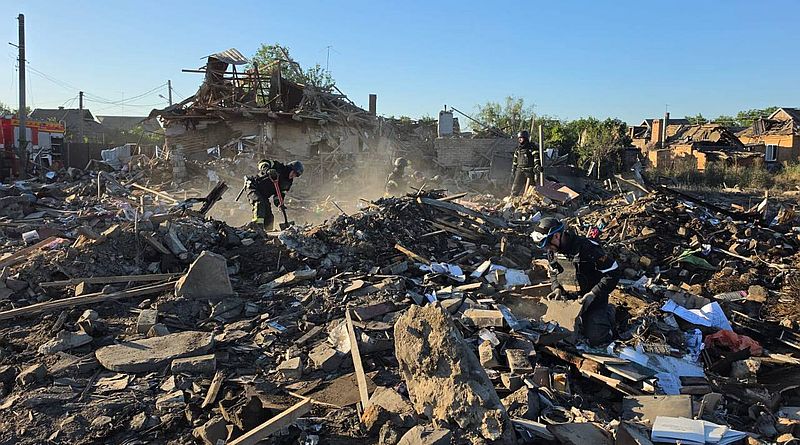
Pictured: In the village of Radushne, Dnipropetrovsk region, a Russian ballistic missile completely destroyed the house of the Voronov family, killing the parents, seven children, and a one-and-a-half-year-old grandson. Photo: Mykola Lukashuk, Head of the Dnipropetrovsk Regional Council
