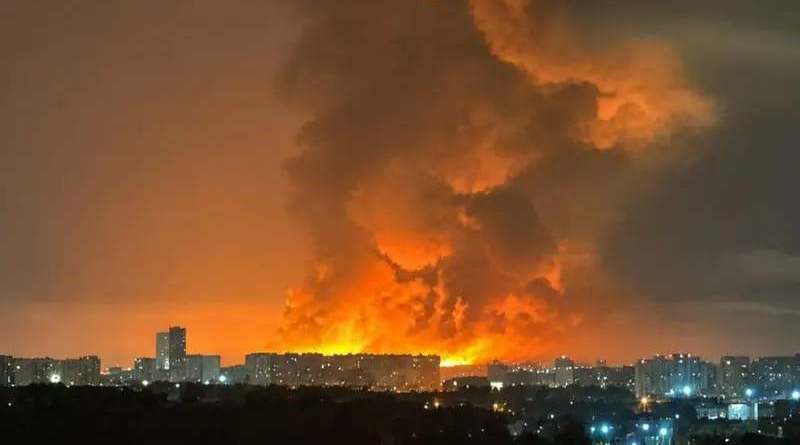

Analysis of the massive strike on Ukraine on August 5

Analysis of the massive strike on Ukraine on August 5
Sergiy Misyura

Night attack. Analysis. Ballistic, unique.

Everyone saw that we couldn’t shoot down a single ballistic missile. I’ll write separately about interaction and counteraction. And why the problem is not just the absence of PAC-3 missiles. For now, I’ll briefly try to describe why the attack was unique.

The main uniqueness — it was completely unplanned. A planned attack of 4-6 missiles was supposed to happen today. A large one with 18-22 missiles happened only on August 1st, opening the new month. Today, it was purely a response to our strikes on the Wildberries warehouses.

This was an emotional, hastily executed attack. Carrying out an order. Most likely, news about Wildberries reached the top, so they quickly executed a response. And that’s bad for them. Not a planned operation, not a strategic level, just fulfilling a whim for a response, with stomping feet of size 39 under a huge table. Show them Kuzkin’s mother, Gerasimov! That was roughly the reaction in the Kremlin to the billions in damages. A response to the hundreds of videos from sellers and entrepreneurs. People are very shaken. A response was needed. And it will continue.

Why is emotionality bad? Because planning and strategy are disrupted. And most importantly, a great nuclear state was forced to respond. We don’t respond; we carry out planned work. We are strategically higher here.

Today, the enemy hit the logistics warehouses of Novus, Rozetka, Silpo, and Epicenter. Nova Poshta has long been targeted at its sorting facilities. Metro, Fozzy, and other large retailers, you have time to disperse large warehouses into smaller ones. More attacks are coming.

The only planned target tonight was Bortnychi. The aeration station. It is very large; it will be hard to stop with one attack, but we will see if the target is systematically hit. Like, for example, Kyiv’s TPP-5.

Uniquely, this was the first use of ballistics with a cluster warhead. Such a warhead, like the first version of the Taurus missile, is mainly designed for destroying airfield runways. These strips are always concrete and kilometers long. They require area attacks, not pinpoint strikes.

At night on my Telegram, so as not to spam here, I wrote that this is a very rapid attack. That someone is pushing them, or they brought a supply of ballistic missiles from North Korea. It turned out to be both. The main headquarters were pushing (since I didn’t know about the hits specifically on the warehouses), and the missiles arrived. And the use of a cluster warhead on warehouses is for maximum area damage.

The initiative is back with us. They respond, we hit planned and strategic targets. Again, for the third time in a week, one of the three refineries in Ufa, and another Wildberries warehouse is burning. Now it’s Aleksin in the Tula region. The result in the video is a volcanic eruption 🙂.


Serg Marco

The strikes on Kyiv last night once again confirmed the statements of Russian propagandists that they hit Kyiv solely for terror, to force people to demand meeting somewhere in the middle, and not because there are a large number of military targets here.

And this terror will continue.

We have a non-linear trend of strikes. Russia began to destroy our infrastructure and business back in 2022. Then they were already buying “shaheds” from Iran and hitting civilian objects with missiles. During this time, they wiped out the most valuable, and now they are more engaged in terror.

We managed to overtake Russia in launching drones only this year and started methodically burning their facilities. Yes, we are doing this better and more effectively, and Russia has a lot of valuable and economically justified targets to burn (unlike Russia, where the cost of a missile drone attack can be more expensive than what they hit), but terror is always terror, and it is understandable that it hurts us and makes us want the same terror in return.

But we have a goal, and this goal is not in terror but in destroying the Russian economy so that it cannot support the autumn mobilization. How we perform this task will determine our winter.

Because Putin doesn’t care about his people. And about reciprocal terror. He will only stop when he no longer has the economic means to continue the war. And we need to bring this day closer, without bending to terror, not deviating from this course, and maintaining unity.

But it’s very, damn it, I must admit, it’s very tempting to repay in kind…


Oleksandr Kovalenko

Russia intensifies missile strikes on Kyiv: what the enemy has bet on, whether “two walls” can save, and what to do without interceptors for “Patriot”.

In July 2026, Russian occupation forces carried out 10 strikes of varying intensity on the capital of Ukraine – Kyiv. During these attacks, the enemy predominantly used missiles that are difficult for conventional air defense systems to intercept. Ukrainian President Volodymyr Zelensky has been asking partners for months to supply anti-missiles, but it seems Ukrainians will need to take care of their safety independently. Therefore, understanding what means the enemy uses is more important than ever.

Since the beginning of 2026, Russian occupiers have steadily and confidently switched to using a selective range of weapons on Ukrainian cities (within the framework of distributed adaptive terror). Specifically for Kyiv, it mainly comes under attack from missiles that are difficult to intercept, namely: ballistic, aeroballistic, and hypersonic.

Currently, all these missiles can be intercepted by systems in service with the Ukrainian Defense Forces, such as the Patriot and SAMP-T. No other systems possess such capabilities. However, as Ukrainian President has repeatedly noted, the ammunition supply for these systems is insufficient to effectively counter Russian strikes. For example, after the attack on the capital in the early hours of August 1, Volodymyr Zelensky reported that only one ballistic missile (out of 27) was shot down “simply because there are no missiles (interceptors) for the Patriots.”

This material aims to examine what missiles Russia is using on Ukraine’s capital, how protection can be self-sustained, and what air defense means from other countries might be beneficial for Ukraine in combating Russian terror.

Instruments of Terror and Methods of Protection

Let’s start with the missiles that Russia has been using more frequently than usual against Kyiv lately. Among them are both familiar models and those that Kyiv residents might be hearing about for the first time, although residents of the Mykolaiv and Odesa regions have already had the unfortunate experience of encountering them. Now, let’s proceed in order.

9M723 – the main ballistic missile of the Iskander-M missile system.

Flight range – 500 km.
Maximum flight altitude – 100 km.
Speed – 2,600 m/s at maximum altitude, 2,100 m/s when approaching the final flight segment, 800 m/s when targeting. At this moment, the missile is most vulnerable to interception.

Warhead – 500 kg. The standard high-explosive fragmentation warhead is a capsule in the form of a Soviet-model BETAB-500 concrete-piercing bomb, designed to combat fortified and bunker-type targets. This is its main danger – the missile can penetrate more concrete floors and pose a greater threat when hitting multi-story buildings. The degree of destruction varies depending on the building materials. For example, the 9M723 missile has a specific power capable of completely destroying a five-story brick building.

The 9M723 also uses cluster warheads, comprising 54 submunitions 9N730, which are released at altitudes from 900 to 1,400 meters and are intended for inflicting indiscriminate damage over large areas. The destructive effect on concrete buildings is lesser unless you consider fire risks, and they pose a greater threat to people in open areas without shelter.

Production – on average, three units of finished product per day, depending on the supply of all necessary components, including those of contraband origin.

The 9M723 missiles are predominantly used against Kyiv and its region from the Bryansk and Kursk regions. This allows the adversary to use them from safe distances (sufficiently far from Ukraine’s border) and minimize the risk of the system being hit in response or detected when moving to a launch position.

The 9M723 missiles cover 500 km in just over 3 minutes. The distance to Kyiv from the Russian border is covered in one and a half minutes.

Kh-47M2 “Kinzhal” – an aeroballistic version of the 9M723, modified for launches from the MiG-31K aircraft carrier.

For these tasks, the missile received a reinforced structure for an aerial launch, an improved tail section, and reduced aerodynamic fins. This launch format and structural changes allowed for increased missile flight range from 1,500 to 2,000 km.

Regarding flight speed, it can reach 3,400 m/s or 12,000 km/h.

The warhead has a standard weight of 500 kg for such missiles, based on the concept of the Soviet aviation BETAB-500 concrete-piercing bomb. Considering its speed, the penetrating effect of the Kh-47M2 “Kinzhal” is higher than that of the classic 9M723.

In Russia, on average, one such missile is produced every 2-3 days, but with all necessary components, production volumes could be higher.

3M22 “Zircon” – a Russian hypersonic sea-launched cruise missile.

It was developed by NPO Mashinostroyenia. Despite its similarity to the 9M723 and Kh-47M2, it possesses a scramjet engine and does not exhibit ballistic flight physics.

Flight range – 1,000 km.
Warhead weight – 400 kg.
Flight speed – from 2,700 to 3,000 m/s.

Previously, launches of “Zirkons” at Kyiv were conducted from the territory of temporarily occupied Crimea, but from June 2026 – also from the Kursk region of Russia. The enemy relocated part of the “Bastion” complexes there from the ARC, as stated by the speaker of the Ukrainian Air Forces, Yuriy Ignat.

It reaches the distance to Kyiv on average in 3 minutes.

As for production, it’s a unit of finished product every 2-3 days. But during the full-scale invasion, the ROV stockpiled munitions, which now allows for active deployment of “Zirkons.”

KN-23 (Hwasong-11A) is the North Korean analog of the 9M723, which in the DPRK, due to technical and technological production shortcomings, could not be fully replicated, resulting in a unique path of solid-fuel ballistic development, partially replicating the Russian design.

As a result, the missile became larger and heavier. This allowed for certain variations between flight range and warhead weight.

Flight range – 450 – 600 km.
Warhead weight – from 500 kg to 1,000 kg.
Speed parameters are practically identical to the 9M723, except for quasi-ballistic altitudes, varying depending on the flight stage from 40 to 60 km.

As with the 9M723, the KN-23 missile is most vulnerable during the approach to the target stage.
Production volumes are unknown.

48N6DM.

48N6 missiles are part of the munitions for the S-400 “Triumph” air defense systems, but Russian occupiers actively use them for surface strikes.

Flight range – 200-250 km.
Warhead weight – 180 kg.
Flight speed – from 1,800 m/s to 2,500 m/s.
Production volumes – on average 1-2 missiles per day.

Most launches at Kyiv are carried out from the Bryansk region, making this complex the most vulnerable to retaliatory strikes if detected early.

Unlike other missiles, the 48N6DM contains a large number of fragmentary elements (tens of thousands of shrapnel), making it not as destructive but maximally dangerous for civilians, especially in open, unprotected spaces.

P-800 “Oniks” (3M55).

This is an anti-ship missile (launched by Bastion-P complexes), but the enemy has been actively using it since 2022 for strikes not only on naval surface targets but also on land objects.

Flight range – from 300 to 800 km.
Warhead weight – 300 kg.
Flight speed depends on flight conditions. Near the sea surface, it’s 680-700 m/s; over the land surface, the cruise segment can reach 880 m/s.

Production volumes – on average one missile every 2-3 days.

Countermeasures

All the above-mentioned missiles pose a threat for several almost identical reasons:

– high flight speed;
– powerful warheads from which no two walls can save;
– complex interception heights and flight trajectories.

As of today, Ukraine has only two types of air defense systems capable of intercepting these missiles, namely: Patriot SAMs (PAC-3 missiles) and SAMP/T (Aster-30 missiles, especially in the B1NT modification).

In addition to these systems, there are others in the world that can also be used to intercept the aforementioned nomenclature of missile means of LAW.

THAAD is the most frequently mentioned exoatmospheric missile defense system in the media, designed to intercept ballistic missiles at high altitudes even before they reach their final flight path (strike phase).

But the problem with THAAD is that its purpose is exoatmospheric interception, but not countering low-flying targets such as the 3M22 Zircon and P-800 Oniks.

Moreover, there are not many of these systems, and their ammunition is extremely scarce.

David’s Sling is an Israeli system designed to counter ballistic missiles, but its effectiveness against low-flying targets like the 3M22 Zircon and P-800 Oniks is unproven.

Additionally, Israel is unlikely to get close enough to Ukraine in the near future to supply these complexes.

It is also worth mentioning the ship-based Aegis BMD system, which has proven effective against ballistic missiles. Especially the SM-3. And the SM-6 as a means of intercepting hypersonic targets. But this is primarily a ship-based system.

Therefore, in terms of passive counteraction, Ukraine can hope for a slight increase in the number of Patriot and SAMP-T air defense systems supplied in the future, but there remains a persistent shortage of missiles.

The localization of PAC-3 and Aster-30 B1NT production in Ukraine can only partially solve the missile shortage issue, as can the prospective development of Freya. To scale all these capabilities for counteraction and reach relative serial production, at least a year is needed in the best-case scenario. But what should Ukraine do in the meantime?

Active counteraction involves hunting for Russian launchers and striking missile production facilities.

I already partially mentioned this above, indicating the range of missile flight and launch locations. Noting that the most vulnerable are the S-400 launchers, as they have to be closer to the Ukrainian border than anyone else to use the 48N6DM missiles. Almost all others have a significant safety buffer to prevent retaliatory strikes.

Recently, retired US Navy Rear Admiral Mark Montgomery suggested that Ukraine use F-16s with Extended Range Attack Munition (ERAM) aerial missiles, which have a flight range of 480 km, a warhead weight of 227 kg, and high resistance to electronic warfare, to hunt Russian short-range ballistic missile systems.

In 2025, the US State Department approved the sale of up to 3,350 ERAM missiles to Ukraine, but there is no official data on these means of strike being delivered to the Ukrainian Air Force.

As for strikes on missile production, this is quite an achievable task, but it requires the use of a significant number of missile strike means with sufficiently powerful warheads. Drone raids cannot render such enterprises non-functional. But, as is known, we have not yet reached the level of conducting such massive and concentrated strikes in terms of missile means application.

Conclusions

The adversary has chosen the tactic of missile strikes on Kyiv using a range of missiles that are the most difficult to intercept. Taking advantage of the scarcity of both air defense systems and their ammunition, the adversary will continue striking the capital, escalating terror.

Ukraine will undoubtedly seek solutions to this problem, which depend on the capabilities of Western countries and the limitations of their resources.

Establishing its own production will take a considerable amount of time to reach serial production, and the destruction of Russian launchers and enterprises also depends on the reaction, capabilities, and efficiency of partners.

During this challenging period, the residents of the capital should pay maximum attention to their own safety and not ignore basic preparation requirements for massive shelling.

The aforementioned range of missiles and their characteristics allow for an understanding of the threat level and response time to launches, in many cases minimized. The most reliable shelter during such strikes is a bomb shelter, basement, or subway. Two walls during a ballistic missile strike won’t save you from a direct hit to a building, especially when it comes to the 9M723.

The responsibility of people for their lives in this challenging period of war becomes as much a priority as finding effective means to combat these threats.


On the cover: Kyiv under heavy fire, August 5, 2026. Photo: social media

Автор