
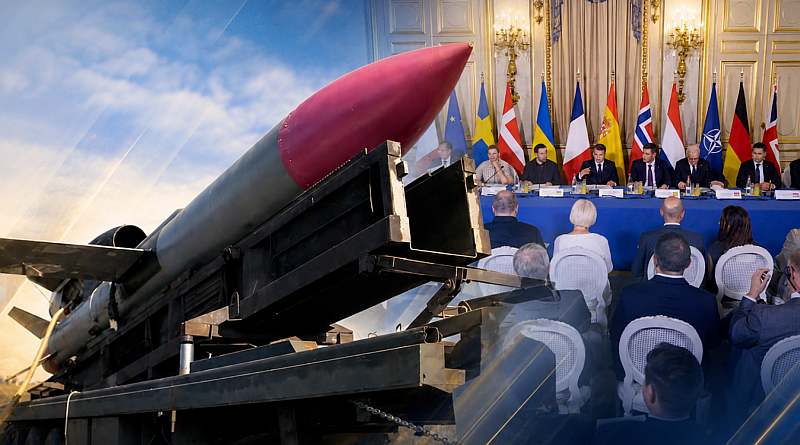

The people are angry and irritated by enemy ballistics and the chatter about 2-3 weeks (maximum), which is why the talk about Ukrainian missile defense from Stihlerman is met with inertia for the missile program ineffectively leaked by Zelensky and for the participation of Zelensky’s friends in this idea.
And that is correct. The President must be accountable for mistakes.
But to avoid filling the information vacuum with conjectures, magical thinking, and not falling for rumors spread by the enemy, let’s figure this out.
The topic is secret, little data is available publicly, but even here important things can be discerned.
Even in my own comments I’ve seen more than once: “ahaha, we made intercontinental missiles, and inept ZE can’t make an anti-ballistic missile overnight!”
It turns out the basics need to be explained.
I myself have written a lot about the disrupted missile program. But for the sake of truth: the interception of ballistic missiles was never part of the missile program.
Firstly, Ukraine never independently developed the R-36M. It was a product of cooperation.
Secondly, ICBM – it’s not an anti-ballistic missile, these are two different stories.
A ballistic missile has to “just” fly downwards into a static target on the XY-plane. This is completely different from what an anti-ballistic missile has to do.
An interceptor missile has to hit not the surface of the planet, but intercept a moving target in the sky, which is super-fast, a thousand times smaller than a factory or an airfield, and the interceptor must do this at twice the speed of the ballistic missile (combined speeds on opposite courses from 4000+ m/s). Additionally, the anti-ballistic system must aim at the target in far more complex conditions: in 3D space (in the sky), where in the terminal phase the seeker, for example, finds it hard to lock on any landmarks.
Anti-ballistics is a completely different engineering task.
It’s like shooting a bullet with a rifle to knock down another bullet fired from a rifle.
So here it must be established: we don’t know how to do this. Because we’ve never done it.
An entirely different issue – the method of defeat.
This topic is used to argue that “the Frey project is fake, because hit-to-kill took the Americans 20 years.”
Yes, we are incapable of doing this.
But there are several nuances here.
One thing is to hit a target with a cloud of fragments (this option has been announced by FirePoint as the closest goal), and a completely different one is to hit a missile with a missile (PAC-3).
And it turned out to be a non-trivial question about which method is better.
In the first case, you need to create a cloud of fragments (say, a controlled shape like a torus with a conditional radius of 10-100 m), and cut through the body of the enemy missile with this disk.
This is the path everyone in the world has taken.
The Americans took a completely different approach with hit-to-kill in Patriot: hitting a missile directly with another missile. The US solved the key problem of anti-ballistic systems: “destroyed the body of the enemy missile, but the undestroyed warhead fell and exploded.”
However, suddenly in 2026, it turned out that despite its incredible effectiveness, the hit-to-kill project was inefficient.
Anti-ballistics is not just a missile. It’s the entire system, which importantly includes production and the potential to scale up this production.
The technological resources required for a missile to reach the interception area within a 0.5m sphere instead of a 100-meter sphere made the missile too complex.
Result: PAC-3, with $5 million per launch, turned out to be ineffective in two aspects: 1) economically unsustainable, 2) impossible to quickly scale up production.
Therefore, when Kim Jong Un found a way to quickly increase ballistic production with smuggled parts, even the entire American industry, with tech giants like Boeing, Lockheed Martin, and Raytheon, together couldn’t quickly counter even one opponent. What to do when there are two – Russia and Iran?
Conclusion: hit-to-kill, despite several obvious advantages, turned out to be an evolutionary dead end.
I would generally express that strategically, Ukraine should not chase the hit-to-kill method at all.
If the Americans invent a way to quickly scale the technology, – fine, until then, Ukraine should only purchase hit-to-kill.
And by the way, the Americans themselves decided in 2026 to take the path of simplification – the cheaper version of PAC-3 will have an airburst instead of missile-to-missile.
Hit-to-kill works for wars with single sporadic attacks, but not for wars with “massive attacks with cheap missiles” variant.
What Ukraine needs in the future is to develop the concept of a smart directed (conical) explosion with a warhead in the EFP-ring variant.
In any case, own concepts – a matter of the distant future.
* * *
Now about reality.
During the signing of the Paris Declaration on the pan-European Freya system in Paris, the concept was supported: take what is available on the European market, assemble it like LEGO, test it, and launch it into large-scale production.
Europe and Ukraine must only follow paths that already lead to the possibility of having hundreds of missiles per month.
In essence, Shtilerman and Terekh are not missile designers. Shtilerman is a cosmologist by education, and by profession a savvy guy (“visionary”). Plus, he’s a good organizer who managed to make cheaper long-range drones that hit the target and scale up production.
If we evaluate the idea itself (and ignore the connections with Mindich or other backgrounds for now), then using designs for engines and missiles from the S-300 is a completely rational and correct idea. A missile is merely a means of delivering a warhead. We need many of them. We have no right to reinvent the wheel when Soviet knowledge is already at hand.
Another point. Europe already has its own anti-ballistic missile project, Aster 30, for the Franco-Italian SAMP/T. On one hand, the Ukrainian Freya is a competing project. But on the other, there are only plans to reach 300 Asters per year by 2028. And 300 units are already not enough even for two months of repelling Russian ballistic attacks.
The promise to organize a cooperation, in which FirePoint can provide a mass delivery means, defined Ukraine’s key advantage, particularly highlighting not just our participation but FirePoint’s managing role.
The fact that Mindich provided access to Soviet archives on the S-300, or even that Yanukovych personally did it, is secondary.
This issue is being speculated upon, but in the conversation about Mindich and the USSR archives, what’s important is that Ukrainian flexibility already allowed for entry into a joint project with Europe, hoping for cooperation where the European engineering school, with Russian pensioners’ money, can fulfill market needs.
Another issue is that the intellectual property in the Shtilerman’s missile belongs to the people of Ukraine, not Shtilerman. It’s like how NASA conditionally provides Elon Musk access to patents for development and commercial use. It’s a myth that someone might think wrongly about the archives given to Shtilerman. This is entirely normal global practice. But the state retains the right to royalties. And if Shtilerman expands to billions of dollars and then sells the company, he will be selling Ukraine’s IP. Therefore, Ukraine must keep the right to intervene and control the transfer of technologies. However, the very idea of developing a cheap interceptor should rightly be supported by all means.
Regarding the claimed speed in the improved S-300 variant of 1500-2000 m/s – this is generally sufficient for intercepting Iskander-type ballistic missiles.
15 launches of the new engine – part of them were shown on video.
For similar tests, military attachés from embassies are usually invited to confirm to their governments that it’s not just a facade. This is exactly how embassies once helped Shtilerman prove the superiority of the now widespread FP-1 during tests.
Then came the Paris Declaration, where a dozen countries and major European defense companies joined the idea. This is an indicator that the project is taken seriously.
The strength of Shtilerman currently lies in this – in marketing. He skillfully utilized the demand and sold the idea. A correct, technically feasible idea, plus you couldn’t come up with a more successful name than “Freyja.” The Scandinavian goddess perfectly matched the perception of Northern Europe, which signed on to the project.
And that’s why, when agreements for cooperation with such a number of partners usually take decades, Ukraine achieved this within months after the announcement of the idea.
And that is where the real success in this entire matter lies.
Working with an industrial base comparable to the American one – Germany, wealthy Norway, engineering schools of the Netherlands, Denmark, and others. This is a goldmine. Even if Shtilerman turns out to be a fake person, his engineering task is relatively simple: reverse-engineering the delivery means, improving it with new technologies, and scaling it up.
However, the key challenge – the brains and the entire outline. This we could never have invented. And this is the whole idea of Freyja with European giants.
The engineering school of the Netherlands alone – this is the ability to solve an industrial task of planetary scale. ASML’s lithography for producing microchips could not be made by anyone else in the world, not even the USA.
Anyone interested in the topic of Twinscan knows that this Dutch machine shoots droplets of molten metal, 30 microns in size, into a vacuum chamber at speeds of 240+ km/h. Each droplet must be hit in flight by a laser microbeam. The laser must be guided by sensors and microelectronics to hit from a specific, calculated side so that the controlled plasma flash burns a nanodesign onto the crystal’s surface. This process must be reliably repeated 50,000 times per second.
The engineering and scientific school of the Netherlands, with European contractors, solved a problem at the level of the USSR’s space program, giving Western civilization a global advantage over the whole world: microchip production.
ASML is not involved in Freyja. However, the lithography company ASM had contractors.
Sensors were developed by Thales. Thales also developed complex electronic systems and power management modules. Now Thales is one of the signatories of the Freyja missile defense system cooperation.
In Twinscan, the main manufacturer of the most important and expensive part — the EUV light source vacuum chambers (where the laser shoots the tin droplet) — is VDL Groep. Another contractor, Neways Electronics, created the printed circuit boards and microelectronics that control the positioning of silicon wafers inside the lithograph (with precision down to the nanometer).
Both are contractors for Thales, a participant in Freyja.
Another participant in the Freyja project, Hensoldt, states on its website that without them, Dutch Twinscan lithography could not function. The German company Hensoldt developed the system ensuring the highest precision in laser control, allowing every shot to hit its target flawlessly. Now, Hensoldt writes on its website that it will help the Freyja project achieve pinpoint accuracy with its radars.
This is the true strength of this project — cooperation with such industrial potential.
* * *
So, weak points of the Freyja project:
• The ability to provide a mass-produced, not custom-made, delivery method is not yet proven,
• The prospective missile speed based on the S-300 at 2000 m/s is sufficient only for intercepting lower ballistic types like Iskander,
• Competition for technological resources with the Franco-Italian SAMP/T — suppliers of nodes and modules overlap, potentially creating a bottleneck even with mass-produced engines and bodies,
• The intellectual property of the Ukrainian people lies in private hands: beneficial for rapid development — unclear who profits,
• Where exactly Freyja addresses bottlenecks and reduces interceptor costs is unclear if the engine + body conditionally costs €200–300k, while the seeker and ground guidance systems equal the same million.
Strengths:
• we are not doing it alone, but in cooperation with the powerful industrial base of the EU + the experience and speed of decision-making in Ukraine – this alone makes the project theoretically possible (unlike the dreams of “doing it ourselves”),
• Hensoldt, Diehl, Saab, and Kongsberg receive stable contracting funded by Russian pensioners – theoretically beneficial to cooperate with Ukraine,
• an inexpensive, mass delivery method with the “explosion nearby” approach completely allows for a mass interceptor (unlike hit-to-kill),
• all factors together allow at least some hope that the project is not currently on the wrong path and is capable of countering Putin’s ballistic trump card within two years. A hypothetical “own project from Luch” cannot. Because we need not a small series in 20 years, but a huge one in 2.
Well, and to avoid speculation, a real contract from Hensoldt, Diehl, Thales will be a clear marker when it becomes clear that Europe’s tech giants have agreed to provide these technologies to the system. We need to watch for contracts specifically. As soon as there are contracts and not just memorandums of understanding, it will signify Ukraine’s success on the scale of EU accession.
* * *
Anti-ballistic missile defense is an insurmountable task for Ukraine alone. And only a naive person would believe that Ukraine could solve it independently in a short time.
However, in cooperation with an engineering consortium like Thales, Hensoldt, Diehl Defence, Saab, Kongsberg Defence & Aerospace, Weibel, Leonardo, MBDA, Eurosam, Safran, and Destinus, who are signatories of the Paris Declaration, surpassing Russia in a short timeframe is a completely realistic task. Moreover, if we have a means of countering ballistics, and we ourselves have a means of attack, it strikes a blow to Russian civilization in the long term.
Those who doubt that Stilerman and Terekh can make missile defense are right. But they are slightly following a false lead, directed by hostile units spreading rumors and scandals, which always operate in a gray area.
The most difficult part of missile defense is not assembling modules and connecting plugs to sockets. The most challenging part is developing each separate module of the system. During the Soviet era, the missile program was done through cooperation of all the republics. And Russia would very much like us to keep reinventing the wheel, only to then quarrel and disrupt all initiatives.
That’s why it’s good that Stilerman and Mendych will not be making germanium lenses. Their and Zelensky’s clever “technical genius” was enough to unite European competencies in a joint project.
This is the main thing.
Collage: Delo.ua
