
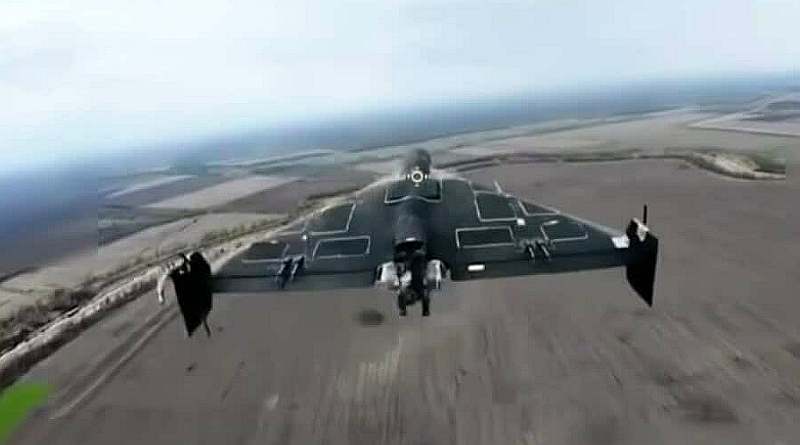
The Air Force Command regularly informs about the directions and number of air attack means in each strike. Every day, Ukraine is targeted by attack drones of almost all possible types. Leaving aside the “Orion” drones, decoy drones “Parody”, reconnaissance “Gerberas”, and not-quite-drones “Banderyol” and “Dan’-T”, the menu includes Shahed-136, “Geran-2,3,4,5”. The share of jet models is constantly increasing. For instance, on September 18, there were 46 out of 93, and on September 19, half of 174.

All this aerial debris arrives from relatively stable directions: Orel (the most popular), Kursk, “Millerovo” airfield (Rostov region), “Primorsko-Akhtarsk” airfield (Krasnodar region), Donetsk airport, “Gvardiyske” airfield, and Cape Chauda (AR Crimea).
The primary way to launch most of these drones is from the ground, using rail or catapult launchers. Such installations are often mobile, mounted on trucks or pickups. This allows operation from unplanned and unprepared areas, quickly concentrating for launching and dispersing after it. If the first type of launch is used, there is a need for ground infrastructure, so-called droneports.
Shahed-136 and “Geran-2” are launched by the opponent from ground rail installations. Typically up to five UAVs on one installation. The launch is carried out using a solid-fuel rocket booster (RATO). The booster accelerates the drone to a speed sufficient for flight, after which it is jettisoned, and a piston engine with a pusher propeller is activated.
“Geran-3” (production stopped, the enemy is using up the remaining stock) and “Geran-4” (jet) are also launched from rail installations. Jet UAVs require longer rails (for example, the droneport in the area of Tsymbulovo, Orel region, has rails about 80 meters long). Initial acceleration is the same RATO or analogue, launch of the turbojet engine, and jettisoning of the booster. Launchers for jet models are usually separate and more massive.
“Geran-5” starts like “Geran-4” from long rails.

The Russians are exploring the possibility of air launch—from Su-25 attack aircraft, Mi-28N attack helicopters (the squadron of the 39th enemy helicopter regiment from the Dzhankoy airfield does this by launching “Banderoli” and the new “Dany-T” cruise missile from the airspace over the Sea of Azov). Air launch increases flight range and complicates detection of the launch site.
Decoy drones and reconnaissance drones, which were left aside at the beginning of the text, also launch from drone ports and move as part of strike groups in a single wave. That is, the ground infrastructure must also be designed for their launch.
What does a typical drone port look like?
The largest today is the drone port in the village of Tsimbulovo, Oryol region, Russia. Until recently, it was an open field.

The typical infrastructure of a Russian drone port consists of several main elements: launch positions (the most important component), which include stationary rail launch systems (catapults). There can be from a few to 16 or more. Another element is long runways or roads for launching from mobile installations on trucks.
The Russians equip garages and hangars for storing UAVs and rocket boosters: small (for one or two drones), medium (for five or more) and large. Increasingly, storage locations are equipped in underground concrete structures. Necessary open parking areas are where UAVs are rolled out before launch. A preparation and maintenance area is required—technical platforms or hangars for pre-flight preparation, places for mounting warheads, electronics checks, refueling, and repair zones (hangars or shelters).

The functioning of the droneport is supported by auxiliary infrastructure: fuel storage, warheads, spare parts, power supply facilities (diesel generators, transformers, in Tsymbulove — solar panels for autonomy). All this is connected by internal roads and access routes. Just like a decent airfield (though unmanned, it’s aviation!), there must be a weather station, communication hub, radio engineering and navigation support unit, flight control tower, parking for vehicles (including mobile launchers). War entails the deployment of air defense positions, security, surveillance, and shelters for personnel around the droneport.

At large sites like Tsymbulove or DAP, dozens and even hundreds of drones can be stored simultaneously.
Droneports or UAV launch sites are identified at the Shatalovo airbase in the Smolensk region, at the airfield in Yeysk, Krasnodar Territory, and in other locations.
Understanding how strike UAVs are prepared for use, we see that it is possible not only to intercept drones in the air already over Ukrainian territory or destroy manufacturing enterprises, but also to actively impact their storage, preparation, and launch sites. Yes, it is a challenging task, as destroying an underground concrete shelter is difficult and costly (each storage location requires a hit with a ballistic or cruise missile, preferably several), and stocks are dispersed over large areas, including outside droneports.
The most vulnerable appear to be stationary launch installations and runways/roads. However, this is not a cure-all; they are restored quite quickly. Nonetheless, this buys time for our air defense and emergency rescue teams that work to restore Ukraine’s vital infrastructure. Considering this, such strikes are justified.
Air battles in southern Ukraine show that enemy drones actively use a communication technology known as mesh. Mesh in Russian UAVs (“Geranium”/Shahed, “Gerbera” and others) is a decentralized radio network that allows drones to communicate with each other and with the operator in real-time. Each drone is equipped with a mesh modem (primarily of Chinese manufacture, for example, XK-F358 from Xingkai or similar models). The modems create a dynamic network where each drone acts not only as a receiver but also as a signal repeater for others. In other words, there is no main repeater; each is a repeater for the others. If one drone is shot down or jammed, the data is automatically rerouted through other nodes in the network (self-healing capability). This significantly extends the control range of the drones (up to 150–175 km and more from the ground station), allows real-time video reception, route and target changes during flight (including targeting moving objects like trains or vehicles), and carrying out missions even when a significant portion of the drones are destroyed.

Previously, most Shahed flew based on pre-programmed coordinates, but with mesh, they have become controllable, almost like FPV drones but over long distances. Therefore, during strikes, for example, on Odesa, information systems displaying the air situation often show a single drone over the sea, which functions as a mesh network repeater until the end. This establishes a network for relaying control signals and telemetry between the enemy UAV command post somewhere in Crimea and strike groups over the Ukrainian coast.
It’s also worth mentioning Belarus and its game of turning mobile communication towers on and off. Ground repeaters (radio towers and mobile antennas) on the territory of the semi-empire’s branch act as ground nodes for the mesh network. They receive signals from UAV operators or drones closer to the border, amplify them, and transmit them further into Ukraine. This provides the enemy with the capability to control drones over Kyiv, the north, and the west of Ukraine, where direct radio communication from Russian territory does not reach. An additional bonus is a quality channel for video and route correction.
Intelligence from the State Border Guard Service and some other informed sources have recorded several such points (particularly in the Gomel region, near the border). They operate on TV towers or similar high structures. In February and June 2026, their operations were temporarily halted (including after Zelensky’s ultimatum to Lukashenko). Retransmitters are periodically activated.
According to Serhiy Beskrestnov, for almost a year, the Defense Forces have not systematically worked on countering mesh technologies. Moreover, the problem of retransmitters on Belarusian territory cannot be solved solely by electronic warfare means. As NATO suggests, “special or kinetic actions” are needed. However, the political risks of such actions currently outweigh potential gains.
Therefore, the Defense Forces must continue to develop electronic warfare means capable of jamming mesh connections. Specialized complexes (for example, the “Shatro Anti-mesh” from Unwave and other developments) are already in operation, capable of jamming channels between mesh modems at distances from several hundred meters to several kilometers. Some developments are specifically targeted against mesh networks of reactive Shaheds. A jammed modem deprives the drone of online control, switching the UAV to autonomous mode (flying by coordinates) or causing it to perform standard maneuvers (circle, figure-eight, or other autopilot-set movements in case of lost control).
We see that this menace is not insurmountable, but countering it is a complex comprehensive task, both technical and tactical.
On the cover: A Ukrainian Nexis interceptor drone by WinFly intercepts a Russian “Shahed” equipped with a radio communication antenna. April 2026. Photo: WinFly
