
While Trump dreams of a quick peace, and Kyiv gets hit by 30 pieces of ballistic missiles (produced by the Russian Federation and North Korea; anti-aircraft palliatives against the ground), we too are working on operational and strategic rear.
The raids on Petersburg and Rostov are very similar — 145 and 100 drones in a wave, a complicated long route in a region with enough fighter aircraft, air defense systems, and maneuver groups. Both locations are near “bloody NATO,” with standby batteries and aircraft. Yet, they didn’t manage.

In the Baltic direction, a new daily record. Within a day, Ukraine dispatches more than 250 machines on average against the enemy, peaking far beyond 500. Some are traps, false targets, and some are different technological tricks like drones launching from marine drones and balloons that carry UAVs deep behind lines.
On October 10, 2026, a swarm of about 100 strike UAVs delivered pinpoint strikes on critical infrastructure in the Rostov region, causing a paralysis of a key transport hub. The main result was a direct hit on the drawbridge on the Rostov-Bataysk route. This is a strategic artery through which the main supplies for the Southern group of Russian troops and occupation contingents pass. As a result of the structure’s damage, train movements were completely halted in both directions, blocking dozens of military and freight trains for up to six hours.
It’s difficult to knock down bridges, yes — much has been written about this. But they must be carefully guarded, as well as data centers, military-industrial complexes, chemical productions, and patched-up coats remain patched. To repel a swarm, Russians would need to deploy dozens of Pantsir missile systems and arrange hundreds of machine gun points around each refinery, plant, and bridge. But that’s impossible. The era of object-based air defenses is over. In the war of cheap swarms, only those with well-prepared mobile fire groups, inexpensive mass interceptors, and total electronic warfare superiority at the point of interest survive, which they lack over vast territories.

As part of the same repeated and massive attack, the Novocherkassk Petroleum Refinery in the Railway District of Rostov — a key fuel supplier for the Russian army in the south — was hit again. Impact on the oil storage tanks and transfer facilities caused a massive fire, leading to an emergency regime in three districts of the city. The cost of the burnt supplies of light petroleum products and repair work is estimated at at least $30–40 million. Additionally, two commercial vessels for logistical needs were hit in the Sea of Azov area, delivering a technological blow to coastal shipping — disabling ship equipment worth $5–8 million.
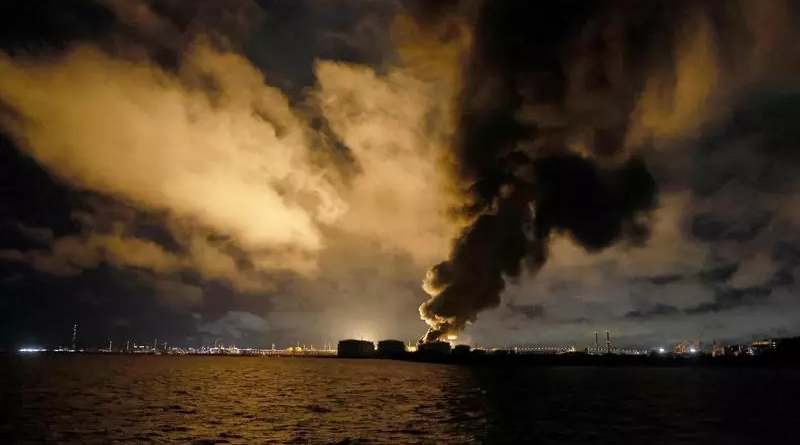
On October 18, 2026, the largest raid on St. Petersburg and the Leningrad Region in the history of the war took place — involving 120 to 145 UAVs. Despite the dense air defense layer (S-400 and “Pantsir-S1”), the swarm broke through the defense of Russia’s second capital. Explosions and fire were recorded at the St. Petersburg Oil Terminal — Russia’s largest petroleum transshipment hub on the Baltic. The loss of tanks, slowdown of exports, and damage to pump stations cost owners and the budget $25–35 million. Simultaneously, a strike hit energy infrastructure facilities in the Yanino settlement area, causing rolling blackouts in industrial zones.
The most painful technological hit to Petersburg was a direct strike on the data center of the VK (VKontakte) company in the Leningrad Region. Destruction of server equipment, cooling systems, and backup storage not only caused direct financial damage (about $15–20 million for high-tech hardware under strict sanctions, which rarely survives severe fire and extinguishment) but also triggered large-scale disruptions in the operation of Russian digital services. Moreover, one drone damaged the cable-stayed bridge over the Ship Channel. Due to the threat of repeated attacks, Pulkovo Airport was completely closed for several hours (in “Carpet” mode), resulting in dozens of flight delays, and airline losses exceeded $5 million.

The total economic and technological damage from these two operations exceeds $100 million. However, the main strategic harm for the Russian Federation lies in the expenditure of scarce anti-aircraft missiles: to repel these two swarms, Russian forces used dozens of missiles from the S-300/S-400 systems and “Pantsir-S1”, aircraft sorties (where an hour of operation costs as much as an apartment in a regional center), and the resources of mobile fire groups.
What do these strikes mean for the Russian Federation?
All the tales about demilitarization as a result of the strategic campaign in Ukraine follow in the footsteps of stories about the disrupted mobilization by “Iskanders”, strategic deployment, transfer of Western weapons, bridges, and total blackout. Just a month ago, all social networks were buzzing that Russians would destroy all our bridges and we couldn’t supply the Left Bank. Well, how many have they destroyed?
If in 2024–2025 a raid of 20–30 drones was considered large, then in October 2026 a salvo of 100–150 UAVs on one operational direction becomes standard. Meanwhile, they cannot remove air defense from the front — our aviation is alive, and we can thoroughly disrupt the front line and tactical rear with Western drones and hexacopters.
Secondly, we have enough drones for actions at depths of over 1000 kilometers to break through not the weakest air defense in the world and achieve dozens of hits on strategic targets. Additional tanks, balloons, various carrier-motherships for launch allow for swift escalation of strikes both in the south and north, overloading channels. We stretch air defense systems between the front, Moscow, and vital ports, refineries, and factories for the Kremlin regime, keeping them spread throughout the extensive theater of war.
The raid on St. Petersburg with the closure of Pulkovo airport, flaming terminals, and debris falling in residential areas deals a colossal blow to the loyalty of the elite and population. The Baltic region has always been considered a safe rear. And this is already the third such large-scale raid — the Coal Harbor is in flames, the FSB icebreaker takes a rest, fires at the shipyard. Surely everything is going according to plan, and Pechenegs with Ruriks are the most important in 2026?
The hit on the VK data center is a signal that not only the railway is under threat, but also the state-controlled “CheburNet” and control systems. A reminder: even if the Americans and Taiwan sell new hardware, the supply queues are scheduled until 2028.
When the data center VK (owned by the Kovalchuk and Kiriyenko brothers) or a private oil terminal burns down completely because the army couldn’t protect them, the social contract is severely strained. Business owners realize that the state can protect the leadership bunkers and large factories, but has abandoned private capital. This breeds hidden sabotage, distrust in the General Staff, and a fragmentation of the elites. They begin to understand that the war is becoming mathematically toxic for their capital. And for what — for the ruins of Popasna and the decaying trolleybuses in Donetsk?

Previously, the rules of the game were dictated by Russia: “We can strike at Kyiv’s energy, but you cannot respond.” Now Ukraine has proven its ability to escalate asymmetrically. Including targets in Russia’s “second capital.” This winter won’t be easy, as Russia is accumulating missiles and experimenting, scaling last year’s pressure on the capital. But it won’t be easy for them either.
Cover image: Fire at an oil terminal in St. Petersburg, which occurred on the night of Sunday, October 18, 2026, as a result of a large-scale attack by Ukrainian drones.
