
Phillips P. OBrien / Translation by iPress
Renowned American historian, professor of strategic studies at the University of St Andrews (Scotland), Phillips O’Brien repeatedly claims that the position of Donald Trump’s administration effectively helps Russia avoid military defeat, while Ukrainian long-range strikes and high Russian losses increasingly exhaust the aggressor. He sharply criticizes the US negotiation line surrounding meetings in Abu Dhabi, considering it morally unacceptable and strategically incompetent. A separate part of the weekly is dedicated to a new leak from Rosstat, which, according to given estimates, may indicate a significantly higher number of Russian military casualties than previously thought. In conclusion, O’Brien writes about new Starlink/Starshield restrictions for Ukraine and links them to the actions of the Trump administration and Elon Musk.
Before moving on to the weekly review, I want to draw your attention to an interview I gave this week to the Kyiv Independent. Having the opportunity to speak frankly with an interviewer like Martin was a real relief. And, in my opinion, this conversation also shows how Ukrainians are now aware of the real state of affairs. The interview lasts less than 20 minutes if you want to watch it in full.
So, now to the review. This week’s developments are somewhat similar to last week’s. The battlefield is increasingly turning into a quagmire for the Russians, and Russian losses seem to be rising and may be even greater than we thought last week. Reports are now emerging that by the end of the year, the total number of Russian fatalities could reach 600,000. At the same time, the long-range strike campaign shows that Ukrainians continue to methodically target Russian oil extraction and processing and are not planning to stop. The only area where Russia has clear success and advantage is the one allowed and supported by the US: long-range strikes on Ukraine. Here, Ukraine still struggles to counter these attacks as, due to US actions, it remains extremely vulnerable to them.
This once again confirms the thesis I expressed last week: Donald Trump may be the only factor standing between Putin and military defeat. This week confirmed that where the US is not helping Russia as actively as in the case of depriving Ukraine of air defense and disabling Starshield/Starlink, the Russians continue to face difficulties. Moreover, their losses continue to grow to levels that, at the beginning of the year, were considered impossible. And Ukrainians seem to be maintaining the pace and general direction of their long-range strike campaign.
Of course, the USA is helping Russia, and this has given the Russians an advantage in certain areas, which this week has once again shown very clearly.
The Week When Foolishness Competed with Evil
The Trump administration is evil, and I use this word without exaggeration. It actively supports a dictatorship that is fighting against democracy and helps this dictatorship kill peaceful citizens of a democratic state with impunity. Moreover, it wants to force this democracy to hand over many of its citizens to the dictatorship, where they can be abused, tortured, or possibly killed. The administration consciously helps destroy freedom and contributes to the increase in the number of murders. All the while, it sheds the most hypocritical crocodile tears over the deaths of Ukrainians. If this is not evil, then I don’t know what to call evil.
The Trump administration is also extremely foolish. It is mostly staffed by incompetent people and sycophants, and it is headed by a criminal with limited strategic thinking who cannot see the world any differently than he wants to. In other words, the Trump administration consists of hopelessly foolish and corrupt people leading the weak and wretched. If this is not historical foolishness, then I don’t know what is.
This week, at the “negotiations” regarding the possible end of the Russian-Ukrainian war, we closely saw how evil competes with foolishness for primacy, and one could say that both are winning. This was manifested during the preparations for the meeting in Abu Dhabi between the Ukrainians and the Russian-American delegation, during the meeting itself, and after it.
So it is worth directly stating what the reality of these negotiations is.
At the beginning of the week, it became clear: the Trump administration seeks to obtain for Putin in this war all that it can, even to the extent of the USA being ready to sacrifice Ukrainians and Ukrainian democracy. It started when Jared Kushner (probably the most foolish American ever to hold such a prominent negotiator position in US history; second most foolish is Steve Witkoff) publicly declared that the US government now wants to end the European security system, which it itself created after 1945 and which ensured US security and helped almost all of Europe become free and prosperous. This great success of American foreign policy is now planned to be dismantled, and the official US position is that it should be replaced by a system more acceptable and beneficial to dictatorial and repressive Russia. Kushner repeated this thesis several times, most clearly in a long post.

It’s strange to read statements suggesting that over the past 30 years, “Europe and Russia” tried to create an effective security system. Nothing of the sort. Europe helped build a security system that enjoyed tremendous support across the continent, and now Russia is trying to destroy it precisely because it was successful. By the way, if you want to read more about this, I wrote a separate article on Tuesday last week.
And that’s not all. While the USA advocated for the destruction of one of the greatest achievements of its foreign policy, they simultaneously pushed even more insistently for a plan to carve up Ukraine and hand over a significant part of it to Putin “on a silver platter.” Donald Trump made this clear at the beginning of the week, stating that as part of any agreement, Ukraine would have to cede territories.
The problem with this evil is that it is constantly hindered by the sheer foolishness of the American team that undertook to “negotiate” a deal to cease hostilities. The USA so poorly understands what it’s doing that both Russians and Ukrainians are likely just holding their heads, while the Russians are also laughing.
Firstly, due to the evil and foolishness of the American side, the Russians have been given the freedom to formulate perhaps an even tougher stance than in 2022. We know this because a document with Russian goals was revealed, which is described, among other things, in this New York Times article. Here’s a brief excerpt from the material about the Russian demands and how clueless the American negotiating team is about what it’s involved in.
Russia’s demands for the withdrawal of NATO forces from the eastern flank in Poland and the Baltic countries have placed European security at the heart of the negotiations over Ukraine. They also reveal the intent behind Putin’s public statements. The Russian leader consistently insists that the “root causes” of the war, as he calls them – Russia’s broad range of grievances with NATO and Ukraine – must be addressed before ceasing hostilities.
The document also shows that the economic incentives offered to Putin by Trump’s envoys Jared Kushner and Steve Witkoff have yet to push Moscow to make concessions. According to critics, the United States risks aiding Putin’s longstanding attempt to restore a Soviet-style sphere of influence from Europe to Central Asia.
Thus, the Russians have already achieved an agreement with the US government that NATO’s structure should be dismantled, without offering any concessions in return. Meanwhile, the US government claims that the Russians supposedly really want peace – Kushner, for instance, repeated this all week. When asked before the negotiations in Abu Dhabi whether Putin actually wants a deal, Kushner responded: “From what Steve and I have heard from him, we can say with great confidence: we believe so…”
Such a refrain was heard all week. The Russians present maximalist demands, the USA agrees with their essence, and then pretends that this is the peace process.
It seems that the Ukrainians and Europeans, faced with this malicious and foolish negotiating position, refused to give the USA anything substantial. This can be inferred from the fact that as the week went on, Kushner and Vitkoff just started proposing one idea after another at random, hoping that at least one would work. The main goal for the USA, apparently, is to get Ukraine to agree to give Russia the entire Donbas. The Americans explicitly told the Ukrainians that they expect them to cede even more territory to the Russians than the latter were able to capture.
At some point, to make this more acceptable for the Ukrainians, they were offered to simply redraw the maps of Donbas, so that the transfer of territories to Russia would seem more acceptable. But my favorite episode of American negotiating incompetence was the proposal to Ukraine to exchange the entire Donbas for NATO membership, which obviously elicited an ironic reaction from Zelensky, who publicly mentioned it: “The Americans asked: what if Ukraine joins NATO? Would Ukraine give up Donbas? This was the first time such a question was raised.”
There is much to analyze here. First, this proposal could not have been serious, because Putin’s entire position on the new security architecture is based precisely on preventing this from happening, and it hasn’t changed. At the same time, it shows how desperately the USA wants to reach an agreement as soon as possible. As I wrote in the Tuesday article, the American administration’s positions are weakening, and it needs a deal if it wants to get funding.
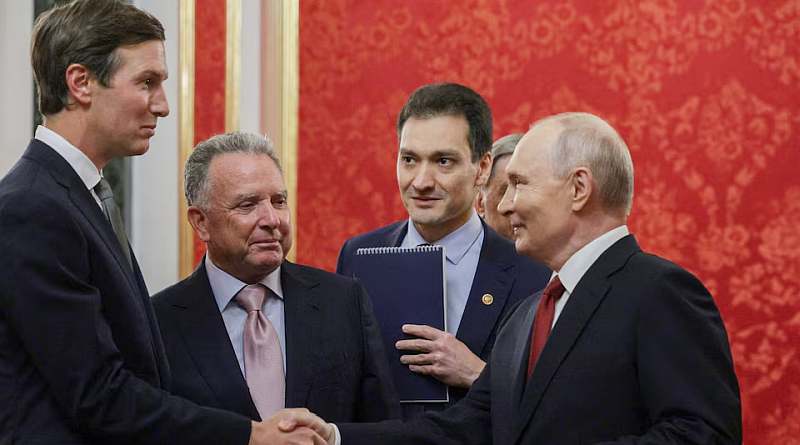
By the end of the week, the negotiations hadn’t progressed anywhere. Things were so bad that Kushner and Vitkoff talked about the need for more active European participation, provided, of course, that they receive Putin’s “blessing.” Then they rushed to Moscow, where they were warmly welcomed, reported everything to Putin, and received no noticeable concessions.

Kushner’s latest mumbling about the negotiations showed that, after such blatant sycophancy towards Russia, they realized they had made a mistake. Kushner made a meaningless gesture in the direction of the notion that NATO would still continue to exist.

However, the most interesting was the thesis about “maximalist” demands supposedly from both sides. It is very telling. Ukraine simply wants to reclaim the lands that are legally part of its state and were guaranteed to it by treaties signed by the USA and Russia. Russia wants to dismember and destroy Ukraine. These are not comparable “maximalist” demands: one side, Russia, is making a maximalist demand, while the other, Ukraine, is making a basic and legitimate one.
Yet it seems, in this case, his foolishness does not allow him to recognize the evil of such moral equivalence.
In a sense, the past week showed that the foolishness of the USA undermines their own attempts to serve evil. The behavior of the Americans in these negotiations was so absurd and weak that they lost the ability to pressure the Ukrainians to achieve the desired outcome, while simultaneously demonstrating a submissive acceptance of the Russian position. Perhaps, in the battle between evil and foolishness, it’s better for foolishness to win, but it is terrifying to what state the USA has descended.
Russian losses are being revised upwards
For many years, pro-Russian organizations and commentators found it convenient to claim that Ukrainian estimates of Russian losses, which some Western intelligence agencies considered credible, were supposedly greatly exaggerated. They said that the Russians simply could not have suffered so many casualties, and Mediazona, which worked with published Russian data, cited much, much lower numbers.
Now we finally have numbers from the stolen Russian documents: a hacker group from Ukraine and Belarus obtained 23 terabytes of data from the official Russian statistics service — Rosstat. And this data reveals quite a different story.
The documents appear to be completely authentic. They have been widely reported — from the Moscow Times to the Financial Times. Moreover, they cover all deaths, which allows them to be cross-referenced with non-combat mortality, and the figures match.
The documents revealed two things. Firstly, the Russian account of war deaths is lagging by several months: there seems to be a significant delay between a battlefield death and its entry into statistics. Secondly, even with this delay as of August, the number of Russian deaths was already between 400,000 and 450,000.
Some statisticians took these official numbers and made some simple calculations. If this was the figure in August, accounting for the reporting delay, the actual number of deaths at that point probably ranged from 500,000 to 550,000. The higher estimate was reached by the Financial Times. FT then extrapolated these data to the end of the year and concluded that the number of Russian deaths in the war at the current pace could reach 650,000. A corresponding graph was provided in the article.
This proves two important things. First: the current level of Russian losses is impossible to sustain for long. If the war continues as it is and the Russians cannot change this, their combat capability will gradually degrade. Indeed, signs of such deterioration likely appeared all summer: the Russians started losing more territory than they were able to capture.
Second: Ukrainian estimates of the losses inflicted on Russian forces, which pro-Russian groups widely criticized and some dismissed as exaggerated, seem to be quite close to reality. This is telling for the history of wars, as exaggerations often occur there. Therefore, when you see such Ukrainian estimates, they should be taken very seriously.
Access to Starlink/Starshield restricted again
Want another sign of how desperately the Trump administration and Elon Musk are trying to help Putin while they can? After the conclusion of the midterm elections in the US, it seems Ukraine’s access to Starlink/Starshield is being restricted again, starting a few days before November 12.
That day, Zelensky described the situation and clearly stated that this was not a technical glitch, but intentional restrictions designed to hinder Ukrainian military operations. He emphasized that these restrictions made it more difficult for Ukrainians to intercept Russian strike drones. In effect, due to these limitations, Ukrainian drones cannot develop sufficient speed to effectively carry out their tasks.
Several assumptions can be made from this. The midterm elections are over, and the new Congress has not yet started, so Trump has a window of opportunity to assist Russia. Musk also seems to fully support this. Notably, unlike the first Starlink/Starshield restriction, when they both staged a deliberate distracting performance in the style of kabuki theater, trying to shift responsibility to each other while the American press played along, presenting the story as a “whodunit” mystery, when in reality the answer was “both,” – now neither Trump nor Musk even attempt to comment.
They know what’s happening and support it.
It can be expected that this will continue for the next seven weeks. This is one of the last windows of opportunity for Trump and Musk to help Putin almost without restrictions – and they will undoubtedly take advantage of it.
