

Information on the current losses of the Russian Federation due to sanctions as of 11/14/2026.
1. Russia is forced to offer Urals oil with the largest discounts in three years due to increased competition in the global market and reduced demand from India.
– According to Argus, in the week from November 1 to 6, the Urals discount to Brent in Baltic ports reached $31 per barrel, and in Novorossiysk — $33. The last time such discounts were recorded was in April 2023. The main reason is the resumption of oil exports from the Persian Gulf countries, which are reclaiming their positions in the Asian market.
– India, one of the largest buyers of Russian raw materials, is gradually increasing its purchases in the Middle East. According to Kpler, in November, oil supplies to India through the Strait of Hormuz increased to 2.1 million barrels per day, while imports from Russia decreased to 1.8 million barrels per day.
– An additional burden for Russian exporters remains high transportation costs. Despite a decrease in freight rates, delivering oil from Primorsk to India and China costs $28.6–32.7 per barrel. The high cost of logistics, along with increased discounts, significantly worsens the economics of export shipments.
– In the week from November 1 to 6, Urals exports from Baltic ports amounted to about 1.5 million barrels per day — roughly at the level of early October. Shipments from Novorossiysk also remained almost unchanged compared to the previous month — 762,000 barrels per day. However, maintaining export volumes does not offset the fall in the price at which Russia sells oil.
2. Ukrainian attacks on Russian oil refineries over the past two weeks may have disabled facilities that account for about 55% of automotive gasoline production in Russia.
– At least nine refineries have come under attack — from Siberia to the Baltic Sea. This creates a risk of a return to a fuel crisis with gasoline shortages, queues at gas stations, and refueling restrictions.
– The scale of the recent attacks may have forced the targeted enterprises to suspend production. The fuel reserves that Russian refiners could have accumulated during the relatively calm October likely cover only about a week’s worth of domestic consumption.
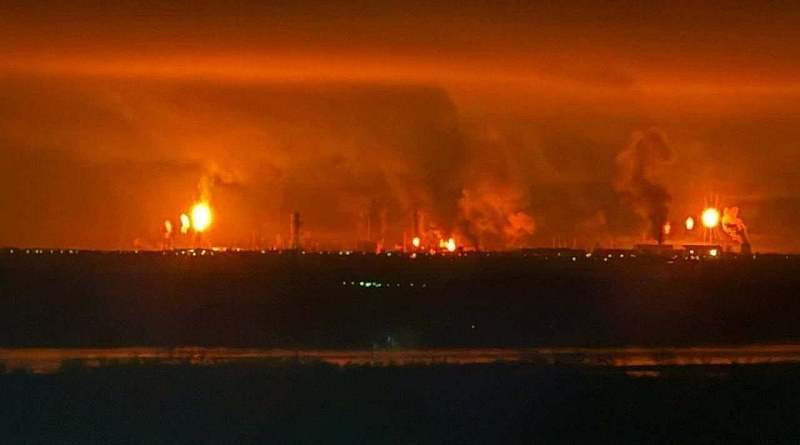
– In the last two weeks, all five of Russia’s largest refineries have been hit. Among them are the Omsk plant with a capacity of 22 million tons per year, “KirishiNefteOrgSintez” (“Kinef”) in the Leningrad region (21 million tons), Ryazan Refinery (17 million tons), “Slavneft-YANOS” (15 million tons), and Nizhny Novgorod Refinery “Lukoil” (NORSI, 17 million tons). Also attacked were the Volgograd Refinery with a capacity of 14 million tons, Novokuibyshevsk Refinery “Rosneft,” “Bashneft-UNPZ,” and Afipsky Refinery.
– The consequences of these strikes may prove significantly more serious than previous disruptions in the oil refining industry. If Ukrainian Defense Forces can repeat attacks of this scale and intensity every two to three weeks for several months, it will radically change the conditions in which the Russian economy operates.
3. The fuel crisis in Russia has led to a sharp increase in the cost of road freight transportation.
– As of the end of October 2026, tariffs for transportation by regular tarpaulin trucks increased by 28.3% compared to October of the previous year, and by refrigerated trucks by 27.6%. The main growth occurred in the third quarter when the Russian market faced a sharp increase in gasoline prices.
– In August, the annual increase in its prices reached 25.9% — the highest level in 18 years. From July to September, the median cost of transportation by tarpaulin trucks rose by 17% — from 99.9 to 116.7 rubles per kilometer. As of November 1, the tariff for transportation by tarpaulin trucks was 112.5 rubles per kilometer — 15.8 rubles more than in January. Transportation by refrigerated trucks rose by 10.6% in October alone, to 118.3 rubles per kilometer.
– Compared to September 2025, rates for such transportation increased by 31%. As a result, delivering a 20-ton truck over a distance of 1,000 km now costs about 25,000 rubles more than a year ago. This increases costs for manufacturers and retail networks and adds additional pressure on the prices of goods transported by road.
4. The EU ban on the import of Russian liquefied natural gas from 2027 will force Russia to seek new buyers for the Arctic “Yamal” project and rebuild export logistics.
– According to Urgewald, from January to October 2026, 81% of registered LNG deliveries from “Yamal” were directed to Europe. During this period, European countries spent 8.7 billion euros on Russian gas — more than in the entire year 2025 (7.2 billion euros).
– The ban will end long-term contracts that linked the project with European buyers. Europe was the closest major market: delivery took 6–10 days.
– Reorienting to Asia will mean significantly longer routes and higher costs. One option is transporting gas via the Northern Sea Route; however, Russia has only 15 specialized gas carriers capable of making this journey in winter. Another is transferring LNG from the ice fleet to regular tankers near Murmansk. Bypassing Africa takes 35–40 days one way.
– Despite the possibility of partially resuming exports within one or two years, the loss of the European market will make supplies from “Yamal” more expensive and complicated. Russia will have to compete for Asian buyers with suppliers that do not have such logistical constraints.
5. Ireland is urged to stop supplying alumina to Russia — a raw material necessary for the production of aluminum, used in the manufacture of missiles, drones, aircraft, and explosives.
– Currently, exports from Europe’s largest alumina plant, Aughinish, owned by the Russian company Rusal, are not subject to EU sanctions. From March to October 2026, about 491,000 tons of alumina were sent from Ireland to Russia. Irish supplies account for approximately 17% of the raw material imported by “Rusal.”
– After ceasing supplies from plants in Australia and Ukraine, the Russian manufacturer’s dependence on Irish raw materials has significantly increased. An investigation by OCCRP and The Irish Times found that Irish alumina is processed in Russia into aluminum, some of which goes to companies supplying the Russian defense-industrial complex.
– EU sanctions envoy David O’Sullivan also stated that the raw material goes to Russian plants manufacturing materials for the military industry. Despite this, the Irish government claims to have no direct evidence of alumina’s use in military production.
– Aughinish Alumina denies any connection of its products to Russian military supplies. Meanwhile, the results of the government investigation have not been published.
– The issue of banning alumina exports to Russia is being discussed in the EU, but it was not included in the 21st sanctions package in July. Implementation of restrictions requires unanimous support from all 27 member countries.
– The Irish opposition urges the government to act more decisively, including considering temporary nationalization of the plant and redirecting its supplies to European buyers.
In the background: The Volgograd refinery attacked on November 13. Illustrative photo: screenshot Exilenova+
