
The famous British series “The Twilight Zone” from 1959 began with a brief explanation and adjustment to its title: “There is a fifth dimension, beyond that which is known to man. It is a dimension as vast as space and as timeless as infinity. It is the middle ground between light and shadow, between science and superstition, and it lies between the pit of man’s fears and the summit of her knowledge. This is the dimension of imagination. It is an area which we call the Twilight Zone.”
For me, the “twilight zone,” a timeless space where “parallels intersect” and names from Ukrainian history converge, is the small border, evacuated village of Kostobobriv in the Chernihiv region. The word “Mazepa” is associated with it, traditionally evoking a bitter aftertaste and shivers in the average Russian. However, the surname of the well-known Ukrainian hetman turned out to be far from the only one involved. The Prime Minister of the Ukrainian People’s Republic and head of the government in exile, Isaak Mazepa, originated from Kostobobriv. The Russian journalist of opposition views, Anna Politkovskaya (née Mazepa), also had roots there.
What if we delve deeper into the paths of the “twilight zone”? There, Odysseus-like, at the entrance to the beyond, we see shadows of the past that would wish to speak. One of them is the Mazepite Ivan Bystrytsky. We can imagine him by Hetman Ivan Mazepa as someone trustworthy, someone who can carry out any assignment. We observe him delivering a message to the Swedish King Charles XII about the Cossacks’ intention to become allies and remaining with his “patron” to the very end.
But what preceded this? Ivan Bystrytsky was the manager of the Sheptaky district, founding settlements (including the important Kostobobriv) and engaging in the settlement of the territories under his control. If we can determine the time of the emergence of local “Ukrainian contexts,” it will be associated with the Baturyn period in the history of the Hetmanate. A time when the residence of Ukrainian hetmans was the city of Baturyn, around which a separate estate complex was formed, with its own ceremonies and traditions, court banners, and diplomatic receptions. A time that can be associated with something greater than an unpleasant “tragic episode.”
In the Service of the Hetman

In the cold October of 1678, it rained heavily for a long time. Company Colonel Illia Novytskyi with a group of Cossacks, weary from prolonged battles, awaited the approach of Tatar units to the Dnipro. He was finishing reading a letter from the left-bank Hetman Ivan Samoylovych, who requested to be ready to repel the enemy and remain in position until further instructions. Suddenly, the colonel’s gaze dropped to a “non-official” note: “Although it’s cold, hungry, and home is far away, endure a little longer, for ‘he who endures to the end will be saved.’ You often preach this yourself” (author’s translation). The colonel folded the letter and reminded himself: the hetman relied on him.
In the swirl of shifting alliances and prolonged wars, hetmans found support in loyal troops. Those who formed a personal guard and carried out special assignments swiftly and efficiently. The Cossack militia often proved ineffective and unpredictable, while mercenary units allowed for a readily operable force. Court formations at the hetman’s court performed three main functions: ensuring the personal safety of the hetman, participating in military operations, and representing hetman power during ceremonial events.

Relying on volunteer companies, left-bank Hetman Demian Ignatovych came to power. At his disposal were mounted company units. As the Chronicler puts it, he “gathered companies from Lithuanians, Poles, and many others…” Additionally, he had a foot guard, which protected his residence in Novhorod-Siverskyi and the new capital in Baturyn. The guard was led by Captain Petro Voroshylo, whom the hetman trusted.

It was due to the dangerous independence of Demyan Ignatovych that the Konotop Articles of 1672 prohibited the newly elected Hetman Ivan Samoylovych from keeping mercenary troops. However, he violated that prohibition and actively recruited “volunteers” for service. One of the first mentioned contingents is the banner of Yakiv Pavlovsky and several others, including dragoons and foot serdyuks.
Under Ivan Mazepa, the court troops gained particular color, scale, and significance. They performed both ceremonial and practical functions. Separate hetman guard units, such as the zhuldaks, were distinguished. They had a specialization in guarding the hetman and his residence. There were also much larger guard regiments, such as the serdyuk regiment led by Dmytro Chechel.
 |
 |
| Volokh of Hetman I. Samoylovych’s Courtyard Banner, 1670s–1680s. Artist Serhiy Shamenkov | Soldier of the Infantry Mercenary Regiment during the times of D. Mnohohrishny, 1660s–1700s. Artist Serhiy Shamenkov |
 |
 |
| Dragoon of Hetman D. Mnohohrishny, 1660s–1670s. Artist Serhiy Shamenkov | Dragoon of Hetman I. Mazepa, late 17th – early 18th century. Artist Serhiy Shamenkov |

The Hetman’s court also included the “Zaseim” hundreds of the Nizhyn regiment. The hundreds located on the Hetman’s rank estates near the residence in Baturyn had a special status and were directly subordinate to the Hetman. On the eve of the Cossack revolution, the owner of Baturyn was Crown Chancellor Jerzy Ossoliński, emphasizing the city’s priority in the strategy of the administration of the King of the Polish-Lithuanian Commonwealth, Władysław IV. There is an opinion that the special position of the local formations originates from the times of active “settlement” activities carried out by the Commonwealth government on the Moscow borderlands.
Space
The swift removal of Demyan Ignatovich following the senior coup of 1672 set a precedent regarding potential risks for the power of the Baturyn hetmans. Despite apparent loyalty to Moscow, they had to create a subordinate and safe space around their own court. This was based on a network of patron-client relationships and hetman estates. Besides the established hetman rank estates, such as the Hadiach castle or the Sheptakivska volost, granted during the time of Ivan Bryukhovetsky, new lands were actively purchased around Baturyn. These were to be managed by loyal “regiment” members — a circle of close individuals and families. Overseers and elders were appointed to manage the subordinate estates. The Baturyn court did not exist in isolation from the surrounding area. Its functioning was ensured by a whole network of properties, administrative points, roads, crossings, servants, and dependent population.
Most of the hetman possessions acquired during the “Baturyn” period were interconnected: on one side, they bordered Baturyn, and on the other, they were linked by waterways. Near Baturyn, Ivan Samoilovych established the Obmachiv estate, which included the outskirts of Sosnytsia, Novomlynsk, and Baturyn hundreds. To the north lay the Sheptakivska, Ropska, Pochepska volosts in the Starodub Regiment, and the Perelyubka, Okhramiievka, Lyubechka — in the Chernihiv Regiment. In the Nizhyn Regiment, the Yampil volost was actively developed. Ivan Samoilovych’s son, Semen, received the office of the Starodub colonel. He was also granted several villages in the Topal Hundred, including Hremyach, Perehon, and Borshchiv villages. The hetman’s son founded the town of Semenivka in the territory of the Starodub Regiment. The territory under the control of the hetman possessions united trade routes — from Starodub to Baturyn, connecting with the Dnipro crossings. Thus, under Ivan Mazepa, an estate appeared in Perevolochna with its own overseer.
In the village of Mytchenky near Baturyn, the general scribe Pylyp Orlyk, close to Hetman Ivan Mazepa, resided. He also owned the village of Domashlyn in the Chernihiv Regiment.
It is important to note that Ivan Mazepa relied on the communication line between the hetman estates when making an alliance with the Swedish King Charles XII. They were to enter the territory of the Starodub Regiment, where the loyal Ivan Skoropadsky was located, and receive the promised support in the territory subordinate to the hetman’s estates.
Ceremonies and Traditions
An important place in the ceremonial was the establishment of the hetman’s authority. The strict court ceremonial was initiated by Ivan Samoylovych. He introduced rules designed to elevate the hetman’s status above the officials. All these practices had a common function: they created a distance between the hetman and his entourage and transformed his power into a visible, daily reproduced hierarchy. Specifically, entering the residence with weapons was prohibited, and during audiences, all visitors—including senior clergy and general elders—were required to stand. Eventually, these practices became a tool of political pressure and an indicator of the ruler’s true attitude toward specific individuals. Samoylovych demonstrated his superiority in churches as well: according to the Chronicles of Samovydets, he never accepted church gifts personally—they were ceremoniously presented to him by a priest. Additionally, Samovydets reproachfully mentions Samoylovych’s purchase of a carriage, which he used instead of riding on horseback. Although such innovations initially caused considerable irritation among the upper echelons of the officials, over time, they became a customary element of court life and no longer met resistance.
An important part of the political strategy was the visual presentation of state power beyond the residence. A telling example is Ivan Mazepa’s visit to King Charles XII’s camp in November 1708. This ceremonial outing took place according to a strict protocol: officials and a trusted person with a baton adorned with precious stones, gold, and silver rode ahead, a white mace reminiscent of a Turkish horse tail was carried behind the hetman, and the procession was closed by an entire military unit.
The representational culture of the hetman’s court is vividly manifested during ceremonial banquets. However, the lifestyle of the first leaders of the Cossack state was relatively modest, and much property was inherited by their successors, especially in cases of violent removal from power. The scale of such feasts was impressive.

The scale of the inventory shows that a banquet at the hetman’s court was not a private meal of the ruler but an important mechanism of collective power representation. For example, Ivan Samoylovych’s silver and gilded dish inventory included almost one and a half thousand items (among them 77 cups, 60 mugs, nearly two hundred glasses, dozens of plates, and 181 spoons). Individual bowls were crafted in the form of mythical creatures or animals (unicorns, owls, cats), and spoons were adorned with family crests. The size of the tableware allowed for hosting over 180 guests simultaneously.
Apart from official receptions, court life was accompanied by hunting, a favorite pastime during the times of Ivan Mazepa. Notably, there is information about the delivery of four falcons and two gyrfalcons to the hetman, accompanied by professional falconers to train hunters. Other sources mention hunts with Turkish hounds. To support such events, a whole network of specialized servants existed. For instance, the description of the Baturyn district in 1726 records over twenty wolf hunters in the village of Obmachev, and several bear handlers in the town of Ropsk who were directly involved in organizing hunts.
Fresh game was supplied to the hetman’s court by groups of shooters, akin to hunters. By the 18th century, the shooters from the village of Perelyub were recounting their duties: they “shot beasts and birds, and delivered them to the hetman’s court. During Mazepa’s time, besides hunting animals and birds, they transported wood to the Desna, linden logs to Baturyn, and firewood to Hetman’s estates in Sosnytsia on carts.”
Heads of the court played a key role in managing the household, overseeing finances, estates, and handling complaints. Close associates included marshals, horsekeepers, chamberlains, treasurers, and tent keepers who ensured daily operations and participated in ceremonies. Noblemen, chamberlain servants, and couriers, who undertook delicate tasks and diplomatic missions, were important supporters of the hetman. Serving as a hetman nobleman had career prospects. For example, Mykhailo Myklashevsky, who started as a hetman nobleman, became the Starodub colonel.
What Followed
The estates belonging to Ivan Mazepa were a concern for subsequent rulers of the Hetmanate for a long time. Initially, they were taken by a favorite close to Emperor Peter I, Aleksandr Menshikov (the same one who commanded the assault on the city in the autumn of 1708). First of all, he took control of the Pochep, Yampil, and Baturyn hundreds.
Then, in 1726, a special investigation was conducted regarding the future state of the former Baturyn castle holdings. The materials of the investigation were compiled into the so-called “Mazepa Book.” A few years later, the new hetman, Danylo Apostol, intending to restore the complex of rank hetman estates, conducted a so-called “general investigation of estates” across various regiments of the Hetmanate.
Some possessions were returned to hetman control, some had already changed ownership several times, and in some places, only part of the inhabitants was returned to subjugation. The same Danylo Apostol requested permission to return the hetman’s residence to Baturyn but was refused.
The times when hetmans were in Baturyn remain in historical memory. Interesting microtoponyms around Baturyn include “Kochubeivshchyna” or “Kochubei Forest,” Chechel Forest, the island “Mazepa Apiary,” or the corner “Chuykove,” possibly connected to the Chuykevich family.
Baturyn Court disappeared as a political center after 1708, but its traces did not vanish along with the court. They remain in documents, estates, local memory, and even in the names of the surrounding area.
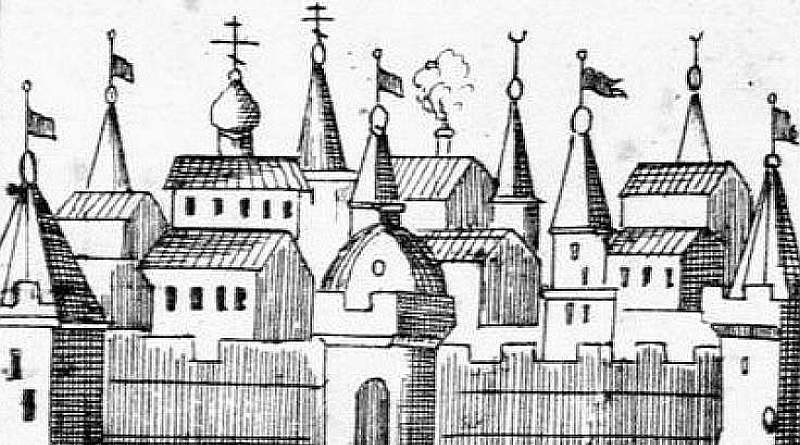
On Cover: View of Baturyn, a lubok of the early 18th century.
