
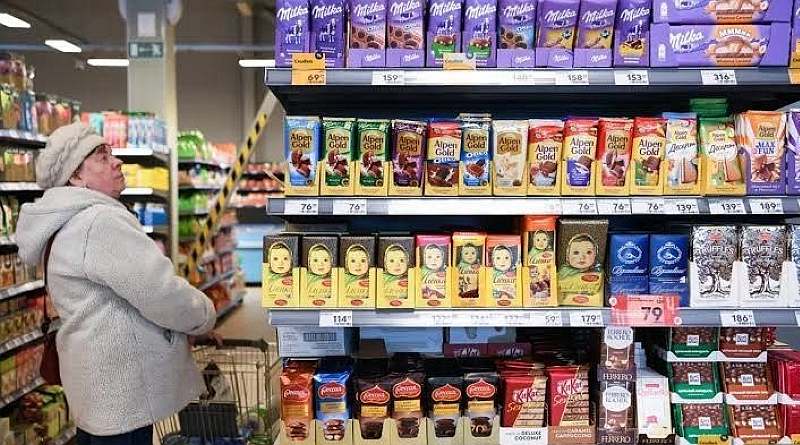

One of the most telling signs of the current economic situation in Russia is that state structures are increasingly advising citizens not to wait for improved conditions but to adapt in advance to their deterioration. In particular, “Roskachestvo” officially advises purchasing long-lasting products for the New Year right now, while they haven’t become even more expensive in anticipation of the holidays.
At the same time, official statistics do indeed record a 3.36% increase in food prices in August and September, which only confirms the concerns of buyers. When government officials urge stocking up on canned goods, sugar, and grains several months before winter festivities, any observer inevitably asks: if the economic policy proclaimed by the Kremlin is so “successful,” why must Russians insure themselves against its results with their own wallets?
The economic consequences of the war unleashed by the Kremlin are inextricably linked with record defense spending, as their impact on the budget system has been enormous.
In September 2026, the federal budget deficit may reach about 3% of GDP compared to the originally planned 1.6%, with the main increase reason being military expenses. A rather simple chain emerges, in which the state directs more resources to continue hostilities, and the budget faces a colossal additional burden.
Simultaneously, citizens are persistently instructed on how to “more rationally” buy pasta, vegetable oil, and sweets to somehow survive the next round of price hikes.
After the start of military actions, Russia faced large-scale sanction restrictions that affected virtually all areas of trade, technology, financial operations, and logistics. Although their impact does not mean that every price increase in canned goods or flour can be automatically explained by external factors, prices are always formed by a whole range of internal and external conditions.
However, denying the effect of sanctions, the forced restructuring of trade routes, and growing costs means completely ignoring the obvious economic reality. In this regard, the situation appears particularly cynical when the authorities first make political decisions that catastrophically increase systemic costs, then suggest that the population “solve” the arising problems in the simplest way—by purchasing in advance.
Perhaps “Roskachestvo’s” advice seems quite rational from the perspective of an individual buyer, as early purchase of rising goods can indeed save family funds for a time. However, on a countrywide scale, the picture is different, as citizens are essentially advised to “manage” the consequences of galloping inflation themselves, spreading purchases over time and trying to guess which particular product will rise in price tomorrow.
A paradoxical situation arises where large-scale economic problems become systemic, and the Kremlin structures suggest seeking solutions “at the level of the kitchen shelf.”
While the Kremlin stubbornly continues the war and ignores the accumulated imbalances, the country sinks into a state of deep economic isolation. Inflation creeps up, the budget is strained to the breaking point, and basic products are demonstratively becoming more expensive. The recommendations of officials to stock up on food in advance clearly indicate an understanding by the authorities themselves: by December, the price situation will inevitably worsen, and thus, a part of the concerns for the holiday table should be placed on the shoulders of the citizens themselves.
