
108 years ago in Kyiv, a real Apocalypse began – Muravyov’s gangs captured the city and unleashed red revolutionary terror.
February 7, 1918. Kyiv was under intensive artillery shelling by Bolshevik troops under the command of Mykhailo Muravyov. Polupanov’s armored train fired on the central areas of the city. The troops of the Ukrainian People’s Republic defended the line Khreshchatyk — Bibikov Boulevard — Brest-Litovsk Highway, but were forced to retreat in the evening. Under the protection of the Sich Riflemen, the Central Council also left Kyiv.
The motto of the occupation was “death to Ukrainians.” Muravyov even wrote this on his personal armored vehicle.
On the same day, the Bolsheviks killed Metropolitan Volodymyr — an event that became a symbol of deep moral and human tragedy during the fall of the capital.
On the night of February 8, 1918, Bolshevik troops under the command of Mykhailo Muravyov, after shelling from Darnytsia, invaded Kyiv. From this moment, the merciless destruction and looting of everyone who came in the way of the invaders’ army began. The Bolsheviks justified their actions by “revolutionary expediency.” And perhaps of all the areas of the capital, Pechersk suffered the most from the actions of Muravyov’s bandits at that time.
After Ukrainian units began to withdraw from Kyiv with fighting, the Reds began to disarm and shell neutral units with artillery. The reason for this is still unclear to researchers, but the Bolsheviks punished everyone who did not support them – even absolutely neutral military or civilians.
Muravyov boasted in reports to the leadership about the beginning of the capture of Kyiv: “I ordered the artillery to hit the high-rise and rich palaces, the churches and priests… I burned Hrushevsky’s large house, and it blazed with bright flames for three days.” Later, he gave an independent assessment of his actions: “We are establishing Soviet power with fire and sword. I took the city, hit the palaces and churches… no one was spared! On January 28, the Duma (of Kyiv) asked for a truce. In response, I ordered them to be suffocated with gases. Hundreds of generals, perhaps thousands, were mercilessly killed… We could have stopped the wrath of revenge, but we did not do this because our slogan is to be ruthless!”
By the way, Muravyov was one of the inventors who came up with the idea of using poisonous gases in the civil war. It was with their help that he captured the bridges across the Dnipro and the Dnipro cliffs, which were guarded by Ukrainian troops.
In the first week of the Bolsheviks’ madness in Kyiv, at least three thousand people were killed. Mostly intellectuals, industrialists, entrepreneurs, teachers, officers.
These events were well described by an eyewitness, historian Dmytro Doroshenko: “I went through the Sennoy market. It was full of people and many soldiers with rifles, all young, beardless boys, speaking and swearing in Russian. They were leading an old, gray-haired, shabby general somewhere, pushing him in the shoulders… The Bolsheviks entered the city from the Pechersk and Lipki sides — the wealthier quarters of the city where richer military and civil officials usually lived, generally well-off people, and carried out a bloody bath here.
They broke into houses, dragged out generals, officers, and simply adult men, and killed them on the spot or led them to the former royal palace and shot them there or even on the way.” They killed both supporters of the White Guards and Ukrainians. Among the dead were generals of the Tsarist army and the UPR army B. Bobrovsky, A. Rozgin, Ya. Safonov, N. Ivanov, Ya. Hanzhuk, and many others.
Sometimes, wild peasants from central Russia could shoot a person just because they spoke Ukrainian. The invaders saw this as hostility.
When the Bolsheviks sent their officials to control the conquered city, they themselves reported in horror about the complete disintegration of the Red Army and thousands of corpses of peaceful residents in the parks and courtyards of Kyiv. The Kyivites themselves called Muravyov the “leader of the bandits” who fiercely hated Ukrainians, calling them Austrian spies and traitors, and agitated for the “single and indivisible Russia.”
Such a position also led to conflicts with other Bolsheviks; however, despite numerous complaints and attempts to remove the maniacal officer from commanding the troops, the higher leadership of the Reds stood up for him.
The most famous and resonant at that time in Kyiv was the murder of Metropolitan Volodymyr of Kyiv-Pechersk Lavra. This is how Muravyov himself reported about it: “To all citizens of Kyiv! At a time when the revolutionary troops fought, bleeding, on the streets of Kyiv with the enemies of the freedom of the proletariat and the working peasantry in Ukraine, some criminals, undoubtedly falsely claiming to be anarchists, committed a terrible deed in the rear of the revolutionary troops on the night of January 25. They broke into the bedrooms of the Kyiv Metropolitan Volodymyr, robbed him, led him out of the monastery, and killed him. I find no words of indignation for this evil deed. I declare on behalf of myself and the entire revolutionary army that I will take the most decisive measures to search for the villain-provocateurs and punish them most severely. Commander-in-chief Muravyov.”
However, no one was found guilty.
Moreover, before the capture of Kyiv, Muravyov himself repeatedly called on his fighters to deal with the enemies of the revolution and even promised to give them the city for looting. Specifically, Muravyov’s order No. 9 of January 22 (February 4, new style) 1918 to the troops, issued in Darnitsa, stated: “I order the troops of both armies to mercilessly destroy all officers and cadets, Haidamaks, monarchists, and all enemies of the revolution in Kyiv.”
It is worth noting that the atrocities of Muravyov’s bandits outraged some Bolsheviks who left descriptions of those events. So Yefim Lapidus described the bloody massacres on the streets of Kyiv in Muravyov’s instructions to his subordinates: “Soldiers and Red Guards often brought the arrested to Muravyov’s and Yegorov’s headquarters for investigation. Muravyov, and after him Yegorov (the commander of the First Army), repeatedly said: ‘Why the hell are you bringing them here, don’t you know where the ‘Dukhonin’s headquarters’ is? Send them all there without interrogations!’” The Bolsheviks called execution without trial or investigation the “Dukhonin’s headquarters.”
In just over three weeks of the Reds’ rule, Kyiv turned into a branch of hell on earth, and the residents themselves called it an “apocalypse.” The number of victims killed in Kyiv has not yet been calculated, and it is subject to discussion. It is only known that in three weeks, between 4,000 to 10,000 people were destroyed in just one place. After the liberation of the capital from the Bolshevik invaders, the victims of the Red Terror were buried all over the city in various cemeteries, including Askold’s Grave.
The fate of Muravyov himself after the genocide in Kyiv is no less interesting: in April 1918, after Muravyov’s admitted defeats and endless conflicts with the leadership of the Soviet government of Ukraine, he was arrested and sent to Butyrka prison under investigation. A medical examination determined that Muravyov was suffering from “neurasthenia of a degree greater than average,” after which he was transferred to a psychiatric hospital, from where he was soon discharged. By June, he was already appointed commander of the Eastern Front, where he raised a rebellion against the Bolsheviks. During the suppression of the rebellion, Muravyov was shot on July 11, 1918. And the Red Terror would return to Kyiv with even greater scope, but in 1919…
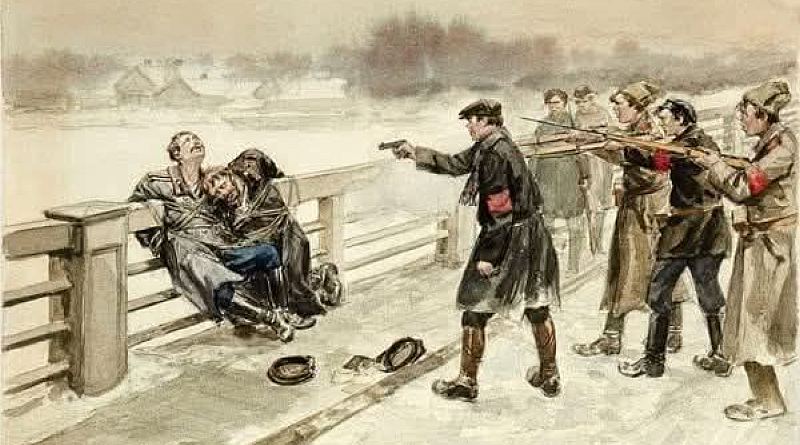
Illustration by artist Ivan Vladimirov, who documented the Red Terror based on what he personally witnessed in 1917-1922: Executions in 1917-1919.
