
Before the full-scale invasion of Ukraine, I didn’t believe they would dare to do it – there was no readiness or mobilization of the rear, deployment of numerous repair bases, and road units.
I refused to believe that “pedal to the metal” and reaching Kanev in 48 hours, and then “somehow it will be” against a country the size of France, was their actual plan.
Now we are closely watching the northern part of NATO’s Eastern flank, with bloody experience: they are truly insane, having put half a million people in coffins just because they thought it would be like in Crimea after Debaltseve. And right now, there are very alarming bells ringing there.
Operational Camouflage and Border Isolation
From September 21 to September 26 in the Kingisepp and Slantsevsky districts of the Leningrad region (right next to the Estonian Narva and Ivangorod), the FSB imposed a strict curfew with a ban on movement. The official excuse is “possible escapes from mobilization”. In reality: this is how they clear the operational zone of prying eyes, dashcams, and smartphones of local residents. This is classic preparation for the deployment area to covertly transfer columns, set up electronic warfare complexes, or Iskander missile systems. Narva is extremely tense as a result. Currently, this is an exercise in closing the district, and with the fall mudslides ahead, they are training very actively.
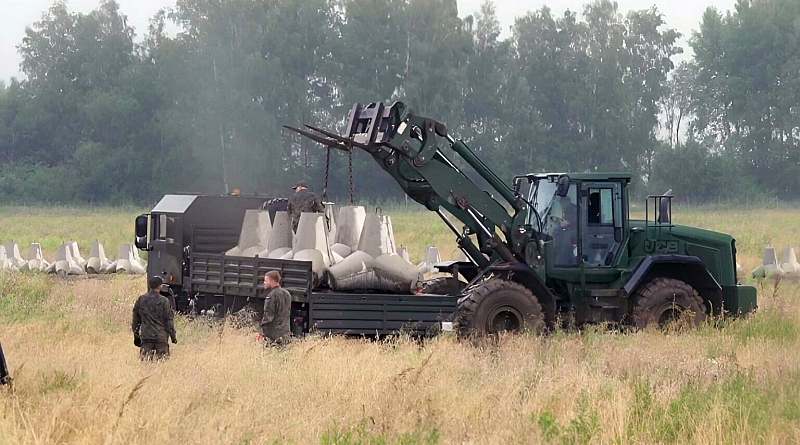
In all Baltic countries and Poland, an emergency security strip is being formed, ranging from 20 to 150 meters wide. The key tactic for 2026: Lithuanians have abandoned forest planting and have started artificially swamping the area to make the border territory physically impassable for heavy armor by 2030. The network of military depots with engineering obstacles (dragon’s teeth, minefields, concrete bunkers) has been expanded from 27 to 50 facilities. NATO is preparing for a sticky contact war.

Electromagnetic Terror and Air Defense Testing
Since the beginning of 2025, the number of antennas for electronic warfare systems (especially stationary systems like the 14Ц227 “Tobol” and “Murmansk-BN”) in the Kaliningrad region has increased manifold. The range of jamming and spoofing systems reaches 450 km, covering the Baltic, Poland, and part of Scandinavia. According to the Polish Institute of Communications, during the summer of 2026, prolonged signal disruptions (GPS, Galileo, GLONASS) were recorded in the Gdansk area for 60-70% of the days. This is a direct blow to civil aviation and maritime shipping. On August 21, 2026, the Polish minesweeper ORP Albatros was subjected to a targeted radio-electronic attack during operations in the Baltic Sea.
On September 23, the leaders of the Baltic countries wrote an urgent letter to Ursula von der Leyen. The essence: they urgently need half a billion euros for drone defense of the eastern flank (“drone wall”) by the end of 2026. They refer to intelligence data on the high probability that Russia is preparing massive UAV strikes on their infrastructure. Neither Poland nor the Baltic states historically have a layered air defense capable of holding back several hundred 4+ generation Russian aircraft, and now also drone swarms. In August at the Sēlija training ground in Latvia, the BATT26 exercise took place, where the Alliance tested drone defense — from detection to physical suppression. Simultaneously, the Netherlands extended the mission of their MQ-9 Reaper reconnaissance UAVs on the eastern flank until the end of 2027.
On September 16, emergency services were alerted in Finland — a Russian drone brazenly flew directly over the no-fly zone of the Loviisa nuclear plant. And on September 21, Latvia (where a “Shahed” recently crashed near Rezekne) and Poland scrambled combat aircraft due to the activity of Russian UAVs near their borders. The Russians are testing the real-time response speed of NATO radars, air police interceptors, and AWACS aircraft from depth.

Lithuania, understanding that the usual contingent for deterrence is not enough, this week by parliamentary decision lifted the ban on housing nuclear weapons in the country. This was not done for a headline but is a direct reaction to intelligence data on the deployment of Russian strike groups. It is all logical here: planes from the French squadron capable of delivering strategic nuclear strikes have already been transferred to Poland during crises. If the bunker grandpa really wants to go to paradise and everyone else dies while he injects Botox and undergoes regular health checks, the Alliance plays its last trump card.
By the way, on September 25, the Russian state agency “RIA Novosti” published an article titled “Russia Faces Another Special Military Operation. It Will Be Very Short.” The author of this publication is Alexander Nosovich, a member of the Council on Foreign and Defense Policy and the editor-in-chief of RuBaltic.Ru – an element of the network created by the Russians to interfere in the internal politics of the Baltic countries. The article is in response to the Lithuanian parliament’s decision and is full of threats: “One cannot say that Russia has no choice at all. Russia has a choice: how to fight. It is not even about whether long or short. Clearly short: the military conflict in the Baltics, just due to geography, cannot be the same as in Ukraine. It’s about which means can be used. And if our opponents are the first to turn the conversation into the realm of nuclear threat, then Russia can afford even to refuse the introduction of ground forces. Only missiles with the appropriate charge.” (The article was later deleted).
Accumulation of Reserves
On the Dobropil-Lyman and Kupiansk directions, there are currently no Russian airborne forces. The units that have not been reduced to zero near Chasiv Yar (98th Airborne Division) and are not bogged down in the Kursk meat grinder (76th and 106th divisions) have been withdrawn from the line of combat contact. Considering the suspicious lack of activity of military transport aviation (IL-76), they are clearly preserving the remains of the Airborne Forces in the deep rear as a mobile strategic reserve, replenishing and re-equipping it.
After the August-September battle, where our 1st AK conducted a surgical cleanup of the 90th Tank Division (those same 237 killed to 44 wounded), it lost its striking potential and critical mass of armor under the blows of our FPV and bombers. The Russian command had to withdraw the surviving regiments of the 90th TD to the rear for recovery, leaving infantry in the “pocket.”

The 4th Kantemirovskaya and 47th Tank Divisions show a similar picture. Over the summer, they lost a significant portion of operational T-80BVM and T-90M tanks in the Kupyansk-Lyman direction. Due to the intense work of our UAVs, mining, and cluster artillery, tank raids became ineffective, and the armor was moved to operational reserve.
Can they restore the numbers and combat capability of the Airborne Forces and these tank units in the rear, for example, based on training centers and deploying divisions? I think so. And they are clearly preparing them not for meat assaults on plantations in the Donbas.
Sabotage in the Rear
OSINT analysts note that old Russian oil tankers and so-called oceanographic research vessels (such as “Admiral Vladimirsky” or “Sibiryakov”) constantly stall or “break down” right over critical undersea fiber optic cables and gas pipelines (like Balticconnector) connecting Finland, Estonia, and Sweden. This is clearly working out a scenario for infrastructure blackout.
There is a wave of small but systematic diversions: arson of logistics warehouses (like TC Marywilska 44 in Warsaw or factories in Wroclaw), relay cabinets on railways. The GRU (including unit 29155) hires local marginals via Telegram for crypto. The aim is not to cause strategic damage but to overload internal special services (ABW in Poland, VDD in Latvia) and test the reaction speed of firefighters and police before a real “H-hour.”
On the Ust-Luga – Baltijsk line, there is a maximum load of Ro-Ro ferries (vessels with horizontal loading like “Marshal Rokossovsky” and “Ambal”). Civilian trucks are waiting in long queues because priority is given to military oversized loads. Under the guise of supplying the exclave, modules for electronic warfare systems and fresh ammunition for Iskander tactical missile systems and Bastion coastal complexes are actively imported there. Kaliningrad is being pumped up as the main A2/AD zone (anti-access/area denial) to block the Suwalki corridor.
Blackmail Instead of Blitzkrieg
What does all this resemble? They aren’t preparing a tank rush to the English Channel. They are preparing hybrid isolation. To blind GPS, cut communication submarine cables with a shadow fleet, send crowds of illegal migrants from the Belarusian border onto Polish bayonets, and amidst this chaos — introduce “peacekeepers” to protect Russian speakers in Narva or break a corridor to Kaliningrad, threatening with nuclear might if NATO responds.

Moreover, this is the sale of another “Victory” (trademark) to their own citizens, who are already a bit tired of burnt warehouses with Wildberries parcels and half-empty gas stations in St. Petersburg due to diesel shortage.
But the main goal is bargaining over Ukraine. After cut routes near Kupiansk, Lyman, and Dobropillya, the timeline for the start of battles for the Sloviansk-Kramatorsk agglomeration clearly shifts by many months. Given the pace of advancement near Chasiv Yar and Pokrovsk — perhaps by a couple of years.
The Bolivar of the Kremlin’s economy, amidst falling production, the knockout of 40% of oil refining, and the blockade of grain transshipment through the Black Sea, will die much earlier. Therefore, the only working option for them is blackmail and an attempt to overturn the geopolitical table. Create a crisis of such a scale that the EU and the US force us to stop knocking out their refineries, factories, and arsenals in exchange for de-escalation in the Baltics.
Only 3-4 weeks remain until the start of autumnal bad weather in the Baltics. Heavy armor in the forests near Narva or Suwałki will come to a dead stop in the mud, but for a hybrid scenario (capturing cities with Special Forces, blackouts, cutting cables with a shadow fleet), weather is not a hindrance. The FSB has closed the border zone until the end of September, and NATO’s “drone wall” is not yet built.
Everything indicates that operational readiness is at its maximum right now. They vitally need to shake up the situation before the November elections in the US Congress, while American politics is absorbed with internal squabbles, and making tough geopolitical decisions in Washington is stalled.
I hope that the Alliance also clearly sees this fork. It’s simple: either the West gets scared and pressures us, or the Kremlin breaks its teeth on the Baltics just as it is breaking them on the defenses near Kupiansk. And judging by the construction of the “drone wall,” NATO is also studying this calculation.
On the cover: Construction of the “Eastern Shield” barriers in Poland. July 2026. Photo: screenshot from the video by the General Staff of Poland
