
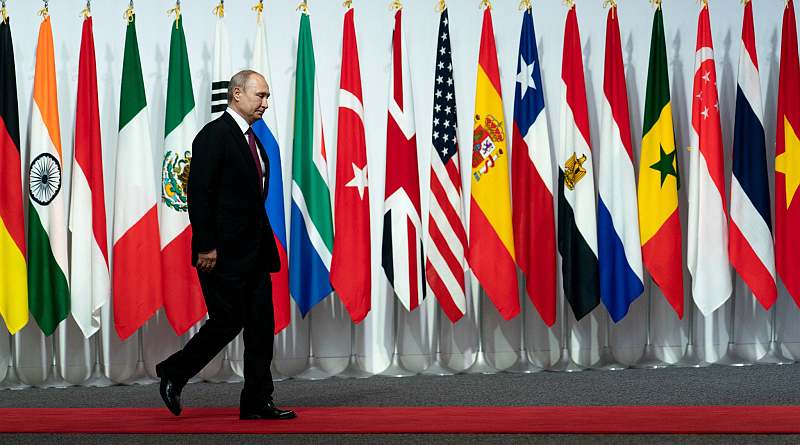
U.S. Secretary of State Marco Rubio has officially invited Russian President Putin to the G20 summit in Miami.
Rubio emphasized that for the Russian leader, it would be a great opportunity to meet not only with U.S. President Donald Trump but also with other world leaders, highlighting the importance of dialogue even with those with whom you have differing positions on many issues.
Thus, Washington once again demonstrated an obvious misunderstanding of Russian political psychology. Inviting the Russian president to the G20 summit, when he practically rejects all American peace proposals, seems to Putin as an obvious sign of Washington’s weakness and pushes away any productive negotiations for ending the Russian-Ukrainian war.
There are still no signs that Putin actually intends to accept Trump’s invitation and attend the G20 summit in Miami. First, because for him, it would not be a demonstration of being welcomed, but rather a demonstration of Russia’s isolation from the rest of the world. Apart from meetings with Trump or leaders of the Global South, who are already partners with Putin in BRICS or the Shanghai Cooperation Organization, the Russian president cannot expect any other meetings.
He will not meet with European leaders, nor leaders from Canada or Japan. Thus, the fact that Russia remains isolated from the rest of the civilized world, and that only Donald Trump in this civilized world holds a different position, will become evident at the G20 summit. So why would Putin agree to such an agenda?
Moreover, he may fear that the American president will propose a trilateral meeting in Miami with the leaders of Ukraine, Russia, and the United States, and Putin has no desire to meet with the president of Ukraine and talk about peace. Therefore, a meeting at the level of foreign ministers, like the one that took place on the sidelines of the UN General Assembly session between Marco Rubio and Sergey Lavrov, might happen. However, even at this meeting, Russia, of course, demonstrated unwillingness to give up any of the uncompromising positions it upholds in the matter of ending the Russian-Ukrainian war.
Putin’s attendance at a prestigious summit of world leaders is unlikely until he is confident that such presence will not be associated with a series of political scandals, demonstrative walkouts, refusals to take photos, and public statements about Russian aggression.
Putin might leave this kind of “pleasure” to Lavrov or Siluanov, but not for himself.
The question is, why is the Trump administration so insistently seeking a conversation with the Russian president? It would seem that the meeting in Anchorage should have convinced the President of the United States that any summit at such a level is used by the Russian leader solely to demonstrate his own political weight, that he is absolutely not ready for any concessions that interest Donald Trump. That it is the American president who makes concessions to the Russian one, both when he abandons his idea of a ceasefire before peace talks, and when he agrees with Putin that a ceasefire can be linked to the fulfillment of certain Russian conditions and only then will there be peace negotiations.
And now, when Trump agreed contrary to his initial proposals for negotiations during the war and as a result did not gain any real pathway to ending the hostilities because Putin simply realized that he can use these negotiations during the war to bide time awaiting the midterm elections in the United States, and then the presidential campaign and elections in 2028.
During the meeting of foreign ministers, Lavrov clearly told his American counterpart that the Russian Federation is ready for negotiations, but there will be no talk of a ceasefire during the negotiations. That is, no Ukrainian strikes on Russian refineries, no difficult situation in the Russian economy, no Western reluctance to lift sanctions against Russia if it does not stop fighting, no Graham law forces Putin to change his position on the Russian-Ukrainian war even by a jot.
And a simple question arises: what prevents the American president from seeing this? Perhaps a monetary mirage? Perhaps the special representative of the President of the Russian Federation, Kirill Dmitriev, is not accidentally telling Steve Witkoff and Jared Kushner about the amazing opportunities for economic cooperation between Russia and the United States both when they arrive in Russia and when Dmitriev himself visits the United States, in which, of course, Trump’s family and closest circle can participate?
This desire to gain access to easy Russian money, which can be earned simply because Putin will treat you well, might be the main reason for completely ignoring the real political motives of the Russian president, a total unwillingness to see that Putin regards Trump, his relatives, and friends almost with undisguised contempt and simply hopes to outlive this American president, as he has outlived previous ones. Especially since it seems even easier to handle when you continue telling him about incredible economic opportunities and prospects.
Of course, from the perspective of the national interests of the United States, from the point of view of their prestige, Putin should not have been invited to the G20 meeting. Because the President of the United States, if he genuinely wishes to achieve results in the peace process, should clearly remember why Putin was expelled from the G8, and why other world leaders do not want to see him, and should not encourage the Russian president to think that no one in the world remembers his crimes.
