
Oleksandr Kovalenko / Obozrevatel
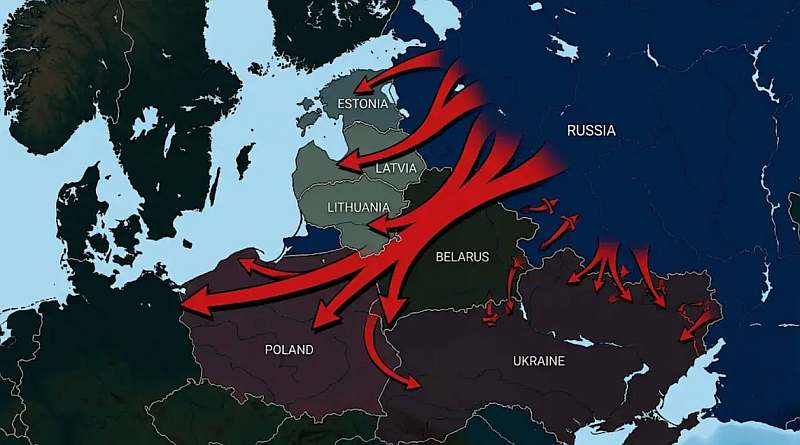
The catalyzation of hybrid provocations against EU countries and the formation of conditions for the direct invasion of Russian occupation forces have reached a critically high level. There are also numerous signs indicating the aggressor’s final preparations for this.
How events will develop further, when “hour X” will come, and where exactly – read in the new material of the joint project OBOZ.UA and the group “Informational Resistance.”
Real Threat
Polish Prime Minister Donald Tusk stated in the Sejm that Russia might launch hybrid strikes on European countries’ territories to test “red lines” – the robustness zone of NATO – based on the response reaction.
And it cannot be said that these claims are correct, as such testing has been ongoing for more than a month. However, the main direction for breaching this overall European robustness is not Poland, but the Baltic countries.
European media, citing their sources, reported that in the Leningrad military district, resources are being prepared in hospitals and local clinics for accommodating from 16 to 20 thousand wounded.
This is an important point to pay attention to. As is the fact that in two border districts of the same Leningrad region, a ten-day curfew was imposed, and hunting was prohibited.
In the five-kilometer zone along the border with Estonia, during non-daylight hours outside populated areas, people and vehicles are now prohibited from being present or moving. The presence of people and small vessels on the Narva River section is also restricted.
Incidentally, earlier (in early September), information appeared online that Russia is building gravel embankments along this river – near the Estonian locality of Vasknarva. This could later be used for setting up pontoon crossings.

As we can see, there are already these and a whole range of other signs confirming the inevitability of Russia’s invasion of one of the European NATO member countries. The least protected and least prepared for a full-scale combined military offensive operation by the adversary.
In October 2025, in my analytical article for OBOZ.UA, I emphasized that there is little time left until the point of no return and which EU country is threatened by a direct invasion of Russian troops, and also outlined in general terms how events might unfold.
And in January 2026, I voiced the worst-case scenario, according to which Russian occupation troops invade Estonia, which might happen as early as the second half of the year.
I then detailed how this would unfold and how countries that had not considered standing up to Russia all these years should prepare.
And now the activation of hybrid provocations against the Baltic countries, as well as the creation of conditions for a direct invasion, reaches a maximally critical level and literally electrifies the EU space. And the placement of infirmaries and field hospitals is actually the last sign of preparation for invasion.
The Baltic countries, especially Estonia, find themselves in the highest risk zone. Not Poland. Not Finland. It is those whose size is equivalent to two Russian regions, and whose logistics and territorial location allow them to be maximally isolated and captured in the shortest possible time.
Hybrid hints
Since Russia’s full-scale invasion of Ukraine in 2022, it has tested EU countries’ resilience to hybrid attacks. Realizing that the war would not conclude in a maximally short and acceptable timeframe for the Russian military-political leadership forced the regime not only to focus on resolving the Ukrainian issue in a more long-term perspective, but also to lay the groundwork for future operations against NATO countries.
The unpleasant truth for the EU is that Russia, counting on a swift victory in Ukraine, planned to quickly reach the borders with NATO countries, simultaneously capture Moldova, and then start a confrontation with the North Atlantic Alliance. Essentially, underestimating Ukraine’s capabilities and overestimating its own potential led to Russia’s plans being postponed for several years. But this did not mean that the Kremlin abandoned its goals.
Hybrid provocations against EU countries were regularly conducted, mostly involving airspace violations by unidentified drones. Aside from these provocations, one of the most audacious was the invasion of Polish airspace by 19 Russian decoy drones “Herbera”, among other “actions.”

In particular, armed individuals in camouflage without identifying marks repeatedly appeared near the borders of the Baltic countries. They did not even try to remain unnoticed; on the contrary, they intentionally drew attention to themselves.

But now it’s not about “neutral,” harmless provocations, but about direct sabotage at enterprises in EU countries—especially those involved in the defense industry. In addition, potentially dangerous tactical drones are detected in airport zones, which may indicate an expansion of Russian sabotage activities in European countries, shifting to the level of force operations.
Over the last four and a half years, Europe has stubbornly ignored threats from Russia, failing to respond to hybrid challenges in advance, often only after they have occurred, or to their consequences. And this has given the aggressor country time to assess the real capabilities of the EU and NATO. The last year and a half can generally be considered critical for both the Alliance and the entire European part of the continent.
Hybrid Risks
Today, Russia is entering a phase of active hybrid operations with force elements, but they may not be the same for all countries.
For those sharing a border with Russia, there may be, in the near future, more frequent violations of airspace using UAVs, including striking types. Moreover, the drones might be of Ukrainian manufacture, as Russian special services have at their disposal not only a large number of fragments of our strike drones but also samples with minimal damage that were brought down by electronic warfare.
One of the scenarios for provocation with strike drones could be the use of UAVs of the Ukrainian type. The drone could be used not only for an attack on the territory of one of the EU countries. Another option is if the Russians launch it from the border zone of the Russian Federation; it crosses part of a neighboring country’s airspace, enters Russian airspace, and strikes the territory of the aggressor country. This allows Moscow to accuse a certain European country of an attack or of aiding an attack on Russia.
In the border zone, Russia may also more frequently deploy armed groups without identification marks to infiltrate neighboring territory and conduct tactical-level reconnaissance activities. Sabotage activities—such as mining border patrol routes and sabotaging energy supply facilities—are also entirely possible.
In countries with which the Russian Federation does not share a border, agent networks have already been activated to carry out subversive and sabotage activities at important defense industry enterprises, as well as logistics hubs. It should be understood here that this refers not only to threats to aviation at airports but also to rail junctions and sabotage in port infrastructure zones.
As the day of Russia’s readiness for more decisive intervention actions approaches, the number of acts of sabotage will intensify, and Russian propaganda and officials will more loudly than usual declare threats from the EU and NATO. Agent networks will also be used to achieve a level of internal destabilization in specific countries and cities. This is especially dangerous for those regions and cities where a significant number of Russian-speaking people reside.
It is possible that the critical period will be October, to which the leadership of the Russian Federation will tie the necessity of general mobilization to protect its borders and territories from “threats” emanating from Western countries.
Meanwhile, the aforementioned reservation of a large number of beds in medical facilities in the Leningrad Military District clearly indicates Moscow’s relative, interim readiness to conduct such an operation. In 2021, the final stage before the start of the invasion was the deployment of field hospitals near the Ukrainian border.
Overall, any invasion operation on foreign territory signals its readiness as field hospitals are deployed and beds are reserved in civilian medical facilities.
Conclusions
Judging from the statements of European politicians, who are seriously concerned about the further development of events and are clearly receiving information not from the press but from their own and partner intelligence services – Europe is on the brink of a Russian invasion.
The visit of the US Central Intelligence Agency Director John Ratcliffe on August 25 to Moscow was also linked to the attempt of the high-ranking intelligence official to dissuade Vladimir Putin from the actions the Russian dictator is ready to take soon.
However, considering the result of the visit of former CIA Director William Burns in the fall of 2021 with attempts to dissuade Putin from attacking Ukraine, there can be no doubt that such pleas do not restrain the “tsar,” but rather motivate him.
The only open question remains which country will be the center of the strike, although even here everything is quite predictable. Nevertheless, on the eve of a full-scale invasion, one should expect a wave of provocations in EU countries organized by Russian agents. This will probably be the clearest warning that the trigger mechanism has been set in motion.
