
Strike on Moscow Refinery, where a giant trident burned in Kapotnya — again six months in line, Russians, let’s keep voting for “United Russia”. And the launch of Ukrainian ballistic missiles to ensure this celebration. FP-7 “Pelican” — what do we know about it?
Greetings FP7) pic.twitter.com/FxgCHVHMET
— Denys Shtilierman (@DenShtilierman) February 27, 2026
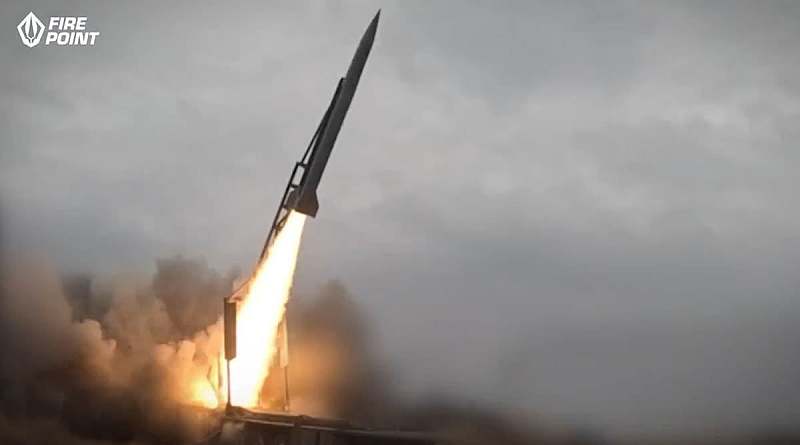
The Ukrainian company Fire Point released a video of the first tests of the FP-7 ballistic missile.
Visually, the missile has a strong resemblance to the 48N6 family of anti-aircraft missiles used in Soviet and Russian S-300 and S-400 systems. But the video captures a “hot” launch from an inclined launcher mounted on a mobile vehicle trailer. This fundamentally distinguishes it from the S-300, which uses a vertical “cold” launch (mortar start from the launch container with subsequent ignition of the main engine).
Firstly, the folding speed. The hydraulics of the inclined launcher are simply simpler: lower the boom onto the trailer, release the brakes, and disappear into the field. Heavy vertical installations (like the S-300 or “Iskanders”) require time to pack the massive transport-launch container and, most importantly, to assemble heavy outriggers — hydraulic legs on which the machine is suspended to prevent crushing from recoil.
Secondly, we threw out all this schizophrenic complexity of the “cold” mortar launch. The S-300 ejects a two-ton missile with a powder generator 30 meters up, and only there does the main engine ignite. This requires jewelry-like assembly, perfect clearances, and aerospace factories. If the engine doesn’t start — the missile simply falls on the heads of the crew. Our inclined launch is a primitive, robust “hot” launch. Close the circuit, the powder ignites, the missile leaves the rail. That’s it.

Thirdly, the chassis and gas dynamics. During a vertical “hot” launch, a jet stream with a temperature of around 2000 degrees hits directly onto the deck. To prevent the machine from burning or cracking in half, heavy gas deflectors, fireproof steel, and specific multi-axle chassis (like the Belarusian MZKT) are needed, which cost as much as a wing of a Boeing. An inclined launch diverts the flame backward into the ground. This means the launcher can be assembled based on a regular heavy commercial tractor (MAN, Tatra) or even on a standard civilian semi-trailer.
Yes, the inclined launch has one downside — the machine must be physically turned towards the target (launch azimuth is limited), while the vertical launcher can fire in all 360 degrees. But we consciously traded this comfort for the ability to fabricate launchers quickly, cheaply, and using the capabilities of any wagon repair or crane factory, even under conditions of disrupted energy supplies.
Radius of 200 km. Is this enough to reach Moscow? Indirectly, yes. They don’t hit the refinery itself but the SAM batteries and radar systems on the way to it, creating a corridor. Currently, the circular error probable from open sources is stated to be around 14 meters. This is very decent — Israel’s LORA is ten meters, which is quite comparable to the Iskander and ATACMS cluster.

The heart of the S-400 battery is the 92N6 radar. Without it, the launchers are just blind trucks with tubes. As soon as the illumination and guidance radar (IPR) begins to “shine” into the sky to illuminate targets, its powerful radiation is quickly detected by radio intelligence and Western reconnaissance aircraft.
The problem for the Russians is that the core of their long-range ammunition consists of the old semi-active 48N6. When the S-400 tries to intercept ballistic targets (like the ATACMS or FP-7), it does so with heavy missiles and is forced to keep the radar on until the last second, guiding the interceptor. It’s during this window that it gets hit.
Then, everything follows the usual pattern: a cluster bomb targets the revealed coordinates of the active radar. It opens, and the submunitions rain down on the control systems and “eyes” of the battery. That’s why the current basic tactic is to launch cheap decoy drones, forcing the S-400 crew to turn on the radar, and then strike it with ballistic missiles at the moment of overflight by the same “Flamingo” and reactive drones. We will refine the technology, scale up, and in winter clear the frontiers near the border, gradually increasing the range. Since we didn’t have a closed-loop OTRK system, there’s a lot to refine in practice, learning from initial problems.

Currently, we have impacted 40-45% of Russian refining capacity, sending them to planned and unplanned repairs (which have not been canceled and it’s the peak of consumption). This is a very successful strategic bombing campaign. During the summer-autumn peak, Russia has fallen into a severe deficit. Daily gasoline production dropped to 75-80 thousand tons with a real demand of 115-120 thousand tons. According to trackers at the end of summer and the beginning of autumn, fuel restrictions affected 92% of Russian regions (78 of the 83 internationally recognized regions). Two-thirds of the regions introduced QR codes for commercial transport, strict limits on sales per person, and a complete ban on refueling into canisters. In Saint Petersburg, half of the gas stations simply have no gasoline—it’s the trading gateway of the USSR 2.0 and the second-highest income metropolis.
The 2026 harvesting campaign is lagging almost three times behind last year’s schedule due to the simple absence of diesel in the southern regions of Russia. Because of the fuel shortage, equipment enters the fields with a two- to three-week delay. Wheat stays in the ear, leading to shedding (losing up to 15-20% of mass) and being affected by fungal diseases during autumn rains. Wheat of the 3rd and 4th classes (food-grade) rots in the fields and turns into 5th class (fodder). Farmers are openly writing in chats that it’s more profitable to dump grain into a warehouse than pay an elevator.
In mid-September 2026, AVT-6 at the Syzran Refinery and AVT-3 at “Slavneft-YANOS” (capacity of 15 million tons) were knocked out. The Moscow Refinery, which processed 11.6 million tons of raw materials per year, suffered the heaviest damage on September 20 and is guaranteed to be out of operation at least until the start of 2027.

All this provokes the most severe systemic crisis — tens of thousands of workers in oil towns are sent at their own expense, Russia loses the ability to earn from value-added products. The country had to block gasoline and diesel exports to plug internal gaps, cutting off the inflow of currency to the budget. From September 2, 2026, in 26 airports in Russia (including St. Petersburg’s Pulkovo), strict limits were introduced — refueling of aircraft is allowed strictly according to the flight plan, without the issuance of additional reserve volumes. The practice of “refueling in reserve” to save on price differences between regions is completely prohibited. Plus, winter diesel involves adding kerosene fractions to the usual fuel, so winter will be even more challenging.
By August 2026 alone, the Russian economy lost over $24.5 billion due to drone attacks. This includes hardware, increased damping payments, and emergency fuel purchases — all combined. Considering the stoppage of two more Rosneft refineries in mid-September (minus 15 million tons of processing per year), this amount will surely exceed $30 billion by the start of winter. And this is pure direct damage, not counting inflation on consumer goods. Also, add the cost of rectification columns, compressor stations and tank farms, lost profits from the halt of high-margin gasoline and diesel exports, as well as the hysterical expenses of oil corporations on purchasing private electronic warfare systems and building anti-drone nets around plants.

For the cost of the war, Crimea could have been filled with diamond dust near Sochi, and a statue of Putin on a crane could have been erected there. But no. Now it is necessary to pay the bills. Regular damage to primary processing units (AT) has turned the issue from a “temporary difficulty” into a systemic economic crisis with long-term consequences that will have to be dealt with for years.
In the foreground: The Ukrainian company Fire Point released a video of the first tests of the FP-7 ballistic missile. Photo: Fire Point
