
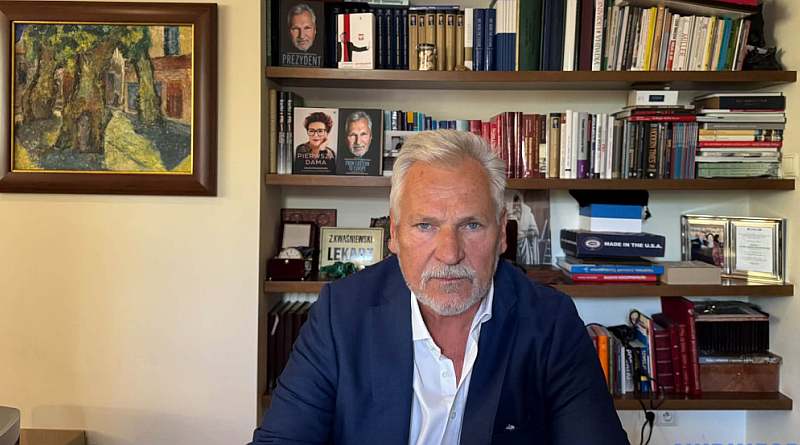
Yurii Banakhevych, Warsaw / Ukrinform
The significance and influence of former President of Poland Aleksander Kwaśniewski on the course of historical events in Ukraine over the last three decades is undeniable. He, more than many other influential foreign politicians, knows and understands Ukraine, as he once made considerable efforts to strengthen Ukrainian-Polish relations: he was one of the main mediators during the Orange Revolution, and later—as part of the Cox mission—Kwaśniewski during Yanukovych’s era—made significant efforts to preserve European prospects for Kyiv.
The former Polish leader, who still holds significant authority not only in Poland but also abroad, does not stay away from political processes in Ukraine, particularly as the chairman of the board of the international platform “Yalta European Strategy” (YES).
In an interview with Ukrinform, Kwaśniewski shared his views on 35 years of Ukraine’s independence, expressed his thoughts on the internal processes in Russia and the prospects for ending the Russian-Ukrainian war. Additionally, he assessed the situation surrounding Kyiv’s integration into the EU and NATO, spoke about domestic political processes in the country by the Vistula, and about the prospects of further Ukrainian-Polish relations.
PUTIN SIGNIFICANTLY STRENGTHENED UKRAINIAN IDENTITY
– Mr. President, the 35th anniversary of Ukraine’s independence was celebrated at the end of August. What would you consider the most important achievements of Ukraine during this period?
– The greatest achievement is that Ukraine is now independent, that it defends its independence against an aggressor who is many times stronger and uses all available methods against it, including military, political, and psychological.
Ukraine in the past was not very fortunate in building its statehood: hundreds of years of fighting for its own independence, but periods of independent existence remained brief.
Now 35 years of independence is already quite a long perspective. The achievement is that
today the Ukrainian people are much more aware of their identity, culture, roots, than ever before.
I’ll say something paradoxical: to a large extent, this is Putin’s merit, who accelerated and intensified this explosion of Ukrainian identity.
Another fact is obvious to me: Ukraine has already unequivocally chosen the Western path of development, democracy, free market, and the protection of fundamental values, such as human rights, minority rights, etc. Of course, there is still a long way to go to the ideal, but no one is perfect. The best example is the current United States.
And finally: I visit Ukraine several times a year, and this is already the fifth year of the war. I am impressed by how, under these extremely difficult conditions—of course, with enormous help from the world, because without Western money and weapons, it wouldn’t have been possible—how high the resilience of Ukrainian society and the state remain.
Trains are running, roads exist, gas stations are open, and people are not starving. I see that Ukraine is capable of finding solutions even in extremely difficult conditions. This is clearly visible both in drone production and the emergence of new types of weapons. In my opinion, this is not just resilience or the ability to adapt to challenging circumstances. There is a special ingenuity here – and that is truly impressive.
– How has the perception of Ukraine changed in the West over these 35 years, and how has Russian aggression against Ukraine affected it?
– It has changed significantly. It applies less to Poland since we are close neighbors. But for many Western countries, Ukraine was an “unknown land.” So these 35 years have been, on the one hand, a process of trying to show itself, and on the other hand, the West realizing that Ukraine exists, that it has the right to its sovereignty, and refuting Putin’s claim that it is supposedly some kind of Little Russia. Instead, the book title by former President Kuchma, “Ukraine Is Not Russia,” is truthful.
Of course, the war has intensified many things, as Ukraine found itself on the front pages of newspapers, and Ukrainian refugees simultaneously became both an opportunity and a challenge for many societies. There is a certain saturation with the war topic in the West, with hopes that it would be good if it all ended soon. But the end of the war is not yet in sight. Meanwhile, anti-Ukrainian rhetoric is increasingly exploited by politicians not only in Poland but also in many Western countries.
So, a lot has happened, but one thing is certain: after 35 years of independence, Ukraine has become a presence in people’s consciousness and on the map of Europe, which is extremely important. In my view, Ukraine is not a seasonal phenomenon; it has entered global and European consciousness permanently.
– What setbacks of our state would you highlight over these 35 years?
– Firstly, unfortunately, from the very beginning of independence, Ukraine failed to achieve what Poland did: in essential strategic goals, there was interparty consensus. Poland integrated into NATO under two presidents – Wałęsa and myself, during the tenures of many prime ministers. In Poland, leftists, rightists, centrists ruled, but there was no doubt about NATO and the EU.
In my opinion, Ukraine lacked this, and with each new president, new question marks appeared on this path. To achieve the main goals, unity was needed on these issues.
Secondly, many reforms, especially complex ones, could have been carried out more effectively to have more significant results today. This concerns justice, fighting corruption, social protection – more fairness for people.
Ukraine is also largely an example of an oligarchic system. This element of social inequality was less pronounced in Poland or the Czech Republic than in your country. But in general, Ukraine has changed. Summing up 35 years since gaining independence, it is a tremendous progress, a clear change for the better.
EVEN A SIGNED PEACE AGREEMENT WILL NOT MEAN THE END OF THE HYBRID WAR
– Mr. President, how do you assess the current resilience of Russia’s political system? Could the September elections to the State Duma of the Russian Federation show any dynamics of change (the conversation took place before the elections in Russia, – ed.)?
– It is worth evaluating the political, economic, and psychological resilience of Russia. Regarding the stability of the political system, it is high. Putin, in 26 years of governance, has managed to consolidate power extraordinarily.
It might sound strange, but he holds a stronger position today than Stalin did at one time. Stalin, although he had a much more powerful repressive system, had the Politburo, which influenced decisions and which he feared, hence he had to consider it. Putin, on the other hand, operates without any parliamentary control, media oversight, or civil society influence, as such oversight doesn’t exist in Russia.
Therefore, the political stability of this government remains high. However, much depends on Putin himself—his physical health and biological capabilities. Even the best doctors cannot make him younger.
Regarding economic resilience, it’s also worth noting that Russia’s transition to a wartime economy has been successful: they’ve been able to conduct this war for five years despite colossal expenses. Sanctions are in place, but their effect is limited. Trump’s attack on Iran and rising oil prices were additional “gifts” for Putin.
If we evaluate the situation politically, I consider the system’s stability high, whereas economically—rather average. With each passing year of the war, the situation in Russia will worsen.
The third part—psychological—is, in my opinion, the most interesting. How long will society be willing to accept this “special military operation,” which is a real war costing thousands of lives? It’s not just about the dead, but also those returning wounded.
The war has become palpable in Russia. Thanks to the development of Ukrainian technologies, residents of Moscow, St. Petersburg, or somewhere near or beyond the Urals suddenly realized this is not just something to watch on TV. It’s not a series. It’s something they are already feeling themselves.
The question is, how long will this society be ready to simultaneously accept a worsening economic situation, sacrifices, and direct threats? I think today this is Russia’s main vulnerability.
Perhaps Ukrainian attacks and the disruption of the state of splendid isolation (a certain detachment) might eventually cause certain consequences.
Regarding the elections… I don’t think they are of great significance, since the results are known in advance. They might hold some significance for turnout, but what the turnout will actually be, we will never know.
On the contrary, perhaps psychological changes and shifts in public sentiment in Russia might push Putin towards accelerating the search for a truce.
As for peace, it’s not worth discussing—it will not happen on any fair terms under Putin’s rule. He wants the whole of Ukraine in his sphere of influence, and this thinking will not change as it’s his worldview.
Putin doesn’t just want Crimea—he already has it, and he wants the entire Donetsk region—he is close to this. Putin desires Ukraine as a buffer between the Russian Federation and Europe to be in his sphere of influence, not the West’s.
And this needs to be loudly told to the world because it seems they do not fully understand what this war is about. It is not for a quarter or half of Ukraine – it is for the whole of Ukraine, which, in Putin’s understanding, should be part of the “great Russia,” that is, under Russian influence.
Therefore, I do not believe that even if a peace agreement is signed, it would mean the end of the hybrid war. I do not think that further manipulations in political matters or the exploitation of Ukraine’s weaknesses will stop.
However, Putin will face something he did not expect then or now – the Ukrainian consciousness, which he himself has created. He will not manage to subjugate Ukraine, for example, as a result of political manipulations. Terror can subdue part of the territory but not the whole country.
– Recently, there has often been talk about the risks of a new wave of mobilization in Russia. The Kremlin supposedly plans to additionally mobilize 600,000 people…
– This is an extremely risky situation for Putin because so far, he has been trying to mobilize people mainly outside major urban centers – that is, those less educated, with limited access to the internet.
If he has to mobilize young people from Moscow – or not necessarily from Moscow, but, say, from Omsk or Irkutsk, major cities with a million population – I think it will be extremely risky for him from a political perspective.
THE PROBLEM OF “KILLED BROTHERS AND SISTERS” IN UKRAINIAN-RUSSIAN RELATIONS – FOR GENERATIONS
– What do you think the war will be like in the near future?
– I think it will be the same. When, right after the start of the full-scale invasion, old political partners from all over the world called me and asked: “How long will it last – days or weeks?”, I replied: “Don’t listen to anyone. This war is for years, and the conflict – for generations.”
The full-scale war has already been going on for almost five years. Meanwhile, the conflict – that is, the level of hatred, grievances, pain, tragedy, and suffering that exists today – is for generations. This cannot be changed.
Even if some wonderful leaders come to power in Russia, the reconciliation process will still take many, many years because such things are not easily forgiven.
And Putin is making a fundamental mistake, constantly calling Ukrainians “brothers and sisters.” And from the Ukrainian side, the question arises: if we are your brothers and sisters, why are you killing us? Why are you taking our children and Russifying them? Why are you setting fire to and attacking our cities and villages? Why are you making us die from the cold, shelling power plants?
For any simple person, this is deceit, lies, something unacceptable. If we are brothers and sisters – you have no right to treat us this way. You can love us more or less, but you cannot treat us like this.
And this problem of “killed brothers and sisters” is for generations. It cannot be solved with one, two, or three gestures. It will remain a difficult issue in Ukrainian-Russian relations for a long time.
– So you do not see the possibility of ending the war in any visible future?
– The political situation can change. I do not dismiss the idea that under additional American pressure or due to Putin’s own calculations, we might achieve a certain ceasefire format with a halt in hostilities along the current front line. Putin may conclude that new mobilization would be too risky for him.
Then he would use the pause for regrouping and reorganization of forces, while Ukraine would ramp up the production of drones and other weapons.
The only question is, when will this ceasefire end and the fighting resume? In my opinion, such a scenario is risky for Ukraine.
– What risks do you mean?
– I understand that this may sound a bit cynical, as any cessation of hostilities is better than the loss of life on the front lines.
But if we perceive the ceasefire only as a pause rather than a lasting resolution of the issue, it will give Putin time to prepare new forces, including North Korean ones.
At the same time, the question arises: will international support for Ukraine remain? The world might decide that if the hostilities have stopped, the need for funding Ukraine is not as urgent.
Nevertheless, negotiations with the EU on membership will remain, which may last two, three, five years, or longer. Ukraine will have to hold elections in conditions of full democracy.
And I always said: Ukraine is a democratic country because no one knows in advance who will win the presidential elections.
In Russia, the result is known in advance. The West understands this well: such elections show where there is democracy and where there is none.
At the same time, democracy has its risks: political confrontation, mutual accusations, election campaigns, a divided parliament, difficulties in forming a coalition. It is clear that Russia will try to exploit all this.
However, there is no other way: Ukraine must remain a democratic country if it wants to become an EU member.
CHINA AND TURKEY MIGHT INFLUENCE RUSSIA
– How do you assess the peacekeeping mission of Vitkoff – Kushner, who recently visited Moscow and Kyiv, considering that Ukraine wants European allies at the negotiation table?
– Ukraine’s position is correct. Europe must be at the negotiation table because it is important to remember: it is Europe that funds almost one hundred percent of the aid to Ukraine, not America. I have lost any hopes regarding this American mission.
Vitkoff says he will remember meetings with Putin in retirement as the best thing that happened to him, that he has full trust in him. How is it even possible to say that? How can you talk about “full trust” in a person responsible for this war, making decisions on attacks on civilian targets, even responsible for the abduction of thousands of Ukrainian children and their Russification?
Of course, not Vitkoff and Kushner, but Putin is the main player here. Trump also plays a significant role, and two other leaders – Xi Jinping and Erdogan – may have some influence.
Speaking of who today might be relatively effective in influencing Russia, it would be the Chinese and the Turks. One thing must be acknowledged: partially thanks to them, nuclear rhetoric has somewhat receded, though it occasionally returns.
It’s risky, but as far as I know, the Chinese have firmly stated that they do not agree even with the purely verbal use of this threat by the Russians.
– How do you assess the scale and effectiveness of Russian hybrid actions — acts of sabotage, diversions carried out in Europe?
– Unfortunately, these actions are effective; they do this on a professional level. But the greatest danger for us is that, by unofficially supporting various political forces, they change the political map of Europe.
The AfD party, gaining strength in Germany and clearly oriented towards Russia, is a problem. The rise of anti-Ukrainian forces in Poland is also concerning.
Elections will soon be held in France, where it might turn out that Marine Le Pen wins, and then we will have a politician who is much more favorable towards Russia.
The situation can develop differently, but Russia cannot be underestimated. Their actions need to be closely monitored.
There are governments that are responding ever more strictly, without illusions, to Russia’s actions. For example, Germany, especially after the attempted drone attack in Leipzig. Now, the Hungarian government is expelling ten Russian diplomats from the country.
– Illusions are dispelling, and that’s good…
– At the same time, the potential for Russia’s hybrid influence on European countries remains significant, and this cannot be underestimated.
– Can next year’s elections in France and Poland, as well as the strengthening of the far-right in Germany, completely or partially change Europe’s attitude towards Ukraine?
– Yes, they can. One of the achievements — not to mention Poland, as it is a special case — is that even in the West, in Germany and France, people through Putin’s actions have realized who is the aggressor, who is the victim, who has brought the war, and who suffers from it. This is a major change in people’s consciousness.
Of course, today all anti-Ukrainian forces gradually try to change these sentiments, but the fact of this change remains in people’s consciousness.
I think even Marine Le Pen, if she won the presidential elections, could not the next day declare that France will no longer help Ukraine because, supposedly, Russia is right.
If today we say that we want to end the war on Putin’s terms, we must directly acknowledge: we want sovereign Ukraine, which has just celebrated 35 years of independence, to surrender and become part of greater Russia, to come under Russian flags. There is no agreement to this.
In short, some kind of “Yalta-bis” or, if we dig deeper, “Trianon-bis,” where everything is decided without the participation of Ukrainians themselves, is too much. I think even pro-Russian forces in Europe will not allow this.
Overall, this political change in Europe may not occur in favor of Ukraine. Apart from Hungary, I don’t see similar favorable trends today.
THE MOST IMPORTANT THING – TO MAINTAIN THE BELIEF IN THE EU THAT UKRAINE IS NEEDED
– What do you think is the prospect of Ukraine’s European integration under the current conditions?
– No one can outline a clear prospect, because it is generally difficult to talk about dates in the European Union. It is set up so that everything simmers for a long time, and then, when certain procedures begin, everything proceeds relatively quickly to a positive conclusion.
I believe that the most important thing now is to maintain in the EU the belief that Ukraine is needed. Once, Pope John Paul II said about Poland: “Poland needs Europe, and Europe needs Poland.” In my opinion, this is the slogan that needs to be politically retransmitted today: “Europe needs Ukraine, and Ukraine needs Europe.” That’s the first point.
Secondly, at the expert level, it is already necessary to work on several complex issues in the relations between Kyiv and Brussels. Among them are agriculture, the service sector, especially transport.
There are several such topics where leading experts need to find solutions. And, as far as I know, since I communicate with such people, solutions can be found.
Poland is also a good example here: there were also fears about Polish agriculture. At the same time, there were fears on both sides: the West – that we would destroy their agriculture, and the Poles – that we would be absorbed by the West. As a result, today everyone has won.
Remember, Ukraine has great potential, very good natural conditions, you produce what the world needs, especially where there is hunger – grain, sunflower oil, etc.
It doesn’t have to all go to Europe – the products can go to Africa, where there are indeed great needs, using European funds and transport. So, at the expert level, complex issues need to be discussed to have ready answers later.
Meanwhile, I will say quite frankly:
the biggest problem in the end will not be technical issues, but the transition from wartime to mature democracy.
This could be key, as it is evident that war is not a time for the development of democracy, and everyone agrees with that. But the war will end, and then it will be necessary to show that the parliament is working, that there is a free media, that there is a system of checks and balances, mutual control of institutions, that it is possible to effectively fight corruption, etc.
And here there might indeed arise a problem.
My perspective on Ukraine is this: some sort of, so to speak, party or movement of veterans is likely to become a significant force after the end of the war.
But military and veterans are not the kind of human resources that have, let’s say, a great deal of experience in democratic functioning. These are people accustomed to a different system of actions.
Therefore, here I would pay attention to the fact that Ukraine, if relatively quickly conducting negotiations and eventually wishing to be in the EU, must meet democratic standards.
– The EU recently adopted the 21st package of sanctions against Russia. Each subsequent one is becoming increasingly difficult for Europe. In your opinion, will the EU be able to continue its policy of pressure on Russia and impose new sanctions?
– The more pro-Russian forces strengthen in Europe – and France might be the first such example – the more arguments will emerge like: “We imposed sanctions, already the 21st package, and nothing happened, the war continues.” Therefore, unfortunately, such voices in Europe can still be expected.
But I am not so pessimistic as to believe that the two most influential players in European politics – France and Germany – will be completely controlled by pro-Russian forces in an instant.
In Germany, this won’t be quick at all. However, conclusions must be drawn from the defeat of the CDU in Saxony-Anhalt. It cannot be ignored as if nothing happened. No, something did happen, and it needs to be acknowledged.
– NATO is needed by Ukraine, but is Ukraine needed by NATO today?
– Here I have a personal opinion, which, frankly speaking, is not realistic today. I generally believe that if we are serious about discussing the future – ours and yours – the issue of Ukraine’s NATO membership should be on the table.
Firstly, to a large extent, Ukraine is already utilizing NATO resources – intelligence, weapons, training, etc. And this is a kind of benefit as well.
Your country is so deeply integrated into cooperation with NATO that speaking of it as some “foreign body” is simply incorrect.
Secondly, if you look at our security system, my argument is quite simple: it’s better to have nearly a million-strong army with modern warfare experience and 21st-century combat capabilities on your side than to leave it in some political vacuum.
Thirdly, today Ukraine is a source of inspiration for NATO and the Allied forces. We must already analyze the Ukrainian experience – both in conducting traditional combat and in airspace defense and the use of modern drones and other technologies.
Ukraine knows more than all of us combined. Perhaps only the Americans have more experience in certain aspects.
And I wouldn’t fear Putin’s reaction here. He was categorically against Finland and Sweden joining NATO, and they are already members of the Alliance.
Especially if it ends with Donetsk and Crimea remaining under Russian influence, then, in my opinion, the issue of Ukraine’s NATO membership will be absolutely crucial from the perspective of Western security.
But there is still the problem of NATO leadership, i.e., the United States. And as long as President Donald Trump is in office, I think everything I mentioned remains unrealistic.
NAVRYTSKY ON UKRAINIAN ISSUES REMAINED IN THE ROLE OF THE HEAD OF THE INSTITUTE OF NATIONAL MEMORY
– Let’s move on to Ukrainian-Polish relations. In your opinion, how can we reverse the negative trends currently observed in our relations? Can we still speak of a strategic partnership between Kyiv and Warsaw?
– We are and will be strategic partners. You can say whatever you want, but certain things cannot be changed. Our neighborhood cannot be changed, nor can the fact that
a million Ukrainians live in Poland today, work here, and are needed by the Polish economy.
And if you look at our “hard” interests, then, of course, an independent Ukraine – a pro-Western state located between Poland and Russia – holds strategic importance for Poland. There is a quite obvious sense of this from the perspective of Polish security.
How can negative trends be changed? Firstly, once again, focus more on the positives – on what Ukrainians contribute to Poland and Polish society.
Secondly, and this is a direct appeal to Ukrainians themselves, it is worth avoiding those irritating and unnecessary behaviors in Poland that later become reasons for negative attitudes towards everyone.
For example, even instances such as demonstratively driving expensive cars significantly exceeding the speed limit can create unnecessary irritation in Polish society.
– Here, you are speaking rather about the behavior of individual Ukrainians, not the whole nation or Ukraine’s state policy?
– Yes. Of course, it is difficult to control, and you can’t reach everyone. But I’m addressing this – so let the Ukrainians listen to me!
Therefore, I believe this is not a lost cause. In the most sensitive issues, one simply needs to do what is necessary: talk about positives, explain the real situation to society, and at the same time not let individual negative cases determine attitudes towards all Ukrainians.
– The most sensitive issues also include a complex history…
– Exhumations need to be conducted, burials properly arranged. This process is now moving forward.
But more needs to be done: writing books, organizing meetings of historians, scholars, students so that this knowledge reaches people.
Because when you have more knowledge, it’s easier to accept, you see more aspects and understand different viewpoints. Demonstrative gestures should also be avoided. Let Ukraine not name military units after UPA or its heroes.
But at the same time, let our president not take away an award that was a gesture not only towards a specific person but also the entire Ukrainian people.
Therefore, such emotional and, in my opinion, unnecessary actions should be avoided. And, as I said, we need to find that new, foundational myth for our relations.
If it didn’t exist, we would have to invent something. But it does!
– What do you mean?
– Firstly, it’s Poland’s recognition of Ukraine’s independence in 1991. We were the first country to do so.
Secondly, it’s our support for Ukraine in difficult times – just recall my role during the Orange Revolution. This is a clear Polish position from the very beginning of Russian aggression in 2014.
And finally, thirdly, the help to Ukrainian refugees, specifically spontaneous and societal. It’s probably the greatest value. It wasn’t organized by the government or any minister – it was done by ordinary people. They opened their homes, helped, welcomed Ukrainians.
These are great deeds that need to be talked about, books written, films made. It’s necessary to show how, despite all our complex history, this can work, how Poles and Ukrainians can help each other and build good relations.
Therefore, I absolutely do not believe that we are in a losing position. And the fact that some cynical politician uses an anti-Ukrainian theme to gain not 7 but 9 percent, not 15 but 16 in the elections, does not yet mean that all is lost. This can still be changed.
– Since 1991, the strategic relations between Poland and Ukraine were largely formed on the model of good personal contacts at the presidential level. Obviously, today this model is changing. Is the current government of Donald Tusk able to take on the role previously played by the presidents in bilateral relations?
– Relations at the highest level between Poland and Ukraine are necessary – both presidential, governmental, and at the ministerial level. I believe that any deviation from them – whether on the Ukrainian or Polish side – would be a big mistake.
Regarding President Karol Nawrocki, his passivity in some issues related to Ukraine, in my opinion, is not beneficial to Poland.
But I also know that he is a historian, headed the Institute of National Remembrance, has repeatedly spoken on the topic of Ukrainian-Polish history, and dealt with the issues of the Volyn tragedy. Therefore, perhaps he just needs to step out of the old role and move into the new one.
– So you believe that he has not yet stepped out of the role of head of the IHR?
– On Ukrainian issues – unfortunately, no. But in my opinion, all the arguments in favor of building strategic Polish-Ukrainian relations are so strong that eventually they will have to be accepted even by those who have great doubts.
Even if we assume a rather unfavorable scenario – that Putin does not leave Donetsk and Crimea and some format of truce is eventually reached – Ukraine will still remain a large European country.
Even if its population is 25 or 30 million people, it will be a country striving to live by principles common to us. It is a large market, a significant human resource, and huge opportunities for business and tourism.
Whether we like it or not, Ukraine cannot be perceived as any temporary or seasonal phenomenon. It will be a permanent element of the new European architecture.
And Poland should play a leading role in this – as a neighbor and as a major European country capable of offering much to Ukraine and at the same time receiving a lot in return.
The difference between the policy we conducted with my Ukrainian partners, like Leonid Kuchma, was that emotions were present, but they did not dominate. We looked at reality, arguments, needs, and interests. And then a lot could be achieved.
Today’s policy depends much more on emotions, sociological surveys, and social media. In this information frenzy, it is really easy to make mistakes.
– We are a year away from parliamentary elections in Poland. How can their results affect Polish-Ukrainian relations if, for example, the configuration of the government and the ruling coalition changes?
– It may change, or it may not. The result may not necessarily be as predicted today. But if you look at current surveys, there is one certainty: Tusk’s party is most likely to win these elections. Another question is – will they have a majority?
However, look at today’s relations between the right-wing parties. Can you imagine a coalition where Kaczyński, Morawiecki, Mentzen, and Braun stand side by side?
– Do you consider such a coalition completely unrealistic?
– I have lived too long not to imagine something. But it would be an extremely complex construction. Moreover, anti-Ukrainian sentiment is unlikely to be the glue that would bind such a coalition.
Because today anti-Ukrainian sentiment means pro-Russian sentiment, and this can no longer align with Polish interests. As I have already said,
those who oppose Ukraine, de facto agree with Russia’s dictate over Ukraine, and thus, take a pro-Russian position.
– So do you believe there will most likely be no tragedy for Ukrainian-Polish relations if a right-wing coalition comes to power in Poland?
– No, I do not wish to speak in such terms at all. I want to say something else: the left and liberals can still win these elections. Ahead lies a whole year. But it needs to be used very actively and, in particular, openly discuss the strategic importance of Polish-Ukrainian relations.
For example, talk about how beneficial it is for Poland that a million or more Ukrainians want to work here, live, and strengthen our economy.
– And how do you assess Prime Minister Donald Tusk’s policy towards Ukraine?
– I can say one thing about Prime Minister Tusk: I have no doubt about his pro-Ukrainian inclination and experience. Moreover, during his work in European positions, he had contacts with Putin. But,
unlike some other European politicians, Tusk certainly holds no illusions about Putin.
And in this sense, Tusk is a very serious partner for Ukraine. Of course, in practice, some things could be done better. But today, he is a person who, in my opinion, correctly assesses the importance of Polish-Ukrainian relations.
Photo: Ukrinform
