
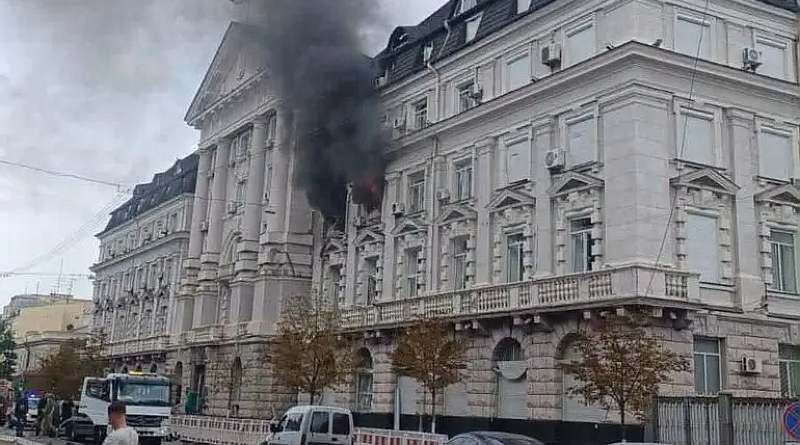

The Russian drone strike on the building of the central office of the Security Service of Ukraine in Kyiv is primarily an element of information warfare.
What can such a strike be compared to? A fake thrown into Telegram. An anonymous bot post on Facebook or another social network. Its task is not to inflict real military damage but to create an image, an emotion, a sense of Russia’s strength and Ukraine’s weakness.
There is practically no military sense in hitting the well-known administrative building of the Security Service of Ukraine.
Since the beginning of the full-scale invasion, Ukrainian security agencies have clearly taken care of the safety of their leaders and key specialists. It would be strange to assume that the people responsible for the state’s security sit in offices at addresses marked on all maps and well-known to Russian special services every day.
No one would be so reckless as to concentrate the leadership of state bodies in well-known so-called “decision-making centers” under the constant threat of missile and drone attacks known to Russians.
That is why the strike on the administrative building of the Security Service itself does not mean the destruction of any important military or intelligence object. However, for propaganda, the picture is excellent: a Russian drone in the center of Kyiv, a damaged SBU building, photos and videos that can be shown to the Russian public and the whole world.
Why?
We have already seen similar logic when Russian drones flew into NATO countries’ territories, or missiles fell near their borders. The military damage from such episodes may be minimal. The political and psychological effect is much greater.
The goal is to allegedly demonstrate the weakness of NATO, which cannot completely close its airspace. The weakness of Ukrainian air defense. The weakness of the Ukrainian state. To make people think: if a Russian drone can reach the SBU building in the very center of Kyiv, then Russia is all-powerful.
Not all-powerful.
But information warfare exists precisely to create an image that does not necessarily relate to the real balance of power.
This is especially important now, as discussions about possible negotiations are reactivated.
Before any negotiations, each side tries to prove that it is in a stronger position. Because at the negotiating table, the one who can convince others that time works for him is listened to first and foremost.
Russia is trying to create such an impression.
Like, we can strike in the center of Kyiv. We can hit the Security Service building. We can reach “decision-making centers.” Therefore, Russia is strong, Ukraine is weak, and the world should convince Kyiv to agree to Russian terms.
This is the main content of the picture. Because with real arguments, the Kremlin has much more difficulty.
The war is dragging on. Russia has not achieved the strategic goals it began the full-scale invasion with. Ukraine, on the other hand, has demonstrated the ability to strike long-range at military and other infrastructure deep in Russian territory. Ukrainian drones have become a factor Russia can no longer ignore.
Therefore, the Kremlin needs to constantly maintain a different picture—the picture of its invulnerability and Ukraine’s helplessness.
And for this, it is not necessary to capture Kyiv.
Sometimes for a TV picture, a drone hitting the windows of a well-known administrative building is enough.
So I would not exaggerate the military significance of this strike. But I would not underestimate its informational significance either.
This is a typical information warfare operation that can simultaneously have several targets.
Ukrainians — to demoralize.
Europeans — to convince them of Ukraine’s weakness.
Americans — to strengthen the Russian negotiation position.
The Russian society itself — to show them another “victory.”
And everyone together — to create the illusion of Russian strength.
Precisely an illusion.
Because the strength that needs to be proven with a photo of a drone in the window of an empty office is largely decorative strength. Almost the same as a fake in Telegram.
It can frighten. It can outrage. It can capture the information space for a few hours.
But that doesn’t make the fake true.
Photo: UP
