
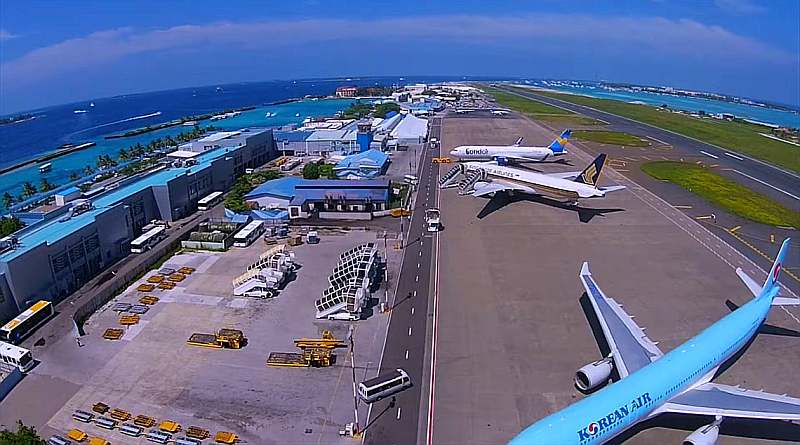

The Russian Federation has established large-scale deliveries of aircraft parts, modern electronics, microchips, optical equipment, and other dual-use goods through the Maldives. Western products worth hundreds of millions of dollars are reprocessed directly at Malé International Airport and sent on regular and charter flights of Aeroflot to Moscow.
Although the volume of the Maldivian channel is somewhat smaller than larger “gray import” routes through China, Turkey, and the UAE, its very existence vividly demonstrates the Kremlin’s ability to involve tourist countries in such schemes, which previously played no significant role in trade with Russia and were outside the focus of Western sanctions control.
The Putin regime demonstrates high adaptability, finding new loopholes where Western partners least expect risks. The use of the Maldives as a transit hub proves that Western sanctions have so far concentrated mainly on major geopolitical players.
Western regulatory institutions have long ignored the involvement of small or exotic jurisdictions that had no historical connection to Moscow’s military-industrial logistics.
The Maldivian scheme itself operates thanks to the unimpeded transfer of goods on the territory of Malé airport with the active participation of local intermediary companies. Since the goods do not undergo full internal import procedures, they avoid real customs control and physical inspection.
A vivid example of the system’s vulnerability is the case of the German company Kraemer Mining, whose mining equipment, through a chain of intermediaries and invoice reprocessing, ended up in the possession of the Russian “TECHNO Group of Companies.” The accompanying documents completely erase the original European origin and the real seller, with the final destination being a Russian flight.
Statistical indicators clearly illustrate the scale of the problem. According to Maldivian customs, exports to Russia should have remained negligible, yet Russian statistics record an unprecedented surge in imports from the Maldives from less than 7 million dollars in 2021 to more than 630 million dollars in just 2022. Western countries’ financial and customs intelligence should have quickly reacted to such anomalous macroeconomic markers, but bureaucratic inertia and the lack of operational analytics indicate an underestimation of the Kremlin’s financial ingenuity.
The Maldives Republic provides its infrastructure for commissions from intermediary services, turning into a convenient “transit offshore.” Diplomatic pressure from Western capitals on such states remains too soft, and the absence of secondary sanctions gives free rein to Russian leadership.
The problem lies not only in identifying individual companies but in the total control of the entire re-export ecosystem — from end users and transit goods to air transport. As long as these links remain vulnerable, blocking one legal entity will only instantly redirect flows through a new intermediary.
Featured: The main and international airport in Malé (Maldives), Velana International Airport. Photo from open sources
