

The fact that social networks are buzzing after Fedorov’s address proves to me that Zelensky has become that “old” politician he himself used to speak disdainfully about in his communication. Karma is like that.
I’m glad that the appearance of new faces is met not only with uniform enthusiasm but also with criticism. This is a healthy reaction. Finally, there is a chance that the country will stop seeking brides in its leaders and instead of “like – don’t like,” will look at “did – didn’t do.” These are only sprouts of critical thinking for now, but they need to be nurtured and cultivated.
It’s also worth understanding that in many cases, not only in Ukrainian politics, the destroyer of a toxic system has been someone from within that system. Effectiveness comes from understanding both the system itself and its individual personalities. Sensitive knowledge.
Regarding the conduct of elections. Zelensky’s egoism, detachment from reality, and inability to take steps needed for Ukraine, not his power, lead the country to trouble. Filling the government with loyalists instead of professionals is a path to defeat. We have reached the point where we have to choose between elections and chaos. That is, between a bad option and a catastrophe.
Zelensky should rely on instincts if he can’t use logic. He will not become president in elections, and he won’t be allowed to turn Ukraine into a mini-Russia. One cannot become an autocrat or dictator with the money of Western partners.
And Ukrainians should create managers, not idols. And not be ashamed to ask them unpleasant questions and make tough demands when necessary. This is the way to the European family.
It is still unclear why the president dismissed Mykhailo Fedorov. But another equally important question is why did Fedorov remain silent for so many years?
He was with Volodymyr Zelensky from the very presidential campaign that he significantly helped to build with his own hands. He was a member of all Zelensky’s governments from day one. And all these years—even before the full-scale invasion and during the great war—we did not hear from him any public disagreement with the undemocratic trends in the state.
We did not hear his voice against the practice of personal sanctions used as a political tool. We did not hear his protest against decisions accused of corruption and extortion from businesses. On the contrary, as a member of the Cabinet of Ministers, he was part of the system that made these decisions.
And only now, after his resignation and after his candidacy was not reintroduced for the position of Minister of Defense, Mykhailo Fedorov delivered what was essentially a programmatic speech.
But even this speech left a sense of incompleteness.
Fedorov says Ukraine needs elections. Fine. But how to conduct democratic elections during a major war?
We have repeatedly discussed the idea of electronic voting, particularly through “Diia.” However, electronic elections during a war create at least two fundamental problems: vulnerability to enemy attacks and the inability to ensure the level of result verification that a physical ballot provides.
Timothy Snyder in his book “On Tyranny” emphasizes the importance of paper ballots among the rules for protecting democracy: democracy should have a material trace that can be verified and recounted.
How to ensure this during war? How will military personnel on the front vote? Millions of Ukrainians abroad? People in temporarily occupied territories? How to guarantee equality of political competition, freedom of campaigning, opposition access to media, and the security of polling stations under missile and drone attacks?
There is no answer to these questions in Fedorov’s speech.
And here we come to the main point.
Any political discussions in modern Ukraine are only possible thanks to the people in the Ukrainian army who hold the front. It is thanks to them that political strategies can be built in the rear, with debates about ratings, parties, and future elections.
But the needs of the person in the trench must remain the key priority of the state.
I will not speculate and speak on behalf of the military about their attitude towards replacing some politicians with others. But even by Maslow’s classic hierarchy, the need for physical security is more fundamental than all subsequent needs. Therefore, the discussion about elections should begin with the question of state security.
There is another circumstance that cannot be ignored.
The demand for elections in Ukraine regularly appears in Russian scenarios of so-called “peaceful settlement.” The reason is obvious: in the Kremlin, they expect that an electoral campaign during the war will exacerbate internal conflicts, alienate Ukrainians, and weaken the state from within.
What Russia cannot achieve on the battlefield, it will try to achieve through internal destabilization.
Elections divide society even in peacetime. And elections under missile strikes will inevitably turn the issue of war and peace into the main subject of political bargaining. Whoever can more convincingly sell the simplest promise of a quick end to the war will win. Then the old “we just need to stop shooting” can quickly gain new life.
But there is another contradiction in Fedorov’s words.
An appeal by a dismissed minister to the people is a popular genre. However, when someone who has been a member of all of Zelensky’s governments from day one suddenly talks about some “unknown forces,” due to which personal loyalty became the main criterion for appointments instead of professionalism, a logical question arises: where was this person for the previous seven years?
Fedorov didn’t watch this system from the side. He was a part of it. He helped to create it.
Yes, this system really needs fundamental changes. But changing it amid a major war due to an election campaign is an extremely dangerous experiment. And it’s especially strange to hear calls for dismantling the system only after the person has lost their position within it.
This raises a fair question: if elections cannot be held now, how do we tackle the inefficiency of state governance that Fedorov talks about, and which is indeed hard to disagree with?
The answer may be less impressive than an election campaign.
Honestly and responsibly work in your place.
Monitor the government.
Criticize not only names but specific decisions and processes.
Propose alternatives.
Help the army.
Protect independent institutions.
And do not remain silent when the government makes decisions, even during war, that could limit democratic rights and freedoms.
Because democracy is not only about elections. It is about daily accountability of the government to society, the rule of law, the independence of institutions, freedom of speech, and the right of citizens to oversee the state.
These are the democratic values we are defending from Russia today. And they need to be defended not only after resignation but also when in power, when in opposition, and when you’re not a politician but a civic activist or a responsible citizen.

I see Mr. Fedorov has greatly energized society regarding elections.
And I am the kind of creature that primarily sees potential troubles, not bonuses. Because the bonuses are just a vague prospect of getting a decent president.
Moreover, this president will be chosen among Zelensky, Zaluzhny, Budanov, and Fedorov, about none of whom, for example, I can say would be a good choice.
And now my thoughts.
1. What will we do if Zelensky wins? A person who is physically incapable of political dialogue with critics will get another term in office. Someone who chooses managers based solely on personal preferences. Who is physically dependent on applause and incapable of correcting their own mistakes. Who has lost everyone from their “team.”
2. Who exactly guarantees us the fairness and transparency of the next elections? The same guarantor whose Constitution is on pause?
3. How can elections be held when half the country is wandering, fighting, or staying at home for fear of going out?
4. What should “political struggle” look like under conditions of complete media subordination to the president? When blocking a media channel or someone’s accounts is a matter of days?
And this is on the brink of winter, which we’ve probably all been advised to prepare for independently.
I don’t claim to be an analyst because I’m not one; I’m a person who has to survive in extreme conditions. And I’m interested in all these questions precisely in the context of survival.
Explain to me what advantages you see in insisting on elections now?
Replace Zelensky? With a high probability, we will not replace him; on the contrary, we will extend his powers.
With a high probability, these will be maximally non-transparent, manipulative, dishonest elections that will not unite society either during the process or after the elections. The pre-election period is always chaos, madness, and debauchery. I can’t even imagine a pre-election during the war.

– We are facing a catastrophic winter… “Two-three weeks” of blackouts with lockdowns and lockouts… Everyone needs to go somewhere…
– Maybe there’s still a better way to prepare?
– There’s little time left… I have an idea! Let’s hold elections!
– Exactly! E-elections!
– Is it possible to hold elections during martial law and a harsh winter?!
– Of course! Turn on the e-winter program in “Diia” for everyone! And hold e-elections…
– Will this help to get through the winter?
– No, of course not… But it will help to think less about the war and the harsh winter…
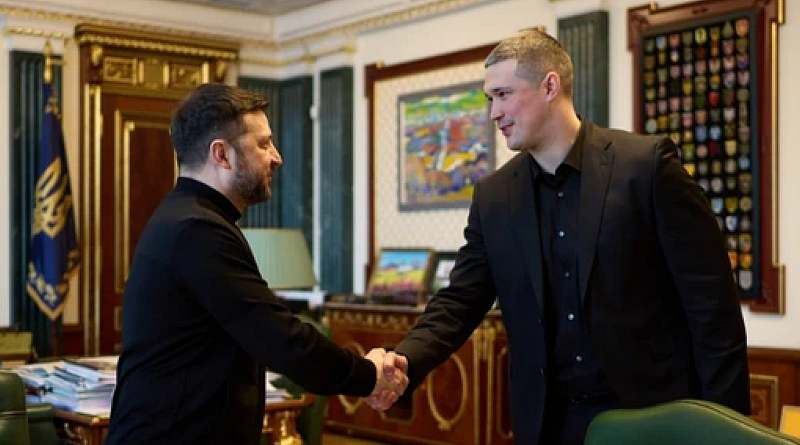
In the image: Volodymyr Zelensky held his first meeting with Mykhailo Fedorov as the Minister of Defense. January 14, 2026. Photo: OPU
