
Oleksandr Kovalenko / Obozrevatel
For decades, Russia convinced the whole world (including its own population) that after the collapse of the USSR it was not only the legitimate successor but also inherited the status of a great superpower. Great naval power, great space power, great resource empire with the strongest army in the world… But the war with Ukraine not only nullified these statuses but completely erased them. Moreover, we are witnessing another stage of this process right now.
More about this in the new material of the joint project of OBOZ.UA and the group “Informational Resistance”.
Blow to Space Ambitions
On the night of August 15, Ukrainian “Flamingo” missiles destroyed buildings 106A and 106B of the “Progress” enterprise, where in conditions of high sterility the final assembly of “Soyuz” family launch vehicles takes place. Today, these are the main launch vehicles that Russia continues to use for reliable missions into space.
Depending on how damaged the buildings were, which came under attack, it will be possible to talk about whether Russian space flights have been crossed off, or whether there is still hope for the restoration of the final assembly stage. Only time will tell.
Russia has always positioned itself as a space superpower, but in recent years it has barely managed to carry out a little more than two dozen launch vehicle launches (LV) per year. For example, in 2025 Russia launched only 17 – the same number as New Zealand, while the USA made 176 launches, and China – 92.
Overall, from 2020 to 2025, the USA launched 583 LVs, China – 385, and Russia – 115. And the overwhelming majority of Russian launches were carried out precisely on “Soyuz-2.1a” and “Soyuz-2.1b” LVs.
Thus, the war with Ukraine has led to the fact that Russia might not only lose its status as a space power but in general find itself dependent on the development of its space programs on the launch vehicles of other countries. But, frankly speaking, this is not the first time that due to the war with Ukraine, Russia is losing one or another “superpower” status.
No Longer the Second Army in the World
After the collapse of the USSR, the Russian army was called the second army in the world for many years, and this was only partially justified. The basis for such status was one of the largest stockpiles of nuclear weapons in the world and inherited armored vehicles numbering tens of thousands of units.
At the time of the Soviet Union’s collapse and for a decade thereafter, Russia exploited this numerical advantage, while potential adversaries didn’t understand how to stop, let alone defeat, this military machine. However, the war in Ukraine solved this issue, significantly simplifying and reducing the cost of destroying Soviet/Russian equipment, depriving the ROV of profitability and the point of deploying armored vehicles on the battlefield.
As a result, the total losses of ROV since 2022 in all types of equipment, from tanks to aviation and ships, exceeded 230,000 units! These are the most extensive and severe technical losses for the enemy, which almost emptied warehouses and storage centers, and caused a shortage of standard equipment in the troops.
In turn, the level of professionalism and training of Russian military personnel, as well as their unchanging tactic of fighting through numerical superiority, has already become proverbial.
The war in Ukraine completely destroyed the decades-long myth of the invincible and strong Russian army.
No longer the “sea power”
Russia has long been established as a maritime superpower, dominating the seas and oceans. Although shipbuilding in the Russian Federation significantly lagged and even limped compared to the Soviet scales of production and the quality of products produced after the USSR’s collapse, few dared not only to challenge this status but even to question it.
The war with Ukraine led to the country, which has neither a fleet nor even a flotilla, completely destroying the Russian Black Sea Fleet. And now it is being finished as a flotilla in Novorossiysk, to where the last ships were disgracefully withdrawn from Sevastopol.
Moreover, Russia not only lost control over the Black Sea, suffering total losses of more than 35 ships, but also could do nothing against the blockade of the Sea of Azov and cannot avoid strikes on the Caspian Flotilla, while also suffering blows in the Baltic Sea.
Thus, Ukraine not only destroyed the Russian Black Sea Fleet but is also expanding the zone of strikes on the Russian Navy in other waters.
This demonstrates the vulnerability and helplessness of Russia, completely stripping it of its mythical status as a maritime superpower and “sea power.”
No longer a gas station
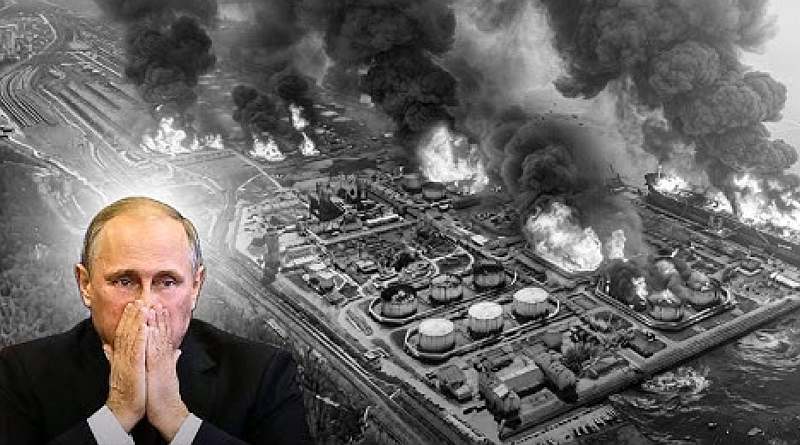
On March 16, 2014, U.S. Senator John McCain, during his interview with CNN, called Russia a “gas station country.” For many years, this comparison vividly described Russia’s role in the world order. However, the war unleashed by Russia against Ukraine led to the fact that starting from 2025, Russia began losing this status—thanks to regular strikes by the Ukrainian Defense Forces on refineries and the fuel crisis that arose in Russia.
As of today, the total loss of functionality of Russian refineries already exceeds 50%!
Export of oil products by sea in July dropped by 33.3% compared to the previous month and by 54.7% compared to last year, 2025. By port directions, the decline was: 85.4% – Arctic routes, 49% – through the Black Sea, 16% – Baltic and Far Eastern ports.
Additionally, the volume of domestic oil refining in Russia decreased to 3.6–3.9 million barrels per day, and actual production of “black gold” fell to 8.89 million barrels per day.
Could John McCain have imagined that the war with Ukraine would lead Russia to a severe fuel shortage, shutting down a whole series of refineries, a drop in exports, and the beginning of gasoline imports from other countries – including India, Kazakhstan, China, and even Belarus!
As a result of the war, Russia has even lost the status that was considered secured for it, if not for a century, then at least for decades. But the situation has drastically changed in just a few years, even months. And this, despite the fact that Ukraine does not intend to decrease the intensity of strikes on refineries, but on the contrary, will only increase them. Especially considering the gradual but systematic increase in the flight range of strike drones.
Conclusions
The war with Ukraine has become a mistake for Russia not only because it is a protracted conflict with significant losses of personnel and equipment but also because in this war, the inflated Russian statuses are being nullified.
Russia has lost the status of a country with the second army in the world. It has lost the status of a maritime superpower. We see it even losing the mocking status of a “gas station.” Before our eyes, the loss of its status as a space power is occurring.
But most importantly – Russia will never be able to restore these statuses, since such technical and technological capabilities in the face of the destruction and losses that have been and will still be inflicted, it no longer has.
