
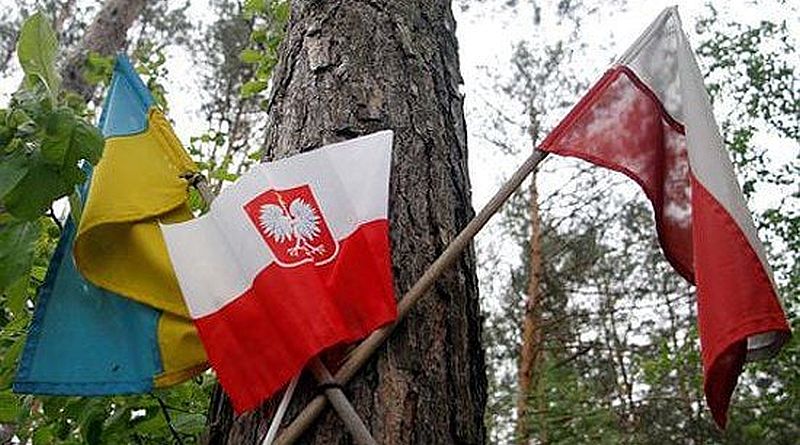
Andriy Harasym, Nadya Kelm / Texty
An investigation by Texty.org.ua about the network of Polish, Ukrainian, and Russian figures who have turned a historical tragedy into a political tool.
Necessary Remark:
The Volyn tragedy is one of the painful pages in the history of both the Ukrainian and Polish peoples. It took the lives of tens of thousands of people, left deep scars on both sides of the border, and still influences the mutual perception of Ukrainians and Poles. Therefore, its study requires maximum responsibility, reliance on documents, and readiness for honest dialogue without political speculations.
The editorial team of Texty.org.ua in no way denies the tragedy of Volyn or the scale of the suffering of the civilian population. These events require further comprehensive study and historical assessment based on facts, archival documents, and the results of scientific research. Meanwhile, our investigation shows that the memory of the Volyn tragedy has often become an object of political and informational manipulation in recent decades, involving networks of individuals and organizations linked to pro-Russian environments. It is these mechanisms of influence, not an attempt to revise the memory of the victims, that are the subject of our investigation.
At the end of the 1990s, Ukraine and Poland managed to set historical disputes aside and put the future first. Presidents Leonid Kuchma and Aleksander Kwaśniewski consistently built a reconciliation model based on mutual recognition of the tragedy of both peoples, a refusal from the language of mutual accusations, and a pursuit of dialogue. This course was symbolized by joint statements, mutual commemorations of victims, and the principle “we ask for forgiveness and we forgive.”
Polish sociology shows how the attitude of Poles towards the Volyn topic has changed. In 2008, only 20% of Poles knew well about the Volyn tragedy, and 41% had never heard of it. By 2023, 64% of respondents claimed good awareness, and altogether 92% knew about these events.
These changes occurred under the influence of political and informational campaigns, involving not only historians but also individuals and organizations that later repeatedly appeared in connection with the spread of pro-Russian narratives. It is their role in shaping the modern Polish discourse about Volyn that we will further examine.
In this material, Texty.org.ua focuses on the period from the mid-2000s to 2013. During this time, the subject of Volyn increasingly transitioned from historical research into politics. The culmination was the 70th anniversary in 2013, when these processes particularly converged at one point.
“Forerunners”
When a Pole speaks of “the genocide of Poles,” it can easily be attributed to historical resentment. But when the same is said by someone who calls themselves a Ukrainian, their words carry a completely different weight. Such witnesses have often become one of the most effective tools in the fight for Polish historical memory of Volyn.
One of the first was Victor Polishchuk, a lawyer who worked in the prosecution office of socialist Poland and later emigrated to Canada, author of the book “Bitter Truth: Crimes of the OUN-UPA (The Confession of a Ukrainian).” For decades, this work remained one of the most important arguments for those who promoted the thesis of genocide against Poles by Ukrainian nationalists.
Victor Polishchuk had a very complicated biography. He was born in Volyn in a Ukrainian-Polish family. After the Soviet occupation of Western Ukraine, his family was deported to Kazakhstan. Later, they moved to socialist Poland, where Polishchuk received a legal education and worked for some time in the prosecution office.
In the early 1980s, he emigrated to Canada. Of course, the Polish People’s Republic was never the Soviet Union, but getting permission to leave beyond the Iron Curtain was not easy. One needed to have substantial reasons for this. Unfortunately, we will never know what truly convinced the Polish special services to let him go.
Polishchuk settled in Canada and tried to join the Ukrainian diaspora movement. He partially succeeded in this. But eventually, he almost entirely focused on the topic of Volyn and ultimately published the book “Bitter Truth: Crimes of the OUN-UPA (The Confession of a Ukrainian).”
Interestingly, Victor Polishchuk supposedly published the book at his own expense. A poor immigrant from the impoverished socialist camp, without a high-demand profession in capitalism, finds the funds not only to live in an expensive country but also for such historical hobbies. Incredible luck. Or one might imagine him eating free meals, sleeping in a homeless shelter, and writing bitter memories. A writer-Don Quixote who, despite everything, strives to convey the truth to readers.
However, the image of a selfless person poorly matches what Polishchuk himself wrote about himself. As he admitted, the material factor was always important to him.
This is what Victor Polishchuk wrote in his book: “Also in Canada, I did not abandon the idea of rapprochement between Ukrainians and Poles. That is why, and also to earn a few dollars, I wrote a number of articles first for the Polish newspaper ‘Zwiazkowiec,’ later for ‘Echo Tygodnia.’ Ukrainian newspapers did not pay fees.”
Polishchuk’s work quickly gained popularity in certain Polish circles. And it’s no surprise. When a Pole talks about the crimes of Poles, there can always be accusations of bias. But when accusations come from someone who calls himself a Ukrainian, the situation changes fundamentally.
In 2013, Vadym Kolesnichenko, an associate of Viktor Yanukovych, a Member of the Ukrainian Parliament from the Party of Regions (2012–2014), known for his pro-Russian views, used this same approach. Arriving at the Polish Sejm and speaking there, he practically played the same role — a Ukrainian confirming Polish accusations. Testimonies “from the other side” almost always sound more convincing than words from one’s own.
It is not surprising that it was Polishchuk’s book that Kolesnichenko later republished in Ukraine and organized its public presentation.

During the final preparation of this material, it once again became apparent how complex a figure Viktor Polishchuk was. Much has been said about his extensive archive. Part of this archive was found to be available in the public domain on the website of the Polish Society of Remembrance of the Victims of Crimes by Ukrainian Nationalists (Stowarzyszenie Upamiętnienia Ofiar Zbrodni Ukraińskich Nacjonalistów). We will return to the activities of this organization and its collaboration with Vadim Kolesnichenko later.
What is more important now is that a significant portion of the materials published on the organization’s website consists of photocopies of interrogation protocols conducted by Soviet state security officers in the late 1940s. Many documents are handwritten by NKVD employees and do not contain archival codes or other details that would allow for their origin to be definitively established.
How these materials ended up in Polishchuk’s personal archive remains an open question. In his works and forewords, he did not, as far as can be determined, explain this.
The reconstruction of this archive’s history—who gave Polishchuk copies of the documents, from which archives they originated, under what circumstances they were obtained, and whether this is a KGB forgery—could become a separate study and possibly help to better understand Polishchuk’s role in this story. (Here is an interesting story about how the KGB forged Nazi documents to influence West Germany’s internal politics).
However, Polishchuk is far from the only predecessor with a dubious background. There were, of course, others. One of the most prominent authors and popularizers of this topic in the 1990s was Edward Prus. He deserves separate mention, especially one interesting fact: during the Second World War, Edward Prus was a participant in the Polish Resistance Movement, and later joined the Soviet NKVD destroyer battalions. This did not prevent (and perhaps even helped) him to build a career both in socialist Poland and after the dissolution of the socialist bloc.
Exterminatory battalions were auxiliary militarized formations created by the NKVD, composed of the local population, used to combat anti-Soviet underground and conduct punitive operations. Upon joining these units, participants became part of the Soviet repressive system. The operations themselves were accompanied by extrajudicial executions, torture, deportations, and other repressions that were characteristic methods of Soviet state security organs.
Particular attention is deserved by the Society for the Remembrance of the Victims of Crimes by Ukrainian Nationalists (Stowarzyszenie Upamiętnienia Ofiar Zbrodni Ukraińskich Nacjonalistów, SUOZUN). It is one of the most prominent Polish organizations specializing in the subject of crimes by the OUN-UPA and the Volyn tragedy. Its representatives have cooperated with Poland’s Institute of National Remembrance in various scientific and memorial projects, and the organization itself has been publishing books, holding conferences, and organizing exhibitions on this subject for many years.
The founder and long-time leader of the Society for the Remembrance of the Victims of Crimes by Ukrainian Nationalists is Szczepan Siekerka. He initiated many publications on the crimes of the OUN-UPA, and the installation of memorial plaques and monuments. He was a soldier of the Home Army. And, of course, it can’t go without saying, in 1944–1945, he served in the ranks of an NKVD exterminatory battalion.
The scale of cooperation between various figures of the Polish kresy movement with this Soviet Gestapo is astounding, as well as the extent to which this fact is ignored in modern Poland.
It’s equally surprising how uncritically a significant part of Polish society has accepted documents created by the same system that executed Polish officers in Katyn, massively deported Poles, killed 111 thousand Poles in the Soviet Union, and carried out political terror in Poland and many parts of the world.
Many arguments, on which today’s concept of the “Volyn massacre” as genocide is built, rely on interrogation protocols of Ukrainian underground members, UPA fighters, or peasants, obtained in NKVD basements. How the Soviet state security obtained such “testimonies” is well known from the history of Poland itself. But when it comes to Volyn, this fact often ceases to be the subject of critical analysis.
The story of UPA commander Yuriy Stelmaschuk (“Rudy”) is illustrative. His NKVD interrogation, during which he supposedly confirmed leadership orders for the mass extermination of Poles, is often presented today as one of the key pieces of evidence. Even the Polish Wikipedia refers to his “post-war NKVD testimonies,” although it concerns the interrogation protocol of a person in the hands of the Soviet secret service. The very choice of the word “testimonies” in combination with the NKVD says a lot about the level of critical attitude toward such a source.
By the time Russia decided to again make Volyn an instrument of its policy toward Poland and Ukraine, it didn’t have to create a new historical construct. The main narratives, archives, authors, and grateful audience already existed. It only remained to breathe new political life into them.
“Massacre” and the Russians
The Kremlin chose perhaps the most effective tactic for itself — not to interfere directly in the Polish-Ukrainian discussion, but to act through Polish actors. Moreover, the groundwork for conflict already existed: Polish historical memory, political disputes, and mutual grievances themselves created a high level of tension.

Russia only needed to periodically fuel these processes with its own propaganda, supporting the most radical narratives, increasing mutual distrust, and turning a painful historical topic into a tool of contemporary political confrontation.
In 2008, a collection of “documents and studies” titled “Forgotten Genocide: The Volyn Massacre of 1943–1944” was published in Russia. The annotation for the publication states: “The book you are holding is the first Russian edition dedicated to the Volyn Massacre of 1943–1944.” The collection was published at the expense of an unknown individual, and its compiler was someone named Oleksandr Dyukov.
It is Dyukov who plays a decisive role in further promoting the theme of the “Volyn Massacre.”
Oleksandr Reshideovich Dyukov calls himself an “Orthodox Russian.” He is persona non grata in the Baltic countries due to his propagandist works on historical topics, in which he tried to accuse the national movements of these countries of collaborating with the Germans during World War II. Here is how he is characterized in 2008 by the Estonian Internal Security Service (Kaitsepolitsei):
“Although Oleksandr Dyukov does not have a degree in history or notable professional achievements, he has very easy access to documents stored in the archives of the Federal Security Service of Russia (FSB). The doors of this archive are tightly closed to ordinary historians, including Russian citizens. Thus, O. Dyukov undoubtedly operates with full knowledge and approval of the FSB.”
In 2008, the “Historical Memory” foundation was created, with Dyukov as its permanent leader to this day.
Briefly about the foundation: to be as precise as possible, it can be considered a tool for conducting Russian special operations in neighboring countries, particularly in the humanitarian sphere, including history. The “Historical Memory” foundation attempts by all means to discredit national liberation movements in the Baltic countries and Ukraine.
The “Historical Memory” foundation received support from Russian state structures, including the Ministry of Foreign Affairs of Russia. The Russian MFA facilitated the foundation’s activities, and ministry representatives regularly participated in its events, indicating its integration into the Russian state’s historical policy system.
The Volyn tragedy was not an isolated project by Alexander Dyukov, but rather part of a broader range of activities by the “Historical Memory” foundation. In parallel, the foundation was publishing books on the Ukrainian liberation movement, the history of the Baltic countries, Soviet deportations, the Holocaust, and World War II.
Texty.org.ua managed to obtain a report from the “Historical Memory” foundation covering the years 2008–2018. It is indeed an interesting and important document. From here on, there will be no assumptions or reconstructions. Only what the Russians themselves wrote about their goals, methods, and results of their work in Poland and around the topic of Volyn.
The Russians’ report was indeed made “in step with the era,” including even infographics. Here is a map of the “Historical Memory” foundation’s events in different countries.

As we can see, Poland was a regular platform for Russia to conduct its “activities,” which were, in fact, humanitarian special operations. The number of such operations in Ukraine is even larger, but it is important to remember that the reporting period includes the presidency of Viktor Yanukovych, when Ukraine essentially became an open door for Russian special services. At that time, this was seemingly not the case for Poland. However, the published infographic actually indicates the opposite.

Unfortunately, the report from the “Historical Memory” foundation does not provide a precise list of the activities carried out in Poland during the period from 2008 to 2018. However, there is a very telling paragraph worth quoting here (translated into Ukrainian):
“Poland interests us as a platform for activities against the official historical-propagandistic concepts of Lithuania and Ukraine. Publishing materials in Poland about the crimes of Ukrainian nationalists or the repressions of the Lithuanian authorities against the Polish population of the Vilnius region is an effective tool for influencing our opponents in Lithuania and Ukraine.”
The presentations we organize regarding anti-Polish activities by Ukrainian and Lithuanian nationalists are recorded by Polish authorities and official historians; in this way, we convey theses to them that can be independently used by the Polish side.
It is pertinent to mention the research by Peter Pomerantsev and Edward Lucas “Winning the Information War: Techniques and Counter-Strategies in Russian Propaganda”. In it, the authors describe an objective among Soviet, and later Russian, active measures aimed at influencing a hostile country: “to disrupt relations with other nations” (Ukrainian summary of the study here).
Further confessions follow. Let’s just quote:
“We also pay close attention to the so-called Volyn Massacre — the mass extermination of the Polish population of Volyn by OUN-UPA formations. We support the research activities of Polish historians on this topic; additionally, we introduce new documents into scientific circulation regarding this crime against humanity.”
Once again, if someone didn’t read carefully: a fund associated with Russian state structures admits that it supports the research activities of Polish historians concerning the events in Volyn. It’s a sort of confession, just without naming names (spoiler: they will be named). To understand which Polish historians the Russians supported, we need to delve into the history of one modest Polish publication.
Myśl Polska — the “red thread” of the network
Oddly enough, the Russians wrote again in their report about all the events described below. Quoting:
“On November 30, 2016, on the eve of the official visit of Ukrainian President P. Poroshenko to Poland, we posted a prepared documentary publication ‘How and Why We Fight the Poles: The Anti-Polish Program of OUN in Archival Documents’ on the website of the Federal Archival Agency (Rosarchiv) about how Ukrainian nationalists planned mass ethnic purges of the Polish population of Volyn even before the start of World War II. This post was noticed not only by Ukrainian media but also by Polish (…).”
So here we have direct confirmation from the Russian side that the publication of alleged historical documents is a deliberate information-propaganda operation tied to a political event.
And also, of course, it’s interesting to see who on the Polish side supports such interventions. And for this question, the Russians, surprisingly, provide a full and comprehensive answer again:
“Already in June 2017, during the following anniversary of the ‘Volyn Massacre,’ the documentary publication was released by the Polish-language publisher Myśl Polska and presented at the Museum of Independence in Warsaw. This publication made a significant contribution to the justification of the legality of classifying the ‘Volyn Massacre’ as genocide and was therefore in demand by Polish historians.”
It seems it’s time to inquire about what exactly Myśl Polska is. And here we find a lot of interesting things.
In the Ukrainian language, there is a hackneyed expression “red thread.” Well, Myśl Polska is precisely that “red thread” that runs through various Polish organizations and events and very clearly marks the network or rather networks working towards the destruction of good neighborly Polish-Ukrainian relations.
This text is about a Polish magazine and publishing house with a “national-democratic orientation,” which, even after Russia’s aggression against Ukraine and the occupation of Crimea, publishes a book by Russian fascist Alexander Dugin. It is headed by a certain Jan Engelgard, who also collaborates with the Museum of Independence in Warsaw. This raises questions about how FSB “archives” could be presented in this museum.
Under Jan Engelgard’s editorship, Myśl Polska systematically popularized the works of Alexander Dyukov, covered events organized by the “Historical Memory” foundation, published interviews and reviews, and provided a platform for authors who promoted conflict-heavy interpretations of Ukrainian-Polish history. Through such media, Russian historical narratives were given a chance to become part of an internal Polish discussion.
Of course, it’s also interesting to know who else is involved with this publication. Here, we will encounter new, strange revelations. It turns out that the editorial board includes Mateusz Piskorski, who might best be described by a Soviet joke about Stirlitz. “Stirlitz was walking through Berlin, and nothing about him gave away that he was a spy: neither the radio behind his back nor the parachute dragging behind him on the street.”
Approximately the same can be said about Piskorski. In May 2016, he was detained by the Polish Internal Security Agency. Piskorski was accused of espionage in favor of Russian and Chinese civilian intelligence, including taking on operational tasks to promote Russian interests, for which he was allegedly paid.
The investigation into Piskorski lasted several years. He was eventually released, and the first media outlet he gave an interview to after his release was a Russian propaganda channel, where he thanked the far-right Polish politician Grzegorz Braun and several other well-known Polish far-right figures for their support.
The same circle includes Andrzej Zapałowski, a long-time author for Myśl Polska, a regular interlocutor of the Russian Sputnik Polska, and one of the most consistent promoters of the narrative of the “Volhynia massacre” as “genocide.”
He is now a deputy in the Polish Sejm from the Confederation of the Polish Crown led by Grzegorz Braun — a political force whose representatives regularly spread anti-Ukrainian and pro-Russian messages. After the start of the major war, he consistently opposed large-scale Polish aid to Ukraine and criticized state support for Ukrainian refugees.
Historian Bogusław Paź will also publish in Myśl Polska, later arguing that Ukraine should come to terms with the loss of territories seized by Russia.
From the examples provided, it is clear that the network that has been shaping a specific historical discourse for many years has not remained on the margins but has obtained direct representation in the Polish parliament.
“Trendy” Topic
Of course, the “Historical Memory” foundation and Myśl Polska aren’t the only ones. Besides them, other powerful structures work with this theme.
Take, for example, an institution with the rather dull name of the Russian Institute of Strategic Studies. For understanding: this institution was previously called the Research Institute of Intelligence Problems of the First Chief Directorate of the KGB of the USSR.
Currently, the institute is headed by Mikhail Fradkov, who previously held the position of director of the Russian Foreign Intelligence Service. Unlike the “Historical Memory” foundation, this institution prefers not to report on the real directions of its work.
However, for example, in the 2010s, they suddenly began to hold many events and roundtables on improving Russian-Polish relations. One of the few monographs dedicated to Ukrainian-Polish relations and published on the institute’s website back in 2010 under the title “‘Ukrainian Katyn’: Ukraine and Poland Await a ‘Reset’ of Humanitarian Policy,” contained the following phrase:
“The Polish-Ukrainian alliance was directed against Russia, which was considered guilty of past crimes. However, the foundation of this alliance rested on shaky ground. Ignoring the entire complex of unresolved acute issues of Polish-Ukrainian history, it is worth recalling just the ‘Volhynia massacre’.”
Overall, one can once again be convinced that the Kremlin does not necessarily bet on large parties or influential political forces. On the contrary, small but well-organized political, public, or media structures often become convenient partners. It is through such mediums that Russian narratives gradually infiltrate broader public discourse under the guise of a local, rather than externally imposed, position.
Wind from Ukraine
If the former regional deputy and concurrently Russian propagandist Vadim Kolesnichenko did not exist, then proponents of discord between Ukraine and Poland would have had to invent him.
In Ukraine, Kolesnichenko had long been integrated not only into the pro-Russian political camp but also into a network of Russian state structures promoting the concept of the “Russian world.”
He headed the All-Ukrainian Coordination Council of Russian Compatriots’ Organizations, led the “Russian-speaking Ukraine” movement, maintained close contacts with Russian state funds and politicians, and his activities promoting the language law were funded by the Russian Pravfond (Fund for the Support and Protection of the Rights of Compatriots Abroad).
The latter, according to published documents, not only allocated funds but also coordinated the information campaign. Already in 2013, Russian President Vladimir Putin awarded Ukrainian lawmakers Kivalov and Kolesnichenko special distinctions in Moscow “for popularizing the Russian language in Ukraine.”
We have talked a lot about the role of various Polish and Russian historians, politicians, and propagandists, but in this whole story of promoting the Volhynia topic, one strategic position remained vacant. This niche was very successfully found and occupied by Viktor Polishchuk. It concerns the place of a person from “this” side, a Ukrainian who comprehensively confirms all allegations of crimes, effectively of genocide.
Vadim Kolesnichenko, perhaps with good reason, reissued Viktor Polishchuk’s book at one time. He understood very clearly the advantages this position provides. It is possible, of course, that this was “suggested” to him, but he turned out to be an excellent executor. Kolesnichenko’s work on this front is extensive; he turned out to be a real workaholic in this area.
Back in April 2010, this MP, through the organization “Russian-speaking Ukraine,” opened an exhibition at the Ukrainian House titled “Volyn Massacre: Polish and Jewish Victims of OUN-UPA.”
Importantly, he did not open it alone but with Polish partners — the Society for the Commemoration of Victims of Crimes by Ukrainian Nationalists (Stowarzyszenie Upamiętnienia Ofiar Zbrodni Ukraińskich Nacjonalistów, SUOZUN), which we mentioned earlier.
During its opening at the Ukrainian House, clashes occurred: people who came to protest were already met by “Berkut” employees. This indicates that the coordination of the special operation was carried out at the highest level of then Ukrainian leadership or its curators from Moscow.
Also notable is the reaction of the official Poland at that time. Olga Hnatiuk, the Science and Culture Attaché of the Polish Embassy in Ukraine, stated: “You can’t indiscriminately throw everything under the slogan ‘Volyn Massacre’ just for the sake of the word ‘massacre.’ This is done to provoke sharp emotions. And as a representative of the embassy and as a person with the academic title of historian, as a professor at the University of Warsaw, I strongly oppose such abuses.”
It is simply striking how balanced and reasonable the position of official Poland was at that time compared to the present.
This exhibition was a joint product of SUOZUN and “Russian-speaking Ukraine,” adapted for the Ukrainian political field: in Russian, with extensive media coverage, without specified authorship, and with a route through regions where pro-Russian parties had a political audience.
SUOZUN not only provided materials from its archive but also officially joined the project, which in April 2010 became one of the loudest political scandals in Ukraine’s humanitarian sphere.
Accordingly, this organization deliberately gave this project its authority and legitimacy, sharing responsibility for its implementation and consequences. In fact, SUOZUN took full part in the Russian special operation on Ukrainian territory.
Of course, the specific individuals who supervised and evidently financed Kolesnichenko are also of interest here.
Texty.org.ua reached out with questions to one of the former allies of the separatist politician, who continues his public activities in Ukraine, Ruslan Bortnik. They specifically asked him who participated in the preparation and financing of the exhibition.
But Mr. Ruslan answered that he was not aware of this information, “as he was not involved in the organization of the exhibition. He was present only at the opening of the exposition in Kyiv as a visitor.” “As far as I remember, the preparation, holding, and financing of the exhibition was entirely the responsibility of the Member of the Ukrainian Parliament Vadim Kolesnichenko, with whom I have not maintained any connections since 2014-2015,” he added.
Perhaps such connections can be better observed in 2013, when a new stage of the campaign to discredit Polish-Ukrainian relations begins, as well as the unfolding of the “Volyn Massacre” topic.
Preparation for the “historical” visit
In 2013, Kolesnichenko’s “star” shone in the Volyn topic as never before. This year was pivotal for him — the campaign that was for the most part internal to Ukraine began to reach an international level.
Let us recall that in July of that year, a group of Ukrainian parliamentarians, predominantly from the Party of Regions and the CPU, appealed to the deputies of the Sejm with a call to officially recognize the “Volyn massacre by the OUN-UPA as genocide of the Polish population.” The authors of the letter not only used the harshest legal qualification of the events but also essentially called on a foreign parliament to make this decision.
Together with a group of deputies from the Party of Regions, Kolesnichenko registered a draft law to establish July 11 as the Day of Remembrance for the Victims of the Volyn Tragedy and to introduce the title “Ukrainian Righteous of the World.”
Kolesnichenko also held a joint press conference in Kyiv with Krakow City Council deputy Miroslaw Gilyarski and Polish activist Jacek Wilczur, where they presented the Ukrainian edition of the “Kresowe book of the righteous 1939–1945.”
At first glance, it was an ordinary book presentation. In reality, it showed which Polish environment Kolesnichenko chose as his ally. Both Gilyarski and Wilczur were associated with Kresy organizations, which would soon welcome the Ukrainian deputy in Poland.
Particularly noteworthy is the figure of Jacek Wilczur. A few months before the Kyiv press conference, his book “You Can’t Get to Heaven Straight Away: Lviv, 1941–1943” was published in Russian by the REGNUM agency under the editorship of Modest Kolerov, a former employee of the administration of the Russian president and one of the architects of Russian historical-propaganda policy in the post-Soviet space.
Thus, one of the main Polish guests of the event was an author who had already been actively promoted by one of the key Russian information-propaganda platforms before the campaign began.
Equally telling was the financing of the book itself. According to RISU, the funds for the Ukrainian edition were provided by the charitable foundation “Dnipro-Sich” of Vyacheslav Boguslayev, the president of “Motor Sich,” a People’s Deputy from the Party of Regions. In 2022, the SBU detained him on suspicion of state treason, collaboration, and aiding an aggressor state.
After this press conference, Kolesnichenko went to Warsaw, where events and meetings with Polish politicians organized by the Committee for Commemorating the 70th Anniversary of the Volyn Tragedy were already awaiting him.
2013: When the Stars Aligned
The 70th anniversary of the Volyn Tragedy became the moment when the topic finally went beyond historical debates and the environment of the families of the deceased. By 2013, a large political machine was already working around it: Kresy organizations, historians, clergy, deputies, civic activists, and media.
As reported by the internet portal Kresy.pl, immediately upon arriving in Warsaw, Kolesnichenko met with a number of interesting figures. We will quote this passage in full; it is indeed very important:
“Deputy of the Party of Regions Vadim Kolesnichenko arrived in Warsaw at the invitation of the All-Polish Committee for Commemorating the 70th anniversary of the Bandera genocide in the Eastern Kresy of the Second Polish Republic in 1939-1947. At Chopin Airport, he was met by the head of the International Committee of Commemoration General Mirosław Hermaszewski and the Committee’s spokesman Jan Engelgard. On the first day, the guest met with members of the Committee, including Colonel Jan Niewinski, Deputy Franciszek Jerzy Stefaniuk (PSL), Dr. Tadeusz Samborski, and Dr. Dariusz Grabowski.”
Thus, he was personally invited to Poland by the Committee for the Commemoration of the 70th Anniversary of the “Volhynia Massacre.” This means that his visit was included in the official program of public events, and was not a private initiative of the deputy himself.
For the organizers of the celebrations, Kolesnichenko was indeed an extremely valuable guest: a Ukrainian deputy who promoted the same assessments of the “Volhynia Massacre” as they did, creating the impression that Ukraine shared their views.
Already at the airport, he was met by Jan Engelgard, the same gentleman mentioned earlier regarding the cooperation between Poles with the Myśl Polska circle and Dyukov’s Russian propaganda fund. It’s interesting how events align. Apparently, the Myśl Polska cooperation package was not limited to promoting propaganda narratives, but was much broader.
Among the participants of the meeting was Dariusz Grabowski, an economist, former member of the Sejm and the European Parliament, representing the Polish conservative community.
Kolesnichenko also met with one of the main “Kresowiacy” — the head of the Kresowy Patriotic Movement of Poland, Colonel Jan Newinski.
One of the most respected figures in his community, despite having once served in an NKVD fighter battalion. Given that Kolesnichenko himself is an ardent admirer of the NKVD and even once held a press conference in an NKVD uniform, they certainly had much to discuss with the colonel.
By the way, Newinski later awarded Kolesnichenko a distinction from the “Kresowiacy” community — the “Cross of Remembrance of the Victims of OUN-UPA Genocide.”
But there is another important point.
The reconstruction of Kolesnichenko’s visit to Poland reveals a rather telling pattern. If his participation in public events was facilitated by Kresy organizations, veterans, and historical societies, the doors to the official Polish parliament were already opened for him by the politicians of the Polish People’s Party (PSL).
“Peasants”-Russophiles
One of the leaders of the PSL, former Deputy Prime Minister Jarosław Kalinowski, headed the National Public Committee for the Commemoration of the 70th Anniversary of the Bandera Genocide in Eastern Lesser Poland. It was this committee that coordinated the anniversary events and invited Vadim Kolesnichenko to Warsaw.
PSL representative Franciszek Jerzy Stefaniuk not only met with Kolesnichenko but also publicly introduced him to the Sejm deputies during debates on Volhynia, effectively legitimizing him as the voice of a “different Ukraine” that supports the demand to recognize the actions of the OUN and UPA as genocide.

Among the political circle of PSL was also Tadeusz Samborski, with whom Kolesnichenko met on the first day and who actively worked with Kresy organizations and participated in commemorative events. It is perhaps worth focusing on him separately.
Here are just a few facts from his biography. According to the information from one of the most well-known Polish independent investigative and fact-checking portals, OKO.press, Tadeusz Samborski obtained a doctoral degree at Moscow State University in 1977.
He then returned to Poland, even served as a diplomat in Laos. But in 1983, he returned to Moscow as a correspondent for a newspaper, where he spent the next 10 years. Later, he engaged in political activities in Poland, constantly emphasizing the issue of “eastern Kresy” and the “atrocities” of the OUN-UPA.
But even in this period, the “charm” of Russia did not let him go. For years, he organized the Legnica Festival of Polish-Russian Romance, in which performers from Russia and Belarus participated. The festival still exists, although after the outbreak of the war, it changed its name to “Autumn Romance.”
And the main thing — ta-da! — Samborski is a regular contributor to the already familiar publication Myśl Polska. His writing talent was so highly appreciated there that his articles were published in a separate book.
However, Samborski did something more than just continuously updating the “crimes” of the OUN-UPA among Polish citizens and warmly welcoming Vadym Kolesnichenko.
Tadeusz Samborski is among the few Polish politicians who have consistently advocated the qualification of the Volyn tragedy as genocide for more than two decades.
Back in July 2003, the day after the adoption of a joint statement by the Polish Sejm and the Verkhovna Rada of Ukraine, in which the parties deliberately used the compromise formulation “Volyn tragedy,” Samborski, speaking from the Polish Sejm tribune, called the events in Volyn the “apex of genocide (ludobójstwo) committed against the Polish population of Volyn by OUN-UPA fighters.”
After returning to the Sejm in 2023, he once again received a parliamentary platform to promote his views on the Volyn tragedy.
Although the decision to recognize the Volyn tragedy as genocide was made by the Polish Sejm back in 2016, when Samborski was not a deputy, it was he who, upon returning to parliament, became one of the main political promoters of this course, ensuring its further legislative and symbolic consolidation. Such a connoisseur of Russian romances.
Returning to Kolesnichenko’s visit. His route through Warsaw was noteworthy. In just a few days, he passed through almost the entire network of Polish circles that would actively influence the Volyn discussion in the following years — from kresy organizations and parliamentary politicians to historians, publicists, and organizers of commemorative events.

“Voice of God”
One of the recognizable faces of the 2013 campaign was Father Tadeusz Isakowicz-Zaleski, an Armenian by nationality, a priest of the Armenian Catholic Church, a former anti-communist opposition figure, and chaplain of “Solidarity.”
He had a national reputation, which most marginal kresy activists lacked at the time. For the Polish audience, he was not a party agitator or a backyard nationalist, but a priest persecuted by communist special services.
It was this biography that made him the most valuable moral asset of the campaign. Isakowicz-Zaleski translated the demand to call Volyn a genocide from the realm of political statements into the realm of moral duty. Disagreement with him could already be presented not as another assessment of a complex history, but as a reluctance to hear the victims and call evil by its name.
However, Isakowicz-Zaleski was not just a symbol used by others. He actively shaped the agenda himself: criticizing the Polish authorities and church leadership for being too lenient towards Ukraine, demanding legal recognition of the genocide, opposing the “cult” of Bandera and the UPA, and for years turning attitudes towards Volyn into a test for Polish politicians.
But if you trace his activities a few years before the 70th anniversary, an interesting discovery awaits. It turns out that in April 2010, Isakowicz-Zaleski came to Kyiv for a press conference with a telling title, “Participants of the Great Patriotic War against Bandera.”
The event was held under the auspices of the International Ukrainian Union of War Veterans as part of the campaign to revoke Viktor Yushchenko’s decrees awarding the title of Hero of Ukraine to Stepan Bandera and Roman Shukhevych.

It is also important with whom Isakowicz-Zaleski agreed to appear. Among the declared participants of the press conference was George Dygas, a former KGB officer and representative of veteran organizations of Soviet special services.
Avigdor Eskin, a Moscow-born Israeli right-wing publicist who, after 2014, became a regular participant in Russian anti-Ukrainian propaganda, was also announced as a participant. The choice of partners is quite telling.
Isakowicz-Zaleski’s personal website would operate not only as a personal blog but also as a platform for other authors. It would feature texts calling for negotiations with Russia, complaints about “hatred of Putin,” criticism of financial support for Ukraine, and claims about the threat from Ukrainian migrants. Not all these words belonged to the priest himself, but it was his platform and reputation that gave them additional weight.
However, it seems that in 2013 few in Poland paid attention to such connections. The country was simply swept by a “historical” wave of the “Volyn massacre.” Isakowicz-Zaleski traveled with a multi-day tour through all cities and towns in Poland with lectures about “crimes of the OUN-UPA.”
It seems there was not a single more or less large settlement in the country where this active priest did not appear. The Polish press constantly reported new details about the event and activities. Large-scale “historical” reenactments of the “Volyn massacre” were organized in the country, which became popular attractions for visits. Evidently, there was no turning back at that time, and it was only going to get worse.

After 2013
After 2013, Volyn ceased to be a topic that surfaced only on the eve of anniversary dates. It firmly established itself in the Polish political agenda, and within a few years the Sejm made a decision to recognize the Volyn tragedy as genocide.
At the same time, a stable circle of politicians, public figures, historians, journalists, and media platforms formed around it, who for years set the tone for this discussion.
The uncritical use of historical sources led to Soviet intelligence documents, dubious archival finds, or works by authors often exposed for manipulation and falsification, frequently receiving almost the same status as academic research.
Another significant issue was the indiscriminate choice of partners, which opened doors to people and organizations later found to have ties with Russian propaganda platforms, political projects, or influence structures.
The readiness of some Polish politicians to use any ally who supported the historical agenda they needed also played a part. They legitimized even figures like Vadim Kolesnichenko, whose role in promoting Russian interests in Ukraine was already well known at the time.
This is why Russian structures and their associated actors could organically integrate into the existing historical and political disputes.
The Russians did not need to replace the Polish discourse — it was sufficient to gradually influence its content by using existing narratives, authorities, media platforms, and political contacts.
The line between sincere historical discussion, honest research, internal politics, and external informational influence became increasingly blurred until it disappeared altogether. However, it seems that most in Poland did not notice this.
Photo on the cover: “Day”
