

The war in the Black Sea has intensified. Russia is systematically hitting ports, maritime terminals, and merchant ships heading to the Ukrainian coast. The main result was not even the destruction of infrastructure, but the recent decision by foreign shipowners not to enter Ukrainian ports. For a country that exports over 80% of its cargo by sea, this is a painful blow to the economy and the state budget. About what makes the six Ukrainian ports of the Northern Black Sea region special, whether Romania will help us, and what to do with the ports after the war, Texty.org.ua speaks with economic geographer Ivan Savchuk.
Competitors in the grain market
— After the intensification of attacks, ships have stopped entering the Black Sea ports of Ukraine, even though the state did not impose restrictions. Why is this happening?
Put yourself in the place of a shipowner. You send a ship here under a Panamanian, Liberian, or any other flag. The crew is there, and the ship itself is expensive. If something suddenly happens, who will cover the losses?
No insurance company in the world insures against acts of war. It’s not force majeure; it’s a direct exclusion in the insurance policy.
Ukraine’s problem is also that we practically do not have our own merchant fleet. Except for ships from the company “Nibulon” and a few others belonging to SCM structures, there’s nothing to transport with. If there were our own fleet, the government, together with the owners, would find a formula for compensating and insuring risks. But when foreigners are the ones exporting, our government’s influence is much smaller.
— So the structure of exports ties us to the sea, but we don’t have our own fleet?
Our exports are dominated by bulk and liquid cargo: corn, wheat, sunflower oil. We cannot wait for a better market condition, accumulate grain in ports, and export later — we simply don’t have such storage capacities in the ports. The largest was Mykolaiv: before the war, nearly a million tons could be stored there simultaneously. By the way, before World War I, Mykolaiv was also the main grain port. The situation is repeating exactly.
— Why do the Russians mainly strike ports at certain times of the year?
Because we are direct competitors with them. Two-thirds of Russian export grain comes from the Black Sea South of Russia, and we trade with them in the same market: Arab countries, the Muslim Middle East. This is feed grain: corn and wheat used for feeding livestock and poultry. This market is key for both sides.
The competition is fierce because the conditions for grain production and export in Ukraine and Russia are almost identical: similar railway and transshipment costs, and approximately the same delivery distance from Odessa and Novorossiysk.
The logic of the Russian strikes is simple: if Ukraine fails to deliver a contracted supply, the client will go to the competitor. There are no long-term multi-year contracts there; purchasing occurs annually, mostly in the fall. That’s your answer to why the strikes have intensified now.
Previously, a restraining factor against attacks was Russian capital in Ukrainian agribusiness and vice versa. Now there are no safeguards: our agribusinesses have sold their divisions in Russia, Russian entities have exited Ukraine. Why not strike?
Alternative Routes
— How do our ports differ from each other?
Only a very limited number of ports can handle containers. Izmail can accommodate ships with a maximum displacement of 20,000 tons, and even then only in the spring when the Danube is high. In contrast, 100,000-ton container ships used to enter Chornomorsk. The larger the ship, the cheaper each container costs. This applies to all imports, including bananas: Chornomorsk was Ukraine’s main banana port, equipped with refrigeration facilities for this purpose since Soviet times.
Currently, large shipping companies — COSCO, Maersk, MSC — are building routes bypassing our ports and are using the Romanian Constanța as a hub. During the war, it increased its cargo turnover by about a third, mainly owing to Ukrainian grain. The Romanians created a special tariff for grain export to Constanța and built the largest grain hub in the EU. Romania itself will never produce as much grain as Ukraine.
— How serious is the mine threat in the Black Sea?
Serious. After storms, mines come loose from anchors and drift — there have been damages to vessels in Bulgarian and Turkish waters. No one guarantees that such a mine won’t end up elsewhere. Due to hostilities, commercial vessels either stay closer to shore to receive help if necessary or avoid dangerous areas. Routes become longer, increasing both the transportation cost and risk.
— How many ports actually operate in Ukraine?
Six: Pivdennyi, Odessa, Chornomorsk, Ust-Dunaisk, Izmail, and Reni. By administrative decision, the Bilhorod-Dniester port has been converted into an inland distribution port. The Danube ports (Ust-Dunaisk, Izmail, Reni) are severely limited by technical and environmental capabilities.
The deepest guaranteed depths are at the Pivdennyi port, which was built for large ships (Pivdennyi, Odessa, and Chornomorsk together form the ports of Greater Odessa). After losing Sevastopol, these are our deepest berths, and therefore the cheapest to transship. Each additional transshipment is an extra 10-20 dollars per ton. If you’re transporting diamonds, these $20 don’t matter. But if it’s grain, this is a critical difference, because it has low margins; the profit is small.
Interestingly, the Chinese found a clever solution: instead of sending empty containers back from Ukraine, they fill them with grain.
Exit from Crimea
— By the way, what role does China play in Ukrainian trade?
A key role. The Chinese government has set a goal to have a six-month supply of basic foodstuffs. This stimulates imports and essentially determines world prices (China consumes 350–400 million tons of grain every half-year, while the entire Ukrainian export amounts to up to 40 million tons per year. — Ed.). China is interested in our ports.
By the way, when a Chinese ship enters a Ukrainian port, the Russians try not to disturb their ships and not frighten their sailors. By tonnage, Chinese ships were the largest in Chornomorsk and Pivdennyi.
— Have military actions changed the logic of Russian port operations?
In occupied Crimea, the Russians closed the ports of Feodosia, Yalta, and others to focus air defense on other points. Their main commercial port is Novorossiysk in the North Caucasus, the largest grain and oil transshipment facility in Europe. Nearby are specialized terminals built by Kazakhstan for exporting its oil. Strikes on them are already a diplomatic issue: Kazakhstan is not participating in the war, and the shutdown of the terminal means loss of tax revenue for the Kazakh budget (simultaneously, Kazakhstan is a major transit point for Russian oil to China via pipelines. — Ed.).
— There are questions about the grain taken by Russia from temporarily occupied territories. What happens to the stolen grain?
They try to “refine” it, mix and reprocess it so it appears like any other. Ships transporting this grain often sail under flags of very specific countries, and protests to governments that do not strictly control their territory achieve little.
The Russians may go further and grind the grain into flour — as the Soviet Union did with American grain, sending the flour to Cuba or Vietnam, which were hostile to Americans. The origin of the grain cannot be determined from the flour. However, the flour market is much smaller as there are no unified standards. Even in the EU, they have not yet been unified.
From Vulnerability to Independence
— Will shipping be restored in our ports?
Absolutely. Technically, Russia cannot launch such a number of missiles and drones at the ports every day. They have to choose: hit the ports or military targets on the front, or rear cities in Ukraine with warehouses. We see this happening.
The problem lies elsewhere. To load a large vessel, you need to accumulate grain at port elevators. And when there’s a direct threat of attack — as we saw when the Kernel terminal for sunflower oil transshipment burned down — companies immediately start thinking: what was accumulated over months was burned in five minutes.
Because of this, the popularity of storage technology using bags — storing grain in plastic bags directly in the field — has grown. The quality of storage there is not the best. There are also problems with elevators. During winter power outages, the grain in elevators loses quality, and thus will cost less.
— Is it possible to shift exports to the railroad?
No. It is technically impossible to export 80 percent of goods by rail.
Today, the Odesa railway has become the key artery of the Ukrainian economy: as soon as problems arise there, foreign economic activity stops. It serves both the ports of Greater Odesa and the Danube ports.
Theoretically, renting terminals in Romania or Poland is possible. But this means several months of negotiations with state organizations and owners. Everything depends on diplomacy and the interest of neighbors.
— Would increasing the depth of processing export raw materials be a solution?
In the USA, about 40 percent of corn goes to bioethanol. If we develop organic chemistry using our own raw materials, we will diversify markets and take a step towards energy independence. There aren’t many countries with such potential: Brazil and the USA.
Brazil is also a significant example in another way: it has specialized ports. There is a separate iron ore port, for which a transnational corporation built a railway spanning hundreds of kilometers. There are separate ports for other cargoes. This is done deliberately to reduce costs: the bigger the vessel and more homogenous the cargo, the smaller the transport component.
After the war
— Does port specialization work in Ukraine?
According to legislation, we have three types of ports: seaports for trade, fishing ports, and specialized ports. But in practice, functions are mixed. In France, for example, this is impossible: if you unload a container in a fishing port, they will simply confiscate your cargo.
Ukraine needs legislation that clearly defines what each participant in transshipment does. This is not yet in place. No large transnational company will invest in our ports.
Separately, there is the issue of Russian capital in port infrastructure. The government is trying to nationalize these assets, but the mechanism is not legislatively defined. The owner is not always the Russian state; often it’s a company registered, say, in Switzerland. This creates many legal problems.
— One last question: how should ports be managed to serve as an additional insurance for the country?
There are several models worldwide. The first is fully private ports. The state only creates the legal framework and does not interfere.
The second, most common in the EU, is where major trade ports are completely state-owned but managed by an administration or a state-owned company. Greece was an exception, where the port was sold to China, sparking sharp debates in the EU. Many view it as a loss of independence.
Lithuania refused the Chinese with Klaipeda. Meanwhile, China is actively building infrastructure around Georgia’s Poti.
The third model is autonomous ports, where the port becomes part of a local community or region.
There is no universal answer to your question. It all depends on the country’s economic policy. For Ukraine, what’s most important is the situation after the war. Moreover, what’s more crucial is not even the port itself but the hinterland (the inland area that supplies the port with goods and infrastructure). The sea will remain, but the hinterland might change significantly due to military actions or policy shifts.
It’s equally important to see if there will be a new Marshall Plan for Ukraine or another development model. Will the state revert to the pre-war idea of “privatize everything because private owners have no interest in corruption”? There is no concrete plan yet.
Another factor is European integration. If Ukraine joins the EU, joint legislation will need to be implemented. Our Achilles’ heel is ecology. Vessels entering Ukrainian ports do not always meet European standards.
Thus, we have many opportunities, but realizing them depends on conditions that are still unknown to us.
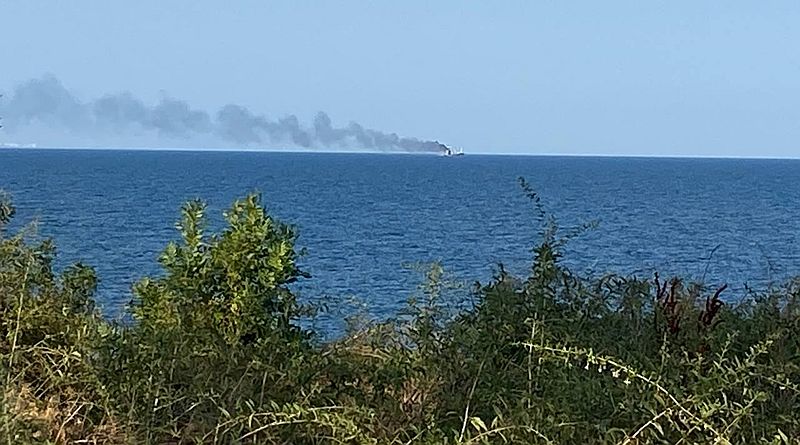
In the photo: On July 19, the vessel Golden Leo is burning with a cargo of corn on the raid of Greater Odesa. That day, the vessel was reportedly hit by three Russian cruise missiles. Nine crew members and the Chornomorsk port pilot, 70-year-old Volodymyr Mykhailov (a sea captain), were killed. The vessel sank on July 26 near Odesa. Photo: Olena Balaba
