
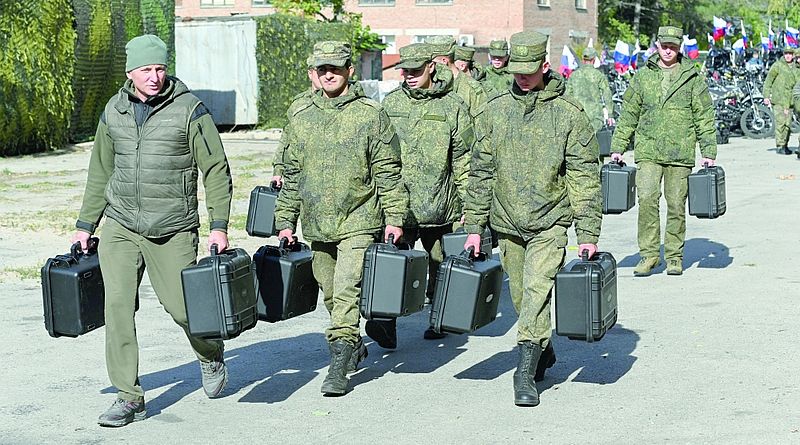

The aggressive informational campaign that the Russian authorities have launched regarding army recruitment reveals deep systemic problems within the state apparatus amidst an endless war. Attempts to convince the public of the absence of any plans for a new wave of mobilization evoke the opposite reaction, as citizens have long been accustomed to perceiving such assurances as a sure sign of preparations for the toughest decisions.
When a citizen is persistently and convincingly reassured, proving there is no cause for concern, social tension instantly increases, resulting in the population becoming seriously anxious.
Within just one week, Russian officials have publicly denied reports of preparations for a forced draft three times. At the meeting of the Security Council’s Interdepartmental Commission on Armed Forces Recruitment, Dmitry Medvedev even characterized the topic as enemy lies, adding the thesis that the army’s personnel needs for the first half of 2026 were fully met.
Against the backdrop of synchronous denials, the words of Vladimir Putin, who earlier publicly quoted the popular question from volunteers about what they would do after the completion of the special military operation, sound particularly symptomatic.
This rhetoric from the top leadership is meant to create an illusion of long-term stability, although the regular return of speakers to the topic of recruitment only underscores the inability to hide the real cost of the protracted conflict.
Mathematical calculations and the reporting figures from Medvedev himself reveal the scale of the personnel shortfall faced by the recruitment system. Considering the Deputy Chairman of the Security Council’s habit of citing data strictly as of the current date, the recently mentioned figures represent quarterly statistics, and projection of the quarterly values for all of 2026 gives a range of 320,000 to 350,000 contract soldiers.
Comparison of current forecasts with the results of previous years shows a steady decline in citizen recruitment dynamics: in 2023, the army enlisted 540,000 contract soldiers; in 2024 – 440,000 people; in 2025, only 400,000 new soldiers were recruited.
The drop in annual intake to a figure of 320,000 to 350,000 convincingly demonstrates that the financial incentive system has exhausted its reserves, and record single payments no longer attract volunteers, effectively putting them at mortal risk.
The resulting personnel shortage forces officials to resort to aggressive administration, with a large-scale recruitment campaign launched in higher education institutions. Russian universities have become pressure points for students, who are being offered contracts under threat of expulsion or with promises of easy service.
The systematic failure of voluntary recruitment plans makes the gap between the front’s needs and available resources critical. No matter how much officials deny the preparation of unpopular decisions, the combination of economic factors and the decline in contract soldiers leads to a rapidly increasing likelihood of announcing a new wave of mobilization.
Photo: Occupant Media
