
Oleksandr Kovalenko / Obozrevatel
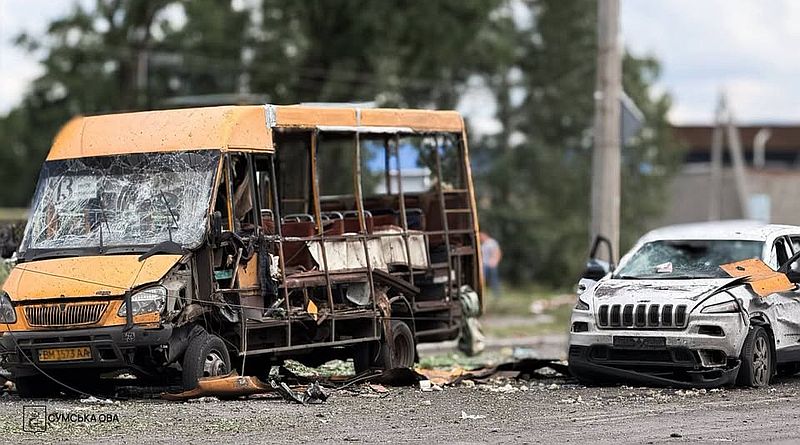
Since the beginning of summer, Russian occupiers have significantly intensified terror in the Kharkiv, Sumy, and Chernihiv regions. At the same time, the enemy is deliberately striking civilian targets. But is this preparation for something bigger—especially in light of the information about a general mobilization in Russia and the possibility of opening a second front?
More about this in the new material of the joint project OBOZ.UA and the group “Information Resistance”.
Cities under attack
Sumy is under attack using MLRS, KAB, and FPV drones on gas stations, residential areas of the city, and infrastructure. On the night of July 22—on “Epicenter”.
More intensive strikes on Kharkiv—with the use of KAB, FPV drones, and ballistic means. In addition, the enemy uses “Banderoľ” ersatz rockets, which in a sense brings me to compare border cities with Odesa—due to the similarity in vulnerability to terror and the use of similar means of attack by the enemy.
In Chernihiv on July 26 the enemy struck an ATB.

And this is only a small part of what is happening.
In parallel with the terror against the civilian population, the enemy does not cease attempts to expand control zones in the border areas of almost all the mentioned regions.
These actions may suggest that the intensification of strikes on regional centers is an attempt to create conditions for more large-scale ground operations aimed at capturing Kharkiv, Sumy, and Chernihiv.
Risks of Occupation
To understand the essence of what is happening and the risks (current and future), it is necessary to determine the enemy’s potential in this direction.
According to various estimates, the total number of the Russian military group “Sever” is between 120,000 and 140,000 personnel. Of these, the “Bryansk” group has about 15,000-20,000 people, the “Kursk” group about 60,000 people, including up to 14,000 North Korean soldiers, and the “Belgorod” group about 50,000 people.
All these military groups lack sufficient forces and means to conduct large-scale combined arms offensive operations, one of whose goals should be to capture a regional center.

For example, the “Belgorod” group launched the Vovchansk offensive in May 2024, aiming to create a bridgehead for resuming the terror of Kharkiv at close distances and to open the Veliky-Burluk direction. As of today, this group remains locked in the Vovchansk area, not even fully controlling this city, which has been wiped off the face of the earth. How can Kharkiv be discussed with such a number of forces and means, and potential combat capabilities?
Likewise, the “Kursk” group, which began the Sumy offensive in March 2025 to reach the nearest approaches to the regional center and consolidate along the Khotin – Maryine line, but even this was beyond their strength.
The “Bryansk” group in its current form is capable of only diversionary activities on the Ukrainian border. Even this without securing the ground, as attempted by the “Kursk” and “Belgorod” groups.
Thus, to say that the concentrated forces and resources of the enemy in the Kursk, Belgorod, or Bryansk regions could pose a threat to the occupation of large regional centers is not justified. However, it is crucial not to forget the risks posed by a general mobilization in Russia.
In early June, in an article on OBOZ.UA “Russia is preparing for general mobilization: when this might happen and how many they plan to throw into the war against Ukraine and beyond”, I noted that to continue the war against Ukraine considering the retention of occupied territories, as well as maintaining the pace of creeping offensive (as in 2026) during 2027 Russia needs to mobilize at least 500,000 people. Not 300, not 400, not UP TO 500,000 – at least 500,000.
If the Kremlin considers opening a new front, for example, the Chernihiv direction, or strengthening the Northern-Slobozhansky/Slobozhansky, then it will involve about 700,000. If Putin intends to open a new theater of operations – in Europe, then we are talking about almost a million resource mobilization.
At the same time, the real threat to a direction after the start of general mobilization will become apparent in about a month or two – as one grouping or another begins to receive more accumulation and grow in composition.
Therefore, today we are talking not so much about the risks of occupying regional centers, but about strengthening terror from the enemy against them using the means available to perform these tasks. The most destructive and widespread are CABs.
Terror in the fifth year of full-scale war
While the entire information space of Ukraine is filled with discussions of the ballistic threat and the need to find ways to counter it, few mention that guided aviation bombs were, are, and will remain no less a threat to Ukrainian cities.
The issue is that the terror of CABs is felt by residents of frontline and border cities, while residents of the capital, the center of Ukraine, let alone the west, do not know what it is and what the danger is. The challenges for Kyiv remain ballistic, aeroballistic, and hypersonic threats, but the issue of CABs – it is somewhere aside, on the agenda, but without urgency.
Meanwhile, in June, ROV used 101 ballistic means of destruction (of which 29 were shot down). Regarding CABs – more than 4,800!
Even if we imagine that all these CABs were on OFAB-250 with a combat part of 95 kg, then the total dropped explosive potential amounts to 456,000 kg! Meanwhile, the CEP of 101 ballistic means (considering exclusively the use of 9M723 missiles) – 50,500 kg!
The difference in these calculations is that ballistic means include not only 9M723 missiles with a combat part of 500 kg but also 48N6DM with a warhead of about 150 kg (i.e., on the lower side), and the CAB OFAB-250 is the smallest bomb by mass used with the UMPK… And there are also OFAB-500/1500/3000…
Aviation bombs cause tens of times more destruction in Ukraine than ballistics, and the scaling of CAB use by Russian occupiers is happening much faster. For example, in June 2024 the enemy used about 2,800 CABs against Ukraine.

In the fifth year of full-scale war, Ukraine has not developed an effective method to counter the use of guided bombs by the occupiers, even though obvious trends towards the development of this area in Russian Aerospace Forces were clearly manifesting. And currently having the ability to deploy from 150 to 200 and even 250 guided bombs, the enemy command has focused on terrorizing the civilian population of front-line and border towns.
The solution to the issue with guided bombs for us remains the anticipation of receiving Saab JAS 39 Gripen fighters and METEOR air-to-air missiles with a range of up to 200 km – to combat the main carriers of aviation bombs within the Russian Aerospace Forces, Su-34. Or attempting to intercept them on the ground, which is extremely difficult.
Therefore, until Su-34s begin to fall actively, reducing the fleet of bomb carriers, there is no question of stabilizing the situation and reducing the level of terror by this component. The enemy will actively exploit this.
In the cover photo: The aftermath of a Russian guided bomb strike on Sumy, July 11, 2026. Photo: Oleh Hryhorov/Telegram
