
When I first saw the paintings of Nikifor Drovnyak in his native Krynica, the first thing that caught my eye was a kind of amazing, almost childlike naivety, even innocence of feelings. It is said that an artist generally has such a childlike soul—though, it seems to me, not in everyone. But with Nikifor, it was not a metaphor; it was an attitude toward life. And later, when I saw the cinematic image of Drovnyak portrayed by Polish actress Krystyna Feldman in Krzysztof Krauze’s brilliant biopic, I was convinced that I was not the only one who felt this way. A big child who transfers their dreams and fears onto the canvas—a child not even allowed to attend their own exhibition where “adults” admire the paintings.
The more I became acquainted with Ukrainian naive painting, the more I felt this motif of childlike purity, which seemed to become a main feature—so much so that it became part of my perception of Ukraine. One might say this is true of any primitivism, but no: the world of European naive art absorbed all the energy of burlesque, vitality of life, and the colors of the Mediterranean—and I remember well that such art in Croatian or Italian galleries intoxicates like a glass of prosecco.
But Ukrainian naive art is often about pain. About the pain of adults who perceive their experiences as a child’s pain because they don’t understand why they are destined for such a difficult fate. ZAG Gallery has gathered some of these works under one roof in Lviv—and now it can be seen that this childlike pain exists in all Ukrainian primitivists. That it can be felt in the paintings of Paraska Plytka-Horytsvit, who lived her whole difficult life in Kryvorivnya, and in those of Dmytro Stryjek, who moved to Canada and became an artist in old age. Ukrainians have always been a people of complicated destinies, and this retreat into childhood could be a salvation for those for whom the brush literally became healing—as it did for Polina Raiko, who turned her little house in Oleshky into a truly phantasmagorical world. And how bitter it is to think that enthusiasts saved this small vibrant house after the artist’s death, only for it to be destroyed by the Russian strike on the Kakhovka dam…
In an amazing way, alongside this exhibition of works by people who seem to show the Ukrainian soul from a different, magical side, the “Ya” Gallery exhibits paintings by Dmytro Moldovanov—one of the authors of the collective exhibition of naive art. Moldovanov is my peer, which means that the view of the world with the surprised eyes of a child who does not want to grow up continues even now: war can flood a home, but it cannot take away the brush. And the fact that one exhibition seems to continue this journey through adult childhood is a reminder that there is an escape from any, even the most terrible, grief in colors.
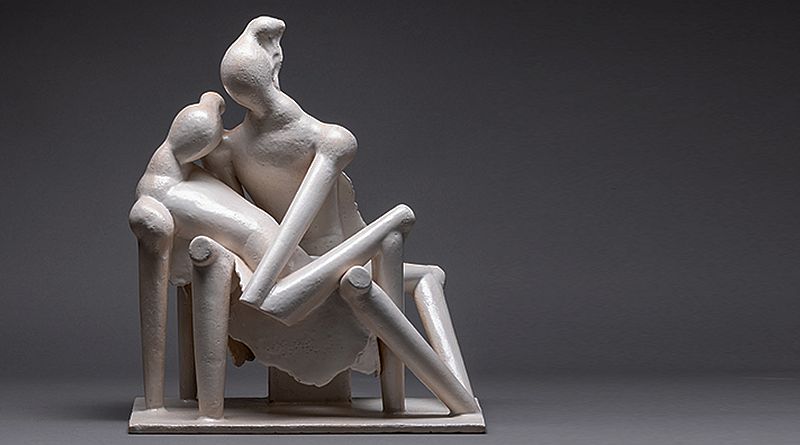
And the farewell to Ukrainian ceramicist Hanna Drul, which took place on the days of the opening of these two exhibitions, turned out to be sad but also very symbolic. For despite all the experimental nature of her amazing art, it was above all touching—that is, the art of a pure view of the world, the very view that holds us here.
And yes, this naivety and purity are the main Ukrainian response to all the darkness that surrounds us. Because all the great books of humanity say that only innocence, translated into words or returned to the canvas, can dispel darkness.
In the foreground: a sculpture titled “Pietà” (2025) created by Ukrainian artist Hanna Drul in a modern style from ceramics.
