
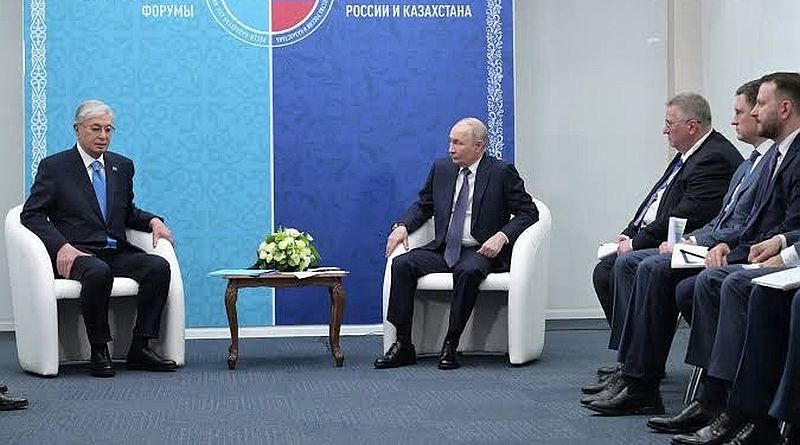

The Kremlin’s uncompromising course has been reaffirmed, showing that the Russian leadership has likely completely abandoned any diplomatic means of resolving the military conflict. When Kazakhstan’s President Kassym-Jomart Tokayev proposed an immediate freeze of hostilities to Vladimir Putin during a bilateral meeting in Omsk, Moscow’s response was predictably harsh and inflexible.
The Kazakh leader emphasized that the nature of the conflict remains unclear to most countries worldwide and called for a return to reviving agreements in the Istanbul 2.0 format with reliable guarantees from leading world powers.
However, the Kremlin showed complete unwillingness to listen even to close partners in regional organizations, as the aggressor’s strategic ambitions rule out any compromise scenarios.
Kremlin spokesman Peskov swiftly publicly rejected the proposed initiative, stating that given the position of official Kyiv, such a freeze is entirely impossible. The press secretary of the Russian dictator once again reiterated the traditional narrative that the unconditional achievement of all the initial goals of the “Special Military Operation” remains the main condition for stopping the bloodshed.
In this way, Moscow demonstrated to the international community that any mentions of readiness for negotiations are merely a cover for continuing the aggressive campaign, as real ceasefire proposals are immediately met with categorical refusal by the Kremlin’s top ranks.
Astana’s initiative reflects the growing concern of neighboring states, which sharply feel the destabilization of the entire international security system due to Russia’s actions. Tokayev’s statement that the true nature of the unleashed massacre raises deep doubts among most foreign policy players dealt a serious blow to the Kremlin’s propaganda myths.
The Russian leadership has been trying for years to impose its vision of events on the world, but even key allies in the Eurasian Economic Union openly acknowledge the absurdity and dead-end nature of the war unleashed. The rejection of the Istanbul 2.0 format shows that Moscow is not seeking long-term peace but the complete capitulation of a neighboring state, destroying any attempts to return international law to a normal legal framework.
Peskov’s references to the allegedly “unyielding position” of Ukraine appear extremely cynical since it is the Russian side that daily strikes civilian infrastructure and issues ultimatums incompatible with the sovereignty of an independent country.
By rejecting Astana’s diplomatic proposals, the Russian leadership has driven itself into deep diplomatic isolation, as even those countries that tried to maintain neutrality are convinced of the absolute unwillingness to negotiate of the current Moscow regime.
The failure of Tokayev’s attempt to persuade Putin to a reasonable compromise indicates that Russia’s aggressive policy has become a direct threat to the stability of the entire Central Asian region. Moscow continues to ignore signals from Washington, Brussels, and Astana, demonstrating its readiness to conduct a war of attrition despite colossal losses and destructive economic consequences for its own population.
The Kremlin’s reaction to the proposal to implement the Istanbul formula 2.0 showed the true face of Russian diplomacy, which is entirely subordinate to the militaristic goals of the leadership. When the diplomatic efforts of neighboring countries break against the firm intention to continue aggression, it becomes clear to the international community that the only way to establish justice remains consistent pressure on the aggressor and comprehensive support for Ukraine.
