
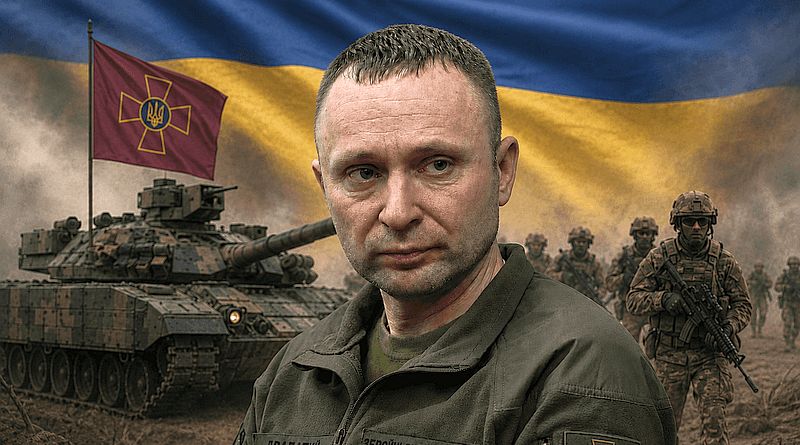
Perhaps the most challenging test for the new Commander-in-Chief of the Armed Forces of Ukraine, Mykhailo Drapaty, may not even be the situation on the front lines, but the internal resistance within the offices of the General Staff, commands, and administrations. The army, always and everywhere as a large institution, has a strong immunity to change. Society welcomes the new Commander-in-Chief, but it’s worth considering the full range of problems he will face. We discussed this with Mykola Bielieskov, a military analyst, senior analyst at the “Return Alive” fund, and chief consultant at the National Institute for Strategic Studies.
All assessments and judgments expressed below are solely the private opinion of the expert and do not in any way reflect the position of the organizations he works for.
Expectations and the Cold Prose of War
The appointment of Major General Mykhailo Drapaty as Commander-in-Chief of the Armed Forces of Ukraine instantly stirred society, the expert community, and the media space. In the public consciousness, such steps are often perceived through the prism of expectations of swift and radical changes.
This is easily explained: the new army leader has undeniable combat authority, a reputation as a commander who has been through the hottest spots from Mariupol to Kharkiv region, and an image of a person who can make unconventional decisions in critical situations. Society wants to believe in the power of personality capable of changing the course of events.
However, the reality of war always turns out to be much more complex, harsh, and multidimensional than any emotional expectations. War does not take into account names or previous merits when it comes to logistics, resources, demographics, and systemic challenges that have accumulated over the years.
“The appointment is undoubtedly positive, but many who react accordingly do not realize the scale of the tasks and do not understand that being the Commander-in-Chief of the Armed Forces of Ukraine is currently one of the toughest missions. The transition from media expectations to cold management of the military machine will be extraordinarily harsh,” says military analyst Mykola Bielieskov.
The new Commander-in-Chief Drapaty will face a monumental array of problems. The front does not contract or pause due to a change in leadership; it stretches over a thousand kilometers and requires daily exhausting work at the interface of military science, management, and strict resource limitations. To understand what exactly Mykhailo Drapaty will have to deal with, it’s worth examining the key challenges in light of the actual state of affairs in the country and the army.
The General Mafia and the Paper Army
The old nomenclature system, built on nepotism, mutual responsibility, demonstrative reporting, and paper management for the sake of inspections and checkmarks, will not stage open revolts against the new leader. Its main weapon is quiet, invisible bureaucratic sabotage.
How this works became evident during the discussions about Syrskyi’s resignation: disagreement on decisions, silence in response, endless revisions, and so on — the skills of bureaucratic sabotage among parlor generals and colonels have been honed to perfection.
In this system, the principle “the less you do, the less you are to blame” has been cultivated for decades.
It paralyzes the initiative of the middle and lower ranks, forcing officers to spend precious time not on planning combat actions or caring for subordinates, but on preparing endless reports, journals, and paperwork for numerous inspections.
The newly appointed commander-in-chief will require exceptional, rare bureaucratic determination. He will need to not only update the faces in offices, but ruthlessly break outdated instructions, dismiss ineffective old-guard functionaries, and promote combat officers of the new formation to key positions, despite fierce resistance from the system, which will attempt to digest any reform attempts.
Limited Military Mandate
Leading the army during attrition warfare is a burden that goes far beyond mere military planning or operational art on the map.
Drapaty acquired the position under conditions where many of the sharpest problems lie in areas where his powers are either limited or intersect with other departments. “The new commander-in-chief faces an enormous number of challenges, a significant portion of which he cannot fully influence,” emphasizes Mykola Bielieskov.
What does this mean in practice? First of all, that the army is just a tool of the state machine.
If there are systemic failures at the level of logistics, economy, legislation, or civil administration, the army cannot fix them alone, no matter how talented its commanders may be.
The new leader will have to start with a large-scale audit of everything currently happening in the military: from the real state of frontline units to logistical chains, supplies, accounting, and the actual capabilities of reserves.
Forming a new team and updating the General Staff will require time and significant bureaucratic efforts, which the new Chief of the General Staff of the Armed Forces of Ukraine, Major General Ihor Skybiuk, will inevitably face. The situation is further complicated by the fact that the country still lacks a full-fledged Minister of Defense — there is only an acting one.
This creates additional managerial gaps, barriers, and tensions at the junction between military command and the civil defense department, which is responsible for strategic planning and state procurement.
Personnel Collapse
One of the most painful challenges facing the new leadership concerns human resources and the management system at the middle and upper levels. The issue has long gone beyond the simple number of soldiers in the trenches — it comes down to a catastrophic crisis of the command staff.
Amid the need to deploy and maintain new formations, the army faces an unprecedented personnel shortage. According to Bielieskov’s estimates, the nominal need for officers in the 20 new army corps is about 8,000 people just for the corps level. Some of these positions are filled, but there are concerns about the quality of those already in positions from major and above.
This means that at the battalion, brigade, and higher levels, a huge management vacuum is forming. There is simply no one to plan operations, direct combat actions, or ensure interaction between frontline units — there is a catastrophic shortage of adequately prepared combat personnel, and rapid development under the conditions of intensive warfare is impossible.
The army suffers from chronic exhaustion and a shortage of personnel. The combat readiness of brigades holding the front lines for months without proper rotations is declining not only due to material losses but also psychological and physical burnout. This leads to the increase of such a painful phenomenon as unauthorized departure from the unit (AWOL).
Mobilization processes and the quality of training for recruits at training centers (often disconnected from the realities of the modern technological battlefield with its drones, electronic warfare, and constant aerial reconnaissance pressure) create a situation where people have to be further trained under fire.
To solve these problems, what is needed is not punitive measures or grandiose orders, but a deep systemic reorganization of the army’s internal culture, establishment of fair rotations, and a change in attitude towards service members. But whether the new commander has sufficient resources to quickly resolve this crisis remains an open question.
Technologies and the “Guerrilla” Conveyor
The modern war in Ukraine has long become a war of technologies, innovations, and rapid adaptation cycles. FPV drones, night bombers, close-range electronic warfare means, ground robotic platforms, and situational awareness systems have become the foundation that allows holding back an enemy with superiority in manpower and metal.
However, the key problem of Ukrainian technological success is that it has been primarily based on volunteer movements, private initiatives, the enthusiasm of individual developers, and the will of brigade commanders on the ground.
This was an effective but “guerrilla” conveyor that functioned thanks to grassroots flexibility, initiatives from civilian state agencies, rather than systematic support from the General Staff or the Ministry of Defense.
Mykhailo Drapatyi faces the task of turning these scattered volunteer-innovative nodes into a standardized, properly fine-tuned state machine.
An obstacle on this path is the outdated bureaucratic system of the Ministry of Defense, where procedures for codification, approval of new weapons samples for use, and state procurement are stalled for months in offices.
If rear structures do not start working at the speed of the frontline, where delays in implementing a new frequency range for a drone mean losing positions and lives, no military talent will be able to compensate for the technological gap. The commander will have to overcome these bureaucratic barriers at the highest level.
The return of Mykhailo Fedorov to the position of Minister of Defense would significantly improve the situation, as he began to do just that.
The Mathematics of War
No strategic genius or authority in the troops can negate the harsh mathematics of resources. A war of attrition is measured in tons of metal, the number of artillery barrels, the availability of ammunition, and the volumes of military assistance from allies.
The enemy maintains a steady advantage in manpower, delivers massive strikes with guided aerial bombs, and has a strong production potential. The Ukrainian army is forced to seek asymmetric solutions daily to compensate for this deficit of iron and equipment. However, the room for maneuver here is limited by the objective reality of international support.
This issue is particularly acute in the context of relations with our key partners. “While Europe generally shows a desire to support us systematically, with the United States, it is very difficult, yet we remain dependent on them for interceptors and intelligence data,” emphasizes Mykola Bielieskov, describing the current geopolitical and resource context.
This dependence is critical. Ukraine’s defense capability is directly linked to the supply of scarce anti-aircraft guided missiles for air defense systems and necessary military equipment components from across the ocean, as well as the provision of strategic-level intelligence data. Any political fluctuations in Washington immediately affect the stability of the front.
The new military leadership is forced to operate under conditions where they do not control the key sources of supplying their operations, necessitating masterful diplomacy, transparency in communication with partners, and maximum efficiency in using every provided shell.
Legal Collisions
The issue of the legitimacy of the procedure for appointing high military leadership during war always sparks discussions among lawyers and political analysts. In the case of Mykhailo Drapaty’s appointment, several important questions arise regarding the compliance of Ukrainian realities with the models considered as standards of democratic governance in NATO countries.
On the one hand, current Ukrainian legislation does not require the consent of the Verkhovna Rada for the appointment of the Commander-in-Chief of the Armed Forces. “This is not a ministerial position. The law does not stipulate mandatory parliamentary approval or preliminary voting on the Commander-in-Chief’s candidacy,” recalls Mykola Bielieskov.
While in an ideal model the new army leader is obliged to maintain constant, constructive, and open dialogue with the parliament and the relevant committee so that lawmakers can fully perform their oversight functions, the appointment itself remains outside parliamentary procedures.
On the other hand, there is a much more complex collision related to the institute of civil democratic control. According to the basic national security law of 2018, the candidacy for Commander-in-Chief must be submitted by the Minister of Defense — an official elected and approved by the state through parliament and having a direct mandate from society.
This is a classic Western model where a civilian minister exercises overall strategic leadership, and the Commander-in-Chief is subordinate to them and responsible for military operational activities.
However, in practice, this mechanism has never worked in its pure form. “As far as I remember, since the law came into force, there hasn’t been a case where the Minister of Defense submitted a candidate and they were subsequently approved. Often the Commander-in-Chief was appointed first and only then the minister. It was the same with Khomchak, Zaluzhnyi, Syrskyi, and now with Drapaty too,” emphasizes Mykola Bielieskov.
This vividly illustrates the deep gap between theoretical models, which Ukraine adopts and writes on paper for Euro-Atlantic integration, and the harsh political-legal realities of wartime. In practice, the appointment of the Commander-in-Chief invariably remains a direct, decisive decision of the Supreme Commander-in-Chief — the President of Ukraine. This reflects the specifics of state governance during war, where bureaucratic chains often give way to a direct power vertical.
Conclusions
The appointment of Major General Mykhailo Drapatyi as the Commander-in-Chief of the Armed Forces of Ukraine is an event of immense significance, providing the Ukrainian army with a chance for a qualitative leap in management and combat operations.
His authority, combat experience, and understanding of frontline realities are assets that inspire
both the military and society.
However, summarizing the full depth of existing problems, it is worth recalling once more the words of Mykola Bielieskov: “The appointment is certainly positive, but many who react accordingly do not realize the scale of tasks and do not understand that being the Commander-in-Chief of the Armed Forces of Ukraine now is one of the toughest missions. The transition from media expectations to the cold management of the war machine will be extremely tough.”
The success of this historical phase will depend on whether it is possible to combine the authority of a combat general with systemic governmental decisions, overcome the scarcity of personnel and management crisis, maintain the stability of the front amidst external dependence, and win the internal battle with the archaic system. It is a path of immense pressure where there has long been no room for error.
Collage by Eastern Variant, created using AI
