
Everyone remembers the jokes about drones and the broken windows in Moscow City, right? So, shall we sum up?
It’s been three years since Russian military correspondents joked that “Iskanders” were laughing — our drones could only break a window. Three years of continuous special military operation that is “going according to plan,” and assaults on Mala Tokmachka.
The enemy captured a strip 30–40 km wide — scorched, shattered into pieces, littered with mines worse than Myanmar and Afghanistan, where they decided not to rebuild a dozen cities.
So, what did they get in return from us?

They currently have no countermeasures against drones on Starlinks (conditionally satellite communication) and with machine vision. Overall, there are measures, of course: small anti-aircraft artillery, drone interceptors, attempts to jam satellite communication, interception by aviation.
But all this is spread across the vast country so thinly that we can bring to a target from an unexpected route, overload the channels, follow riverbeds, and at extremely low altitudes — and sectoral air defense doesn’t guarantee a shoot-down.
Just try to guess: will they visit the last refinery in Bashkortostan today, the Coal Harbor in St. Petersburg, or will they cut off power in Crimea again?
Gas station without gasoline
Oil refining has fallen from 5.5 to 3.9 million barrels per day. This is a 21-year low. Hence the secret of why talks about Euro-2 (a standard from 13 years ago) started. Now any seasonal spike — and an unscheduled repair at a refinery will hurt a lot.
Full ban on fuel exports. Diesel, gas oil, and marine fuel. Just recently (on July 8, 2026), the Russian government took an extreme measure and expanded the ban on diesel exports. Previously, it only applied to middlemen (gray export), but now the export has been blocked for the manufacturers themselves. The ban is in effect until July 31, 2026, but it is highly likely to be extended.
The doubling of the diesel price has already hit the railway — they cannot purchase large batches, opting for smaller ones, which leads to disruptions as the ripple effects impact trucks, tankers, and delivery speed (a 25% average increase). Up to half of the Russian railway is not electrified because funds are needed for “Iskanders” to Kyiv.
The Russian Ministry of Finance planned to collect 8.9 trillion rubles in oil and gas revenues by 2026. In half a year, they managed to gather 3.66 trillion. Trading crude oil instead of high-margin refined products and paying triple freight to the shadow fleet — that’s how they operate.
Deputy Prime Minister Novak even announced the start of importing petroleum products into Russia — a country-gas station without gasoline, how original. Additionally, in many places (Yekaterinburg, Orenburg), they began rationing gas for cars at 20 liters per person, as it is not magical, and many rushed to install gas equipment (a 300% increase and months-long queues), but the market won’t be fooled. Bit by bit, that’s 120,000 rubles for gas equipment per car. Transport companies and deliveries are thrilled as “Putin’s falcons” took Avdiivka.
An export-oriented empire is forced to buy gasoline from India and neighbors to prevent riots at its stations — it looks like a geopolitical victory.
Storm over Azov
Russians failed to protect tankers and cargo ships along the river-sea routes. They face regular losses in the boat fleet, and larger ships don’t enter the Azov due to depth issues and the fear of entering the Hungarian triangle. 190+ affected vessels — this is a reality branch of flooding transport companies with budget funds, paralyzing local trade (including the export of stolen goods from Berdyansk and Mariupol to supply Crimea), and not just fueling “Panamax” ships at sea.

Southern river-sea ports don’t freeze for long, and fats and grains are exported through them — 20% of all Russian oil and grain exports. Here is a critical logistical bottleneck — transportation by trucks is required, which are already queued to unload cargo and get fuel. And these are not distances like in Ukraine, plus the routes pass through regions affected by the fuel crisis. The Azov-Don canal was closed by the FSB — the Kremlin doesn’t want footage of ships on fire in the locks.
Essentially, our strike on the tanker fleet acted as a perfect logistical clot. Grain carriers became hostages of the situation: they can’t sail due to the threat of drones and the FSB’s prohibition, and there’s nowhere to deliver new grain from farmers because the old one is stuck in the holds of ships locked in the port. Naturally, the chain reaction spread further — to the shallow ports of the Volga. This has already triggered a 5% jump in global wheat prices on stock exchanges, and domestically in Russia, it threatens to collapse procurement prices for farmers.
Additionally, dry cargos need refueling (bunkering) with fuel oil and diesel to go on voyages. And we just dismantled the region’s tanker fleet and caused fuel shortages, while light petroleum products in Tuapse burned during the entire harvest campaign in the region.

Tax on Fear
From May 1, 2026, individuals are prohibited from exporting more than 100 grams of gold in ingots from the country. The Kremlin fears that amidst inflation, citizens will massively evacuate savings in physical metal. Probably because “everything is going according to plan”?
This summer, the south of Russia was hit by large-scale rolling blackouts. Sweating from Rostov to Sochi and Crimea. Propaganda blames it on the “abnormal heat” and “scheduled block repair at the Rostov NPP.” Heat in the south occurs every summer. But reserve maneuverable generation was a lifesaver. And now it’s gone. Because good drones systematically struck the Novocherkassk GRES, Lukoil’s TPPs in the Krasnodar Territory, and substations.
Open their state procurement portal, and you will see panic in numbers. Hundreds of civilian enterprises (from poultry farms in Tatarstan to water utilities in Siberia) are spending billions of rubles on the purchase of EW systems, anti-drone nets, concrete shelters, and hiring private security firms with shotguns.
This money is taken away from development, salaries, investments in new machines, and is simply buried in passive security, which still doesn’t save from a drone with a 50–100 kg warhead. This is a gigantic tax on the economy, which we are issuing to them by the mere fact of having a long reach.
The circle is closed. Three years ago, Russians laughed at broken windows in the skyscrapers of Moscow City and considered it senseless PR. They thought war was a TV show happening somewhere under Donetsk or in the ruins of Bakhmut while they were drinking coffee at the Patriarch Ponds.

But the reality is scorched rectification columns, empty gas stations, endless lines of grain trucks, and burning tankers on the horizon.
It looks like the perfect bingo — the progress of the domino effect amid the fuel crisis. This summer, the Russians will remember for a long time.
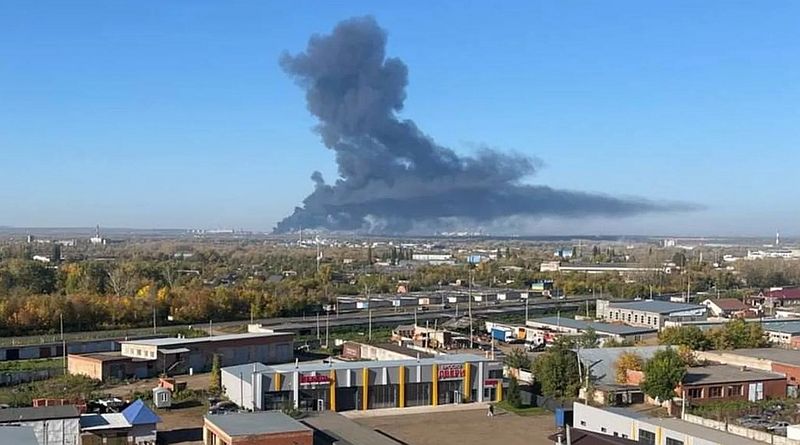
On the cover: “Gazprom Neftkhim Salavat” in Russia stopped after a drone strike on July 14. Photo: social networks
