
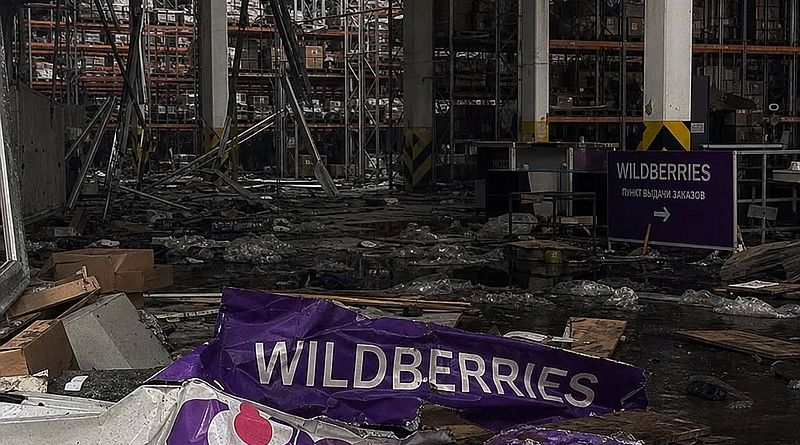
Tonight and this morning, Ukrainian drones delivered a powerful strike on two key logistic centers of Wildberries in southern Russia. Giant distribution complexes in Krasnodar (100,000 square meters) and Nevinnomyssk in the Stavropol region (about 90,000 square meters) were hit. These hubs are critical supply arteries: the Krasnodar warehouse serves Kuban, the Rostov region, and the occupied Crimea, while the Nevinnomyssk facility handles logistics for the entire North Caucasus, including Dagestan and Chechnya.

Massive fires broke out at both sites following a series of explosions, with authorities confirming casualties among the staff. The disruption of marketplaces amidst the largest fuel crisis in history — it’s like having the most delicious ice cream, as in the USSR, soon.
These strikes are not a one-time action, but a stage in a systematic campaign by the Defense Forces to dismantle Russia’s logistical infrastructure for marketplaces. Previously, on July 18 and 20, drones systematically attacked major distribution hubs in Central Russia: warehouses in Elektrostal near Moscow burned, as well as the hub in Kotovsk, Tambov region, logistics centers in the “Southern Gates” industrial park (Domodedovo), and the oldest marketplace hub in Koledino near Podolsk.
The damage from these attacks is catastrophic: according to market estimates, sellers and the platform itself could lose between 100 to 150 billion rubles, exceeding the company’s annual profit by five times. The physical destruction of hundreds of thousands of square meters of warehouse space is disrupting supply chains and demonstrates that hiding logistics for war behind the facade of civilian services is no longer feasible.

Dual Purpose and Connection with the Kremlin
Why did we start attacking the logistics warehouses and infrastructure of Wildberries? What reason should there be, other than war? This is not a “response” — the opponent has been hitting the warehouses of “Nova Poshta”, companies producing household chemicals, and packaging for years, causing damage for damage’s sake. When the “Freken Bok” company’s warehouse in Dnipro was burned, the “professional Russians” did not loudly cry out about the Geneva Convention.
Naturally, drones and their components were regularly imported through marketplaces: cameras, batteries, engines, initiation boards — this is a classic dual-purpose target. Mega tons of Chinese dual-purpose goods pass through the warehouses — from flight controllers, batteries, and video transmitters for FPV drones to trench EW, radios, sights, and tactical medicine.
The burnt-out site spanning tens of thousands of square meters is a huge loss of components that were supposed to be sent to the front in parcels from the so-called Z-volunteers. Moreover, the owner herself is closely affiliated with the Kremlin: the merger agreement of the marketplace was approved by Putin, and during disputes with her husband over the controlling stake, Kadyrov’s people came to “settle” it. The matter ended in nothing — who in the RF can influence Kadyrov?
This deal was lobbied by Kremlin-connected billionaire Suleyman Kerimov, who organized a personal meeting between Bakalchuk and Putin to get final approval. Kerimov is the largest private shareholder of the state bank VTB.
Kremlin was sold this deal not just as business, but as the emergence of the Russian “killer of Amazon and Alibaba.” The project was presented as part of state policy for import substitution and the creation of a “sovereign” digital space. In Russian realities, deals leading to the emergence of such a monopoly are only approved at the presidential level. So burn, burn brightly, as Rurik said to the Pechenegs.

The End of the Illusion of Peaceful Life
We simply didn’t have enough outfits at the refinery before. Last year’s fuel crisis, though present, did not witness four-kilometer lines and shootouts near them. Now there are four-kilometer lines, and enough drones to scout warehouses.
Russians hid behind the curtain for so long, convincing themselves that war is something that happens to others and “we are simple people, it’s the grandpa in the Kremlin who went mad,” that they began to believe it. No, guys and girls, a 700,000-strong occupation army in Ukraine and a couple of million in the rear — that’s your VAT, your frozen pension savings, mobilized from your marketplaces, parcels for your boys, and contributions to the budget, as well as enduro motorcycles, quad bikes, and boats you drag through marketplaces.
You are participating in the war against us, and all the equipment and gear brought through marketplaces is being used to kill our people. That’s why hundreds of thousands of entrepreneurs will wake up poor today.
A Blow to Gray Imports and Z-Merchants
Nothing personal — just war. Small and medium businesses in Russia, purchasing helmets, armor plates, radios, and components from China, operate under an ultra-strict financial model: everything is in circulation. They have no safety cushion. Money is taken on credit or from the proceeds of the previous batch.
When a 100,000 sq. m hub burns down, a conditional Z-entrepreneur from Krasnodar loses goods worth millions of rubles. Wildberries compensates losses over months (or doesn’t compensate at all, citing force majeure). The procurement chain for the next batch of goods for the front is instantly disrupted. No goods — no payment — no means to buy a new batch in Shenzhen. This knocks thousands of small couriers-suppliers out of the game simultaneously.
It’s a pity that someone’s custom dolls and cat food also burned in the flames of war — everyone in Bucha and Borodyanka cried. Write letters to Putin, let him not store assault motorcycles and initiation boards next to your sex toys and Chinese bikinis.
A huge part of dual-use electronics (chips, video transmitters, high-precision sensors) is imported from China as “consumer goods” with minimal customs inspection.
At the official state customs — delays, bureaucracy, and duties. At Wildberries — a shadow traffic established over years.
The destruction of logistics hubs forces these shipments to be redirected through official and alternative channels, where they immediately fall under control, bureaucratic delays, growing like a snowball, bribes, and secondary sanctions.
Dilemma for Air Defense Systems and Transport Collapse
Each attack places the Kremlin in an insoluble dilemma: to cover the next military airfield with a “Pantsir”, an oil refinery, or Kerimov’s private business? If the Kremlin doesn’t provide air defense to Wildberries warehouses, the oligarchs see that the “roof” isn’t working, and their assets are burning up by the hundreds of billions of rubles. If the Kremlin does provide air defense to the warehouses, military objects are exposed. This creates enormous tension between the general staff and the Kremlin-affiliated oligarchs.
A megahub is a node where thousands of trucks and medium-tonnage vehicles arrive and depart daily. When a warehouse burns, thousands of trucks are trapped: they stand in hours-long traffic jams, wait to be redirected, or are forced to travel to other warehouses hundreds of kilometers away, just in the midst of a growing fuel crisis in the south.
This creates a local paralysis of transport junctions, rapidly depletes scarce diesel fuel (already under attack due to oil refineries), and disrupts the schedules of commercial transport, creating a shortage of trucks for other sectors of the economy.

Loss Mathematics
Converting the smoke from Wildberries warehouses into dry numbers reveals a catastrophic picture for Russian logistics. The direct physical damage from destroyed megahubs is estimated at $1.3 to $2.5 billion. These are burned concrete hangars, hundreds of kilometers of high-tech conveyor belts, scarce European and Chinese sorting equipment, and gigantic volumes of remaining goods. The capital infrastructure has turned to ashes, which, under strict sanctions and a workforce deficit, will take a very long and painful time to restore.
Each day of downtime and overloading other hubs means millions of undelivered orders. The logistic blockade in the south and center of Russia will lead to a 15-20% drop in turnover next quarter. The marketplace will not be able to instantly compensate for the loss of 150 billion rubles. Money will be frozen for months. Tens of thousands of sellers will face a cash gap and won’t be able to purchase new batches of goods in China. This triggers a wave of small business defaults.
A massive drone raid with a total cost of $2-3 million at most generates direct losses of one and a half billion dollars to the opponent and provokes an economic shock of several more billion. Not bad for a fun expeditionary “war game” intended to be over in three days, which knocked on the door of millions of Russians on a hot summer morning, leaving them poorer. Ignoring politics in 2026 is costly.
