
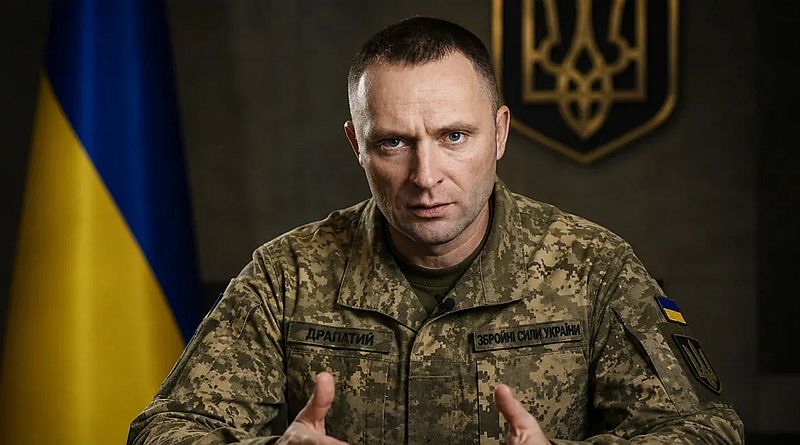

Transfer of command from Syrsky to Drapaty. What this means for us.
I will write not as a soldier, but as someone who has been around various military personnel for a long time. That means I have my own opinion from the outside.
The army is a caste system. It has been, it will be. That’s why it’s the most conservative system in any country.
The caste itself is formed based on trust. That means loyalty, allegiance, and readiness to follow orders exactly as they are given are valued upfront, which creates control of a large system.
As you can see, competency is important, but not the primary trait that shapes your career in the military. These people didn’t pledge to be the most competent, they pledged loyalty and to defend the people of Ukraine.
The caste system in the army is hundreds, probably thousands of years old. It’s a culture formed evolutionarily through the experience of hundreds of wars. And it has its own logic, because if I’m the commander, I entrust you with forces and resources, I trust you, the subordinate, with people’s lives and the sector’s defense, and the first thing someone who trusts such forces and resources will demand is absolute loyalty and execution of orders.
At the start of the war in 2014, I saw several castes for myself.
1. Military personnel who took command positions during the ATO and their surrounding network. These were mostly generals of the 8th Army Corps and their surroundings. This includes Muzhenko, Khomchak, and Syrsky.
2. Military personnel who faced the ATO in roles akin to brigade commanders or similar leadership levels. Representatives of such military personnel include Zabrodsky, Mikats, Nikolyuk, Zaluzhny. They were more “grounded” and understanding of the battlefield because they had experience understanding processes at least at the level of a combat brigade. This, of course, did not mean these people did not participate in actual combat personally. Nobody would say that about Zabrodsky, who led paratroopers on a raid by his example, or Nikolyuk, who, during an attack by separatists on his stronghold, outran the assault group moving towards it, brandishing an RPG in one hand and a machine gun in the other. However, these were people who formed their experience during the ATO at the brigade command level or a similar level. And the ATO experience is a bit outdated.
3. The group of “junior officers,” as I call them. They are no longer young, but that’s how I remember them from 2014. These are servicemen who formed their vision during positions as platoon/company/battalion commanders during the ATO and gained the most combat experience in this war over 12 years of service. This cohort began forming during studies at Chernyakhovsky Institute after the battles of 2014. Commanders who went through the hell of battles in Luhansk region, Donetsk, Sector D, DAP, Ilovaisk, mostly after injuries, were sent to improve their qualifications at VVUZ after the active phase of 2014. Young officers traumatized by the catastrophe that fell upon them studied, made acquaintances, became friends, gathered in the evenings for beer, where they discussed combat actions and (of course) criticized commanders who were detached from the combat experience they had.
Representatives of this “caste” are known to you. These include Drapaty, Mezhevikyn, Kashchenko, Sukharevsky, and many other good officers. That’s where I met Drapaty, who was a simple and competent officer, a good friend to everyone, straightforward, non-confrontational, and humane, though all the “junior officers” there were simpler and less uptight than the Soviet-school generals. That’s why he is trusted by those who know him.
This is a very general oversimplification of “castes,” because, of course, there are many mixed variations. For example, Hnatov, who is more from the cohort between “junior officers” and “battalion commanders of the ATO era,” but became NS of GC. By the way, I consider him a very competent officer, but that’s how the system works; if you are loyal to Syrskyi, you support him to the end. So, it’s not perfect, but this example conveys the general picture.
Caste system is the foundation of the army. But there are also disadvantages to this system. The main disadvantage is that loyalty, prevailing over competence, often leaves promising officers out in the cold merely because they do not belong to the appropriate caste. And that’s where the criticism of Syrskyi came in, and slogans about the change of command lingered.
For example, Sukharevsky. The person who formed SBS, often in opposition to the General Staff, launched many processes that are working now, he formed units meant to work in logistics, ahead of his time, launched drone air defense, and, proving the prospects, developed the principle of mid-strikes. Yet he was still sidelined, and no one knows where he is or what he is doing now, although we don’t have many officers with such experience at the strategic level in UAVs. Unfortunately, there have been quite a few such officers in recent years. This signaled that the indicated “caste” overstepped its authority.
And it was clear to many in the army that the potential of the Armed Forces of Ukraine under such conditions was not being fully realized, and if the commander-in-chief’s group, for the sake of authoritarianism, sidelines people who should develop the Armed Forces, then the overall system has failed.
To immediately close the question in the style of “what’s cooler, kung fu or karate” on the topic “Sukharevsky/Madyar,” I can say that their contributions to the existing SBS are very different, but they shaped this branch of the military as it is.
Sukharevsky contributed the overall concept, being a career military officer, built the structure, and laid out development paths. Madyar introduced the “Drone Line” into this system, which is his creation, ensuring the complaints of the Russians that we hunt one of their assault troops with ten drones, making it nearly impossible to pass or evacuate from this battle, and supported the previous development of the SBS. And this synergy worked.
The SBS is the youngest but most promising branch of the military. Its creation was a timely and correct step. Now, the SBS is our Ukrainian “boogeyman.” Meanwhile, Russia still cannot form the SBS RF and launch them. As for the commander there, it’s a different picture; to put it mildly, they don’t like the SBS commander and do not respect them as we respect Madyar here. This is important because a motivated soldier wants to belong to a strong group with a well-known leader, which is very important for a newly formed branch of the military.
But we digress.
So what does Drapaty’s arrival mean?
It is the formation of management algorithms that he considers more effective. These are more advanced horizontal connections between the “young (once) officers” and the delegation of functions to younger commanders. This involves implementing personal ideas that he has developed over 12 years of war. Yes, this will take time, there will be a transition period, but such evolutionary steps improve the system and make it more modern in a conservative environment.
What does this mean for the Russians?
Well, firstly, it’s whining. Because they are shocked by this example, they have no other castes than “Gerassimov” and “Shoigu.” They understand that the very possibility of such reshuffles in the army represents opportunities, the same opportunities that the RF army will not receive because it will remain a hostage to the “Gerassimov caste” until the end of the war. And this demotivates them. Strongly.
And finally, good luck to you, Commander Drapaty. And I believe that you will succeed. Because there are too many motivated and good officers around you who will extend a hand and support you at any moment when things get tough.
Success and victory.

Reading about Drapaty, I notice once again that with personalities like these, we are moving further away from them. From the Russians. From what we have in common with them.
The less they have in common, the fewer reasons they have to say we’re “one people.” Less shared history – more personal hatred towards them. Interestingly, the current president (for whom the war started only in 2022) is forced to interact with people for whom the war started in 2014 (although, to be fair, our war with them has been going on for centuries). These people surpass small-scale “politicians.” My imagination envisions the pressure in the office during the presence of such individuals as something physical, with form – pressure that walls and bunkers cannot withstand because there is something incomparably greater in the level of people straight from the front line.
The Kharkiv tank school, hit in the early days of the bombings in February – I often pass by it. Then service, service, service, war, war, war. Donbass, when Russians bombard from the border with MLRS, and from the other side pro-Russian separatists also attack, with the task to cut off their logistics from Russia. Somewhere in the rear of Ukraine, at the same time, healthy oafs jump on stages, laughing at those who care. Among them is our future president. Izvaryne, the cauldron. Avdiivka. Bakhmut. And then an even bigger meat grinder from the beginning of the full-scale Russian invasion, numerous awards, experience from a minor position to the highest, and all this WITHOUT commonality with Russians. WITHOUT wobbling “who am I? where am I?”
For me personally, the point that cemented the highest quality of a man is the ability to take responsibility for one’s actions. And not just for one’s own. The Sumy training ground, the Russian Iskander, and the death of Armed Forces of Ukraine servicemen – a point where a person did not shift responsibility onto others or circumstances. Not “it just happened,” not “someone’s to blame” – but I. The word, the awareness, the sense of self “I” – for me, this is the highest pilotage. In a country, and globally, among a large number of irresponsible people who choose irresponsible authorities, “I” is rare.
Russians are in trouble with this, but we have chances with such men.
Photo: Ministry of Defense of Ukraine
